

If you’re looking at the best nootropic supplements for memory loss in seniors because someone you love is forgetting things, start here rather than with a bottle:
New or worsening memory problems in an older adult need a medical assessment. Not because it’s necessarily dementia, but because several causes of memory loss are treatable, and they get missed when families reach for capsules first.
This article covers what a doctor should rule out, what the evidence says about the supplements sold for this, and what actually reduces dementia risk. Some of it isn’t what the supplement industry would like you to hear.
- New or worsening memory problems need medical assessment first, since several causes (B12 deficiency, thyroid, depression, sleep apnea) are treatable.
- Ginkgo biloba, the most tested nootropic, failed a rigorous 3,069-person NIH trial, with no reduction in dementia at all.
- Huperzine A shares a mechanism with prescription dementia drugs and shouldn’t be combined with them without medical knowledge.
- Treating hearing loss, controlling blood pressure, and staying physically active have stronger evidence for dementia risk than any supplement.
The treatable causes worth ruling out
Memory problems in older adults are not always progressive. These are all reversible, and all commonly missed:
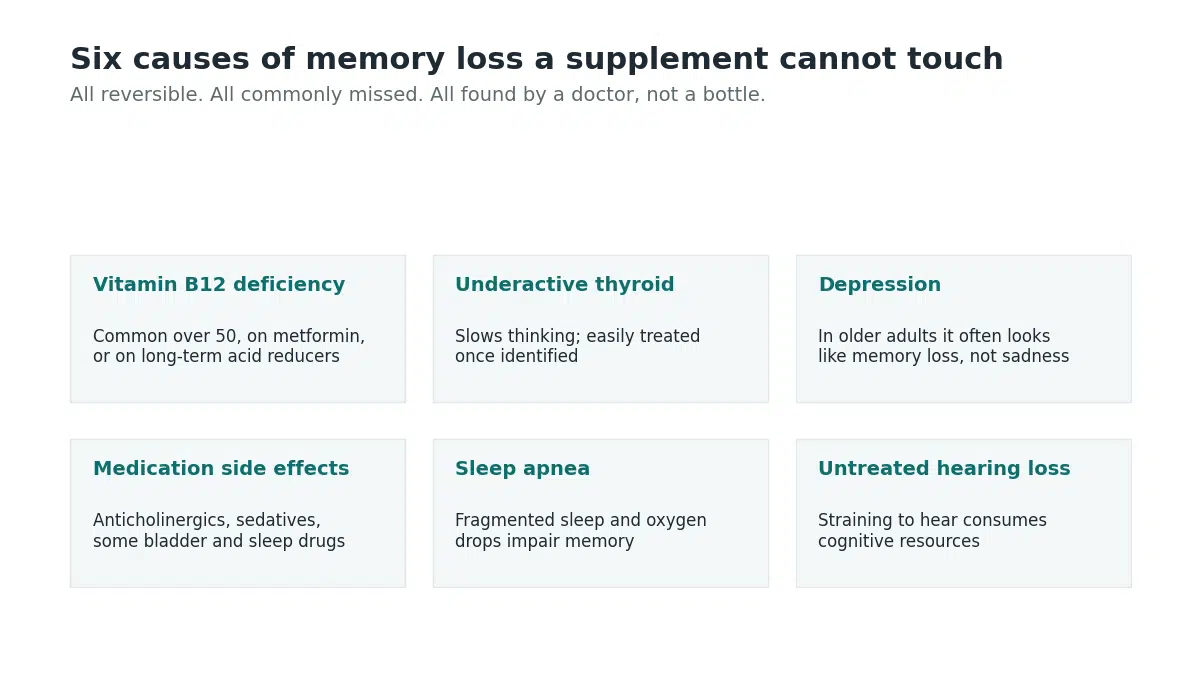
- Vitamin B12 deficiency: causes confusion and memory problems, and is common in older adults, in people on metformin, and in long-term users of acid reflux medication. A blood test finds it, and our guide to what B12 does in the body covers why it matters here.
- Underactive thyroid: slows thinking and is easily treated once identified. Our guide to what an underactive thyroid does and doesn’t explain covers the wider picture.
- Depression: in older adults it often presents as memory and concentration problems rather than obvious sadness. Sometimes called pseudodementia, because it can look exactly like dementia and it improves with treatment.
- Medication side effects: anticholinergics, sedatives, some bladder and sleep medications. Older adults on several prescriptions are especially affected.
- Sleep apnea: fragmented sleep and repeated oxygen drops impair memory. Treatable, and frequently undiagnosed.
- Untreated hearing loss: straining to hear consumes cognitive resources, and hearing loss is one of the largest modifiable risk factors for dementia.
None of these are helped by a nootropic. All of them are found by a doctor asking the right questions and running the right tests.[2] If the picture is more fluctuating fogginess than genuine memory loss, our guide to supplements for brain fog and memory covers that separately.
And if the assessment does point toward dementia, an early diagnosis still matters. It opens access to treatment, support and planning while the person can take part in decisions.
Ginkgo biloba: definitively tested, and it failed
Ginkgo is the most-sold supplement for age-related memory decline, and it has been tested more rigorously than any other.
The Ginkgo Evaluation of Memory study was funded by the US National Institutes of Health. It enrolled 3,069 adults aged 75 and over, gave them 240mg of standardized EGb 761 daily or placebo, and followed them for years (read the trial).[1]
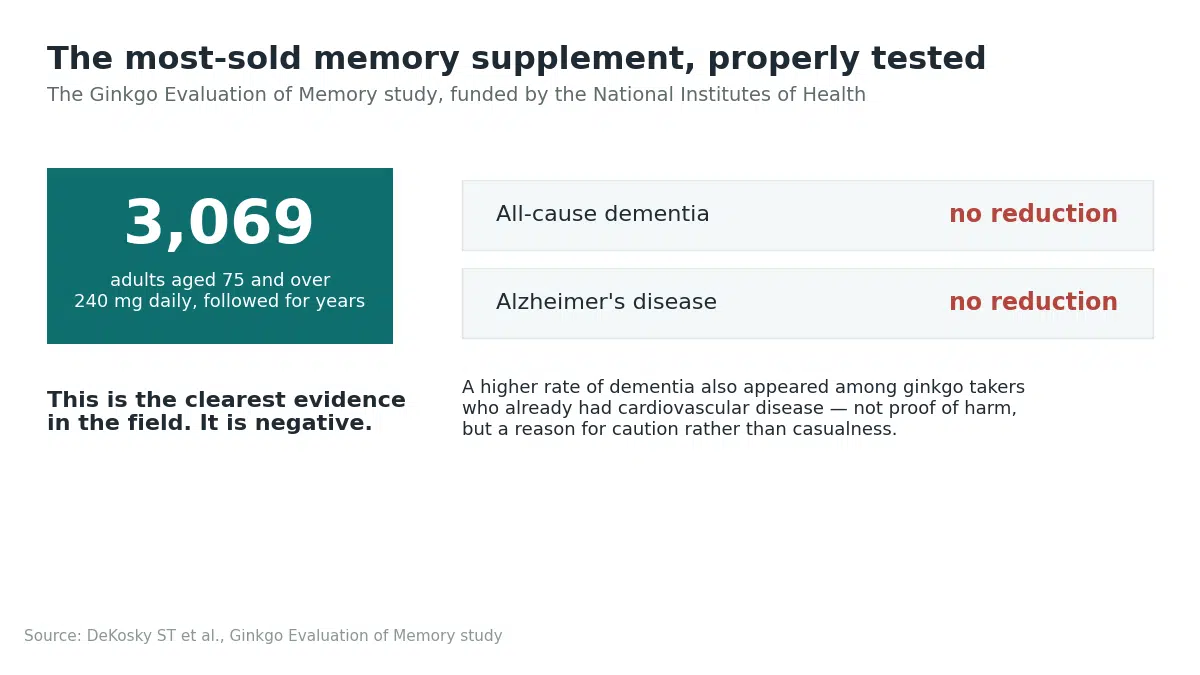
It found no reduction in all-cause dementia and no reduction in Alzheimer’s disease. The accompanying editorial concluded that ginkgo as generally used does not prevent dementia in people with or without existing cognitive impairment.
The trial also found a higher incidence of dementia among ginkgo takers who already had cardiovascular disease. That doesn’t prove harm, but combined with ginkgo’s bleeding risk on blood thinners, it’s a reason for older adults with heart conditions to be cautious rather than casual.[3]
This is the clearest evidence available in this field, and it’s negative.
What’s Actually in Nootropic Supplements for Memory Loss in Seniors
Citicoline has the most respectable evidence of the group. It’s a precursor to acetylcholine and some trials in older adults with mild cognitive complaints have shown modest improvements. The evidence is genuine but limited: small trials, short durations, and nothing showing it changes the trajectory of decline.
Bacopa monnieri has some trial data for memory in older adults, mostly small and mostly measuring modest effects on recall tests rather than real-world function. It takes weeks to do anything, and it commonly causes digestive upset.
Phosphatidylserine is a genuine component of neuronal membranes, and levels do decline with age. Whether supplementing changes cognitive outcomes is much less clear. The studies are older, smaller, and many used a formulation derived from bovine brain that is no longer sold.
Omega-3 fatty acids are good for you for other reasons. For cognition specifically, the large trials have mostly been disappointing. Eating oily fish remains sensible; expecting fish oil capsules to protect memory is not supported.
Several of these also turn up in products aimed at younger adults, where the evidence is no stronger. Our review of supplements for focus and concentration goes through the same ingredients for that audience.
One ingredient deserves a specific warning. Huperzine A, found in some memory formulas, works by inhibiting acetylcholinesterase, the same mechanism as prescription dementia drugs like donepezil. Taking both together risks compounding the effect. Anyone on dementia medication should not take a huperzine-containing supplement without their doctor’s knowledge.
What actually reduces dementia risk
This is the part worth acting on, and none of it is sold in a bottle.
Treating hearing loss. Hearing loss in midlife is among the largest modifiable risk factors identified for dementia. Hearing aids are underused, partly because people delay for years. If the person you’re worried about is also struggling to hear, address that. Our guide to high frequency hearing loss covers what it costs in conversation and what the trial evidence actually shows.
Controlling blood pressure. Vascular damage contributes to cognitive decline. Managing hypertension in midlife has better evidence for protecting the brain than anything on a supplement shelf. Our guide to what counts as a normal blood pressure reading is a reasonable starting point.
Physical activity. Regular aerobic exercise has the most consistent evidence of any intervention for maintaining cognitive function with age.
Social connection and mental engagement. Isolation is a risk factor. Staying connected and doing things that require thought are protective.
Treating sleep problems and depression. Both affect cognition directly, and both are treatable.
Not smoking, and limiting alcohol. Both damage the brain over time.
None of this is exciting. All of it has more evidence behind it than the entire nootropics category.
Choosing Among the Best Nootropic Supplements for Memory Loss in Seniors
Trying one is a reasonable choice, provided it’s made with clear eyes.
Get the medical assessment first. Deficiencies get corrected, medications get reviewed, treatable conditions get treated. That’s where the real gains are.
Bring the label to the doctor or pharmacist. Older adults are usually on several medications, and interactions are the main risk here, particularly with blood thinners and dementia drugs.
Avoid proprietary blends that don’t disclose amounts. If you can’t see the dose, you can’t evaluate it or discuss it with a clinician.
Set a review date. Three months. If nothing has changed, stop, and be honest in that assessment, because hope makes it easy to imagine improvement.
Don’t let a supplement delay anything. The most common harm from these products isn’t the ingredients. It’s the months spent trying capsules instead of getting an assessment that would have found something treatable.
Common Questions
Do the best nootropic supplements for memory loss in seniors actually work?
Not on the current evidence. The most rigorously tested option, ginkgo biloba, failed a National Institutes of Health trial of 3,069 adults aged 75 and over. Citicoline has the most respectable data of the group, but from small, short trials showing modest effects rather than any change in the course of decline.
Is memory loss just a normal part of aging?
Some slowing of recall is normal: taking longer to find a word, misplacing keys occasionally. What isn’t normal: getting lost somewhere familiar, repeating the same question within a conversation, difficulty with tasks that used to be routine, or personality changes. Those warrant assessment.
Do any supplements prevent Alzheimer’s?
No supplement has been shown to prevent Alzheimer’s disease. The largest and best-designed trial of the most popular candidate found no effect across 3,069 people followed for years.
What about all the products advertised online?
Supplements aren’t required to demonstrate efficacy before sale. Confident marketing and clinical evidence are unrelated things, and in this category the gap between them is unusually wide.
My relative refuses to see a doctor. What can I do?
Common and difficult. It sometimes helps to frame it as a routine check rather than a memory assessment, to raise it alongside something else they’re willing to see the doctor about, or to call their primary care doctor’s office yourself first about your concerns. The office can advise on options.
Is it worth getting a diagnosis if dementia can’t be cured?
Yes. Diagnosis identifies the type, which affects treatment. It gives access to medication that can help symptoms, to support services, and to the chance to make decisions about care and finances while the person can still participate. It also rules out the treatable causes that mimic dementia.
SOURCESOur Editorial Standards
HealthMagHub is built on primary sources: peer-reviewed research, clinical practice guidelines, and health agencies such as the NIH, CDC, and FDA. Read our editorial standards to see how we research, cite, and update our articles.
- DeKosky ST, et al. Ginkgo biloba for Prevention of Dementia (the Ginkgo Evaluation of Memory study). ncbi.nlm.nih.gov
- National Institute on Aging. Memory, Forgetfulness, and Aging: What’s Normal and What’s Not. nia.nih.gov
- Memorial Sloan Kettering Cancer Center. Ginkgo: herb monograph, interactions and cautions. mskcc.org