


Before anything else: if you have reduced kidney function, chronic kidney disease, or you’re on dialysis, don’t start a magnesium supplement without asking your doctor first. Your kidneys are what clear magnesium from your blood, and when they can’t, it builds up.
Magnesium glycinate side effects are usually mild, and that’s exactly why the form has become so popular. It’s the one people move to after magnesium citrate sent them running to the bathroom.
But gentler isn’t the same as harmless. There’s one group who genuinely shouldn’t take it, a handful of common medicines it interferes with, and a number on the label that most people read wrong.
- The most common side effects are digestive: loose stools, nausea and cramping. They’re dose-related and reversible.
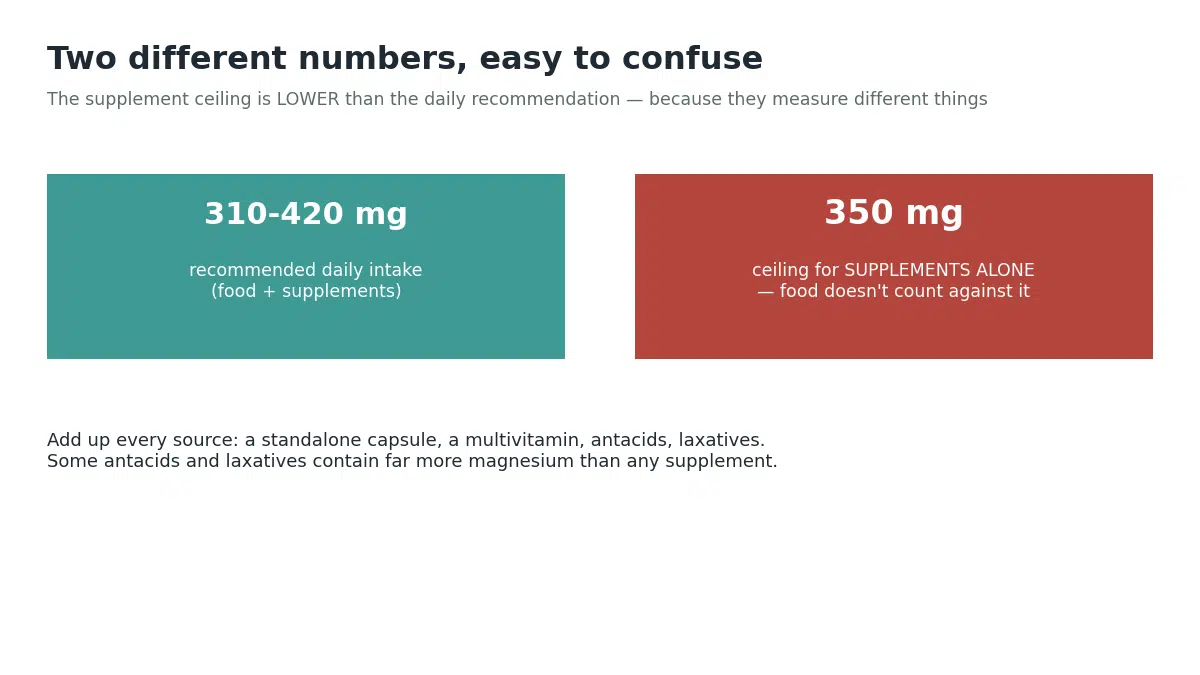
- The supplement ceiling is 350 mg elemental magnesium daily. This doesn’t include food, and it’s lower than the overall recommended intake.
- Reduced kidney function is the real contraindication, because kidneys clear magnesium and when they can’t it builds up to dangerous levels.
- Magnesium binds to bisphosphonates, tetracyclines and quinolone antibiotics in the gut, so separate doses by 2-6 hours.
The common magnesium glycinate side effects
The main ones are digestive, and they’re the same ones every magnesium supplement can cause: loose stools or diarrhea, nausea, and abdominal cramping.
Diarrhea is the one that matters most, and not because it’s dangerous. It’s the effect that set the safety limit in the first place. When the committee that writes US nutrient guidelines picked a ceiling for supplemental magnesium, loose stools were the deciding factor.[1]
Some people also notice mild drowsiness. Glycine, the amino acid attached to the magnesium in this form, has a calming effect, which is part of why glycinate gets marketed for sleep. If it makes you groggy in the morning, that’s worth knowing before you drive.
Why glycinate is gentler than the other forms
Magnesium has to be bound to something. That something changes how the supplement behaves in your gut.
The forms most often blamed for diarrhea are magnesium oxide, carbonate, chloride and gluconate. Magnesium glycinate isn’t on that list, and the reason is mechanical rather than mysterious. Poorly absorbed magnesium sits in the intestine, pulls water in behind it, and the result is a laxative effect. Better-absorbed forms leave less behind to do that.
The glycine half is worth a sentence of its own. Glycine is an amino acid your body already makes and uses, and it turns up in protein-rich food every day. In a supplement it does two jobs: it helps carry the magnesium across the gut wall, and it has a mild calming effect of its own.
That second job is doing more of the marketing than most labels admit. We’ve looked at which magnesium form actually suits sleep separately.
One caution on how this gets sold. The idea that glycinate is easier on the stomach is reasonable and matches what people report, but it rests more on absorption studies and everyday experience than on large head-to-head trials. It’s a fair claim, not a proven one.
If loose stools do show up, they aren’t a reason to give up on magnesium altogether. Halving the dose, splitting it into two smaller amounts across the day, or taking it with food usually settles things within a few days.
Gut symptoms from magnesium are dose-related and reversible, which isn’t true of every supplement side effect.
The number on the label that matters
Here’s where people go wrong.
The ceiling for magnesium from supplements and medicines is 350 mg a day for adults.[1] Two things about that number surprise people.
It doesn’t include food. Spinach, almonds, black beans and pumpkin seeds don’t count against it. In someone with healthy kidneys, food magnesium is cleared without difficulty, which is why the limit applies only to what comes out of a bottle.
And it’s lower than the recommended daily intake, which is 310 to 420 mg depending on age and sex. That looks like a contradiction until you realize the two numbers measure different things.
The recommendation covers everything you consume; the ceiling covers supplements alone. That gap is contested enough that a 2023 review argued the supplement ceiling itself should be re-evaluated.[3]
On a US Supplement Facts panel, the magnesium figure is the elemental magnesium, the actual mineral rather than the weight of the whole compound. So that’s the number to compare against 350 mg.
Now add up every source. A standalone magnesium capsule, a multivitamin, an antacid, a laxative. Some antacids and laxatives contain far more magnesium than any supplement does. It’s easy to cross the line without ever taking a second capsule.
Kidney disease is the real contraindication
Your kidneys control your magnesium level. They excrete roughly 120 mg into urine each day, and they adjust that up or down as needed.[1]
When kidney function is reduced, that regulation fails. Magnesium accumulates, and the risk of genuine toxicity climbs. This is the single most important thing in this article, and it’s the reason the warning sits at the top rather than the bottom.
The same caution applies if you’re older, since kidney function declines gradually with age and often without symptoms, and if you have diabetes, which is the leading cause of kidney disease. If you aren’t sure where your kidney function stands, that’s a blood test, not a guess.
Medicines magnesium interferes with
Magnesium binds to several drugs in the gut and stops them being absorbed properly. In most cases the fix is timing rather than avoidance.
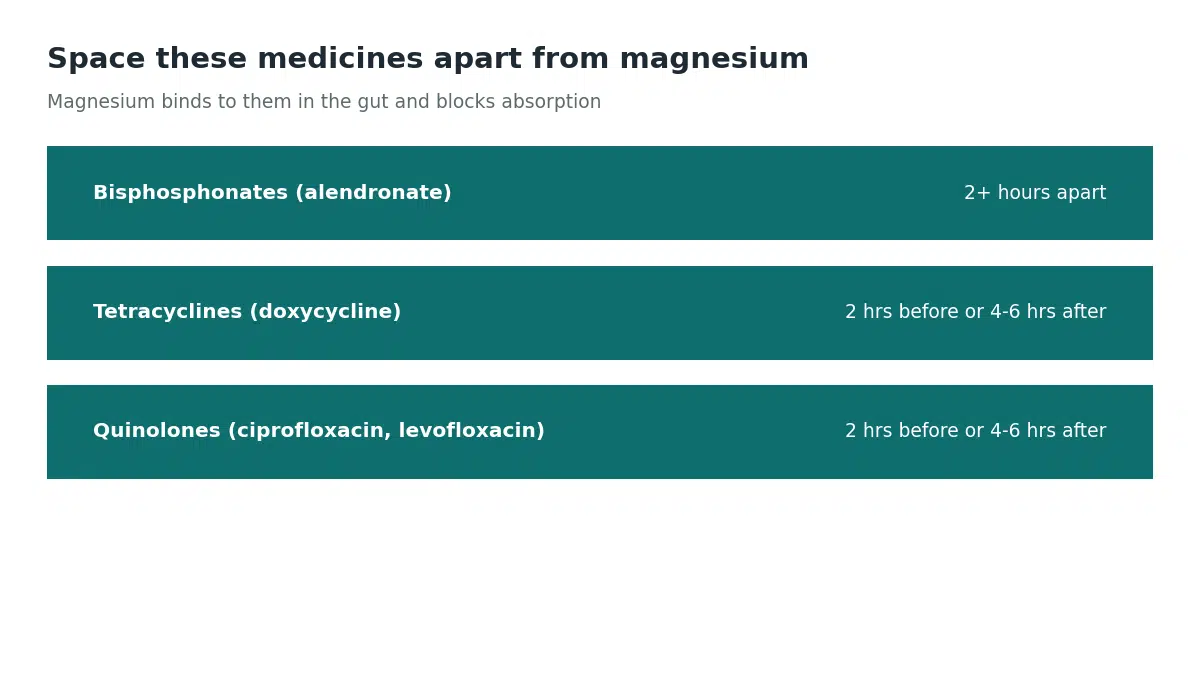
- Osteoporosis drugs. Magnesium reduces absorption of oral bisphosphonates such as alendronate. Separate them by at least two hours.
- Two families of antibiotics. Magnesium forms compounds with tetracyclines, including doxycycline, and with quinolones such as ciprofloxacin and levofloxacin. Take the antibiotic at least two hours before, or four to six hours after, the magnesium.
Two things run the other way, worth knowing because they affect whether you need magnesium at all. Loop and thiazide diuretics, the common water pills, increase magnesium loss in urine over time. And long-term proton pump inhibitors for reflux, taken for a year or more, can drive magnesium low enough that the FDA issued a safety communication about it.[2] Potassium-sparing diuretics do the opposite and reduce magnesium excretion.
If you take any of these, the conversation to have is with your pharmacist. They can see your full list, which no article can.
Magnesium glycinate side effects that mean stop and call a doctor
True magnesium toxicity is uncommon in people with working kidneys, and it usually follows very large doses of magnesium-containing laxatives or antacids rather than a standard supplement. But it’s worth knowing what it looks like, because the early signs are vague.
Get medical advice promptly for: unusual flushing of the face, nausea and vomiting, a drop in blood pressure or feeling faint on standing, unusual drowsiness or low mood, muscle weakness, or difficulty passing urine.
Get emergency help for difficulty breathing, an irregular or slow heartbeat, or severe weakness. At high enough blood levels magnesium affects the heart, and fatal cases have been reported, though they involved extreme intakes.
For most people the practical rule is far simpler. If your stools go loose, you’ve found your ceiling. Reduce the dose.
What magnesium glycinate is and isn’t good for
Magnesium supplements are sold hard for sleep, anxiety, cramps and stress, and the evidence behind those uses varies from modest to thin.
The honest summary: magnesium supplementation lowers blood pressure only marginally in trials. The American Diabetes Association says there isn’t enough evidence to recommend it for blood sugar control. It’s probably effective for migraine prevention according to neurology guidelines, but the doses used exceed the safety ceiling and belong under medical supervision, not self-experimentation.
Where it genuinely helps is correcting a shortfall. Close to half of Americans take in less magnesium from food than the estimated requirement, and certain groups are more likely to run low: people with Crohn’s or celiac disease, people with type 2 diabetes, people with alcohol dependence, and older adults.[1]
If that isn’t you, food is the better route. An ounce of pumpkin seeds carries around 156 mg, an ounce of chia seeds about 111 mg, an ounce of almonds roughly 80 mg, and half a cup of cooked spinach about 78 mg. None of it counts against the supplement ceiling, and the same principle applies to electrolytes generally.
Two practical footnotes. A standard blood test is a poor way to check your magnesium status, because less than one percent of the body’s magnesium is in the blood and the level there is held in a narrow range regardless of stores. So a normal result doesn’t rule a shortfall out, and there’s little point asking for the test purely to justify a supplement. And if you’re pregnant, the supplement ceiling is the same 350 mg, but magnesium is used medically in pregnancy at much higher doses under supervision, which is a different situation entirely from a capsule off a shelf.
The one thing to take away
Magnesium glycinate is the gentlest common form, and for most people with healthy kidneys the worst that happens is loose stools that resolve when the dose drops.
The two questions worth answering before you start: do I know my kidney function, and does anything else I take contain magnesium or interact with it. If both are clear, this is a low-risk supplement. If either is uncertain, ask a pharmacist before the first capsule rather than after.
SOURCESOur Editorial Standards
HealthMagHub is built on primary sources: peer-reviewed research, clinical practice guidelines, and health agencies such as the NIH, CDC, and FDA. Read our editorial standards to see how we research, cite, and update our articles.
- Magnesium: Fact Sheet for Health Professionals. NIH Office of Dietary Supplements
- Danziger J, William JH, Scott DJ, et al. Proton-Pump Inhibitor Use Is Associated With Low Serum Magnesium Concentrations. Kidney International. Discusses the original FDA drug safety communication on PPIs and hypomagnesemia. pmc.ncbi.nlm.nih.gov
- Costello RB, Rosanoff A, et al. Perspective: Call for Re-evaluation of the Tolerable Upper Intake Level for Magnesium Supplementation in Adults. Advances in Nutrition. PubMed 37487817