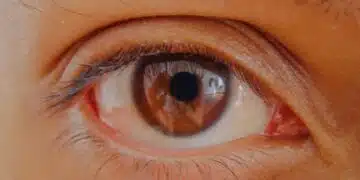

Blurry vision in one eye is usually not an emergency. But a few patterns are. Check these first.
Get emergency care now if you have blurred vision with severe eye pain, rainbow halos around lights, a red eye, or nausea and vomiting. That combination suggests acute angle-closure glaucoma. It can damage sight within hours.[1]
The same urgency applies to flashes of light, a sudden shower of new floaters, or a shadow or curtain moving across your vision. It also applies to sudden blurring or vision loss over seconds or minutes, even if it has already cleared up.
Any sudden one-sided numbness, weakness, drooping, or speech trouble means calling emergency services right away. Over 50 with a new headache, scalp tenderness, or jaw ache when chewing? That combination needs same-day attention too. So does any vision change after a head or eye injury, or a chemical splash. Contact lens wearer with a painful, red, light-sensitive eye? Take the lens out and get seen today.
None of that fit? Here’s the question that actually matters: how fast did it come on, does it hurt, and did anything else change at the same time? The rest of this page covers the far more common, far less urgent answers.
- Most one-eyed blurring is ordinary: a drifted prescription, dry eye, or strain, and not an emergency.
- Vision that blurred and then cleared still needs same-day evaluation, because it can be a warning stroke affecting the retina.
- Severe pain, halos, nausea and a red eye together point to acute angle-closure glaucoma, which can damage sight within hours.
- New distortion of straight lines when reading is an urgent sign of wet macular degeneration, not a routine appointment.
One thing worth doing before you read further: cover each eye in turn. People are often surprised. A problem they assumed was in both eyes turns out to be one, or the reverse. It’s the first thing a doctor will ask, and it narrows things considerably.
The Causes That Need Care Today
Acute angle-closure glaucoma
Fluid normally drains continuously from the front of the eye. In acute angle closure the drainage angle shuts, pressure climbs fast, and the optic nerve starts taking damage.[1]
The classic picture: sudden intense pain in or around one eye, often spreading to forehead or temple, blurred vision, and rainbow halos around lights. Many people feel sick or actually vomit, and the eye looks red.
The nausea is the trap. It gets mistaken for a stomach bug or migraine, and people treat the wrong thing while pressure climbs.
Two things worth knowing. It can also present as headache and blurring without a dramatically red eye. And attacks are often set off by something identifiable: sitting in a dim room, or medications that dilate the pupil, including some antihistamines, antidepressants, anticholinergics, cold and flu remedies, and topiramate.[4]
Outcomes track closely with how fast pressure comes down. Emergency room, not a next-day appointment. While arranging care, lying flat on your back without a pillow may help slightly, and avoid dark rooms, which widen the pupil further.
Giant cell arteritis
Inflammation of medium and large arteries in the head, including those feeding the optic nerve. Affects people over 50, and it’s the cause where a delay of days can cost the sight in your good eye.[2]
Alongside blurring, dimming or brief blackouts, watch for a new headache around the temples that painkillers don’t touch, scalp tenderness, jaw pain that builds while chewing and eases when you stop, tongue pain, aching and morning stiffness in shoulders or hips, unexplained fever or weight loss, and double vision.
Treatment is high-dose steroids started on suspicion rather than after test results, because waiting for confirmation costs vision. Mention those specific features when you seek care. They change how urgently you’re seen.
Retinal detachment
The retina pulls away from the back of the eye and the detached area stops sending signals. It’s one of the commonest causes of sudden vision loss in one eye.
The warning signs are specific: sudden flashes of light, a dramatic increase in floaters, then a shadow or curtain moving across your field.[6] There’s usually no pain at all, which is exactly why people wait, and waiting is the mistake. How much vision returns after surgery depends heavily on how long it stayed detached.
Vision that blurred and then cleared
Don’t file that under “it resolved.”
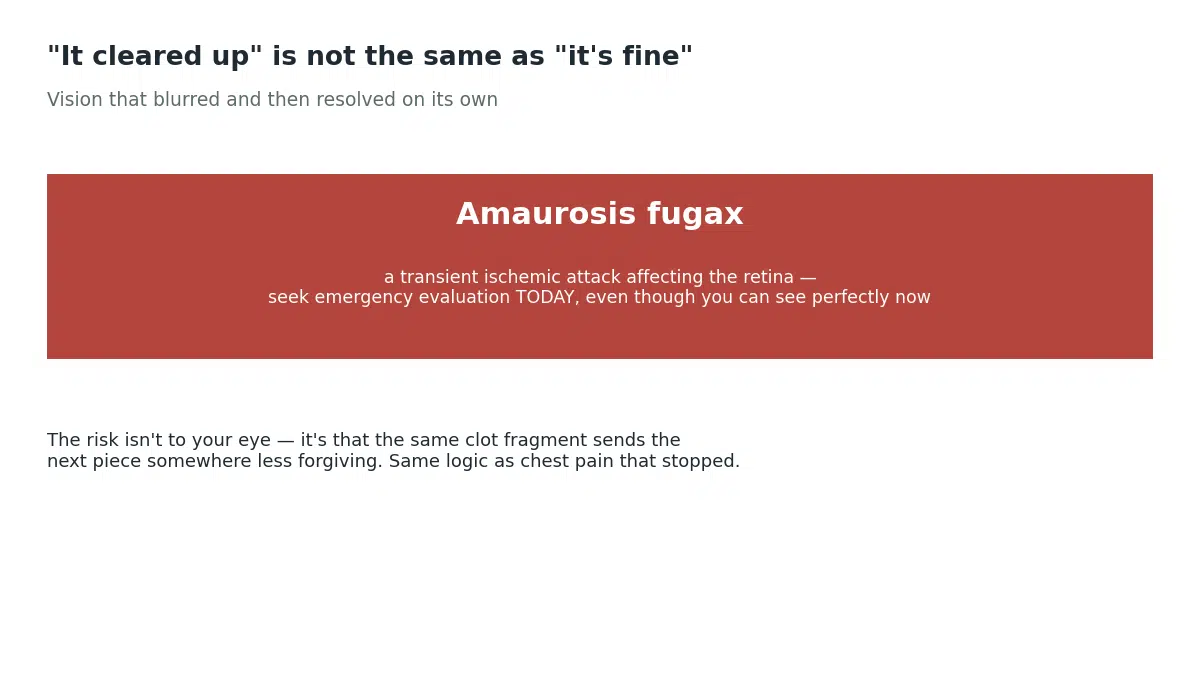
Temporary loss of vision in one eye is amaurosis fugax, a transient ischemic attack affecting the retina. A fragment of clot or plaque briefly blocked the blood supply, usually from the carotid arteries in your neck.[3] Giant cell arteritis can also cause it.
The risk at that point isn’t to your eye. It’s that the same process sends the next fragment somewhere less forgiving. Emergency evaluation today, even though you can see perfectly well now. It’s the same logic as chest pain that stopped.
Stroke
A stroke affecting visual pathways causes sudden vision change, often with weakness on one side, facial drooping or slurred speech.
But don’t wait for the full set. Strokes present with a single symptom often enough, and our guide to sudden one-sided numbness covers the same trap. Sudden plus one-sided is enough to call, and tell them what time it started.
Blurry Vision in One Eye: The Common Explanations
Refractive error is far and away the most likely. Prescriptions drift unevenly between eyes, which is precisely why one eye can seem blurry while the other is fine. Presbyopia catches up with nearly everyone past 40 as the lens stiffens. You notice it first with menus and phone screens.
Eye strain. Blink rate drops sharply during concentrated screen work, and the focusing muscles tire. The 20-20-20 rule helps: every 20 minutes, look at something 20 feet away for 20 seconds. Actually into the distance, not just away from the screen at something equally close.
Dry eye. The giveaway is that blurring comes and goes with blinking. Blink hard and vision clears briefly, then fogs again. Our guide to gritty, dry eyes covers why it happens and what helps.
Infection. Conjunctivitis produces discharge that smears across vision, alongside redness and irritation, and eye discharge in children covers the version parents see. Keratitis, infection of the cornea, is different: genuine pain, light sensitivity, significant blurring. Contact lens wearers are at much higher risk, and a painful, red, light-sensitive eye means lens out and seen the same day, because corneal infections scar the part of the eye you see through.
Cataract. Proteins in the lens clump into cloudy patches over years. Vision looks dim or yellowed, night driving gets harder as headlights throw glare, colors fade. Cataracts frequently develop at different rates in each eye.
Macular degeneration. Damage to the central retina, a leading cause of vision loss over 60. The first sign is often blurred or wavy vision when reading, with straight lines looking bent. Dry progresses slowly; wet moves fast, so new distortion of straight lines is an urgent appointment, not a routine one.
Diabetic retinopathy. High blood sugar damages small retinal vessels, and early on there are no symptoms at all.[5] That’s the whole problem. Blurring appears once it’s already progressing. If you have diabetes, attend the screening even when your vision seems perfect.
Optic neuritis. Inflammation of the nerve causes blurring or dimming with pain on eye movement, and colors look washed out, red especially. Often linked to multiple sclerosis. Most people recover useful vision over weeks to months.
Migraine aura. Temporary blurring, blind spots or shimmering zigzags, typically 10 to 30 minutes, with or without a headache after. The catch: aura and more serious causes can look nearly identical in the moment. If it’s your first episode, or it feels different from your usual pattern, treat it as urgent. Once a doctor has established the pattern, riding out a familiar aura is reasonable.
Central serous retinopathy is fluid under the retina blurring central vision in one eye. More common in men, associated with stressful periods and with steroid medication. Often resolves on its own, but needs identifying rather than guessing.
What Happens at the Eye Exam
Visual acuity on a chart, then a refraction test to see whether a prescription change explains it. A slit lamp examines the cornea, iris and lens under magnification.
Drops dilate the pupils so the retina and optic nerve can be seen properly. Tonometry measures pressure inside the eye, the test that identifies glaucoma. Visual field testing maps what you can and can’t see. Our full guide to what happens during a comprehensive eye examination walks through each of those tests and how long the appointment takes.
Beyond that, depending on findings: referral to a retina specialist for suspected detachment, a neurologist if the problem looks neurological, blood tests for diabetes and inflammation, and CT or MRI to rule out stroke. Inflammatory markers go in urgently when giant cell arteritis is suspected.
Bring a list of your medications. Several affect the eye directly, and the angle-closure triggers above are easy to miss otherwise.
Treatment Follows the Cause
Glasses or contacts for refractive error, and regular exams keep both eyes matched as prescriptions drift.
Drops are not interchangeable. Lubricating for dry eye, antibiotic for bacterial infection, steroid for inflammation, pressure-lowering for glaucoma. Using leftover steroid drops on an undiagnosed red eye can make certain infections considerably worse.
Surgery: cataract replacement, retinal reattachment, or laser iridotomy, which creates a tiny opening in the iris to relieve and prevent angle-closure attacks.
Injections into the eye for wet macular degeneration and some diabetic eye disease, usually repeated.
And the unglamorous one: controlling diabetes and blood pressure does more for your long-term vision than anything you can buy.
What You Can Manage at Home
Mild, intermittent blurring from strain or dryness usually settles, provided none of the red flags apply.
Match screen brightness to the room, put the screen about an arm’s length away and slightly below eye level, and deal with glare from windows or overhead lights, which quietly does a lot of the damage.
Artificial tears for dryness, preservative-free if you need them more than about four times a day. A humidifier in dry indoor air.
If blurring hasn’t improved within a day or two, or keeps returning, book an exam. What feels like ordinary strain is often an uncorrected prescription change, and occasionally the first sign of something that needs treating.
Protecting Your Vision
- Eye examinations at the interval your eye doctor recommends, more often with diabetes or existing eye conditions
- Keep blood pressure and blood sugar controlled. Our guide to normal blood pressure ranges covers the targets
- Safety glasses for sports, power tools and chemicals
- Sunglasses blocking 100% of UV
- Stop smoking, which sharply raises cataract and macular degeneration risk
- Proper contact lens hygiene, and never sleep in lenses not designed for it
Many serious eye conditions build quietly with no early symptoms. Routine exams are how they get caught while treatment still works well, and your eye doctor can spot signs of diabetes and high blood pressure there too.
Common Questions
Why is my vision blurry in one eye but not the other?
Cover each eye in turn before your appointment. That single observation is genuinely useful to bring.
It blurred and then cleared. Do I still need to be seen?
Recovered vision doesn’t mean you’re in the clear.
When is blurry vision an emergency?
Gradual blurring without pain isn’t an emergency, but still deserves an exam.
I wear contacts and one eye is blurry and sore.
That combination raises the possibility of corneal infection, which progresses quickly and scars. Don’t put the lens back in for the appointment. Bring it, and your solution, with you.
Can stress cause blurry vision in one eye?
But stress is a conclusion for a doctor to reach after examining you, not one to settle on yourself.
Can high blood pressure cause it?
Severely elevated blood pressure can cause sudden visual change and is itself an emergency.
The Sorting Question
Blurry vision in one eye covers everything from a prescription that needs updating to conditions measured in hours. What separates them isn’t how severe it feels. It’s the pattern.
Today, at an emergency department: sudden onset, real pain, halos, flashes, a curtain, any stroke symptom, or being over 50 with a new headache or an aching jaw when you chew. And vision that blurred then cleared.
An eye examination: gradual blurring, no pain, nothing else changed. Most of the time that ends with a new prescription.
Knowing which bucket you’re in is the whole job. Everything else is your eye doctor’s.
SOURCESOur Editorial Standards
HealthMagHub is built on primary sources: peer-reviewed research, clinical practice guidelines, and health agencies such as the NIH, CDC, and FDA. Read our editorial standards to see how we research, cite, and update our articles.
- Acute Angle-Closure Glaucoma. StatPearls, NCBI Bookshelf. ncbi.nlm.nih.gov
- Giant Cell Arteritis (Temporal Arteritis). StatPearls, NCBI Bookshelf. ncbi.nlm.nih.gov
- Amaurosis Fugax. StatPearls, NCBI Bookshelf. ncbi.nlm.nih.gov
- Cleveland Clinic. Angle-Closure Glaucoma. my.clevelandclinic.org
- National Eye Institute. Diabetic Retinopathy. nei.nih.gov
- American Academy of Ophthalmology. Retinal Detachment: Symptoms and Treatment. aao.org
Disclaimer: This article is general information about blurry vision in one eye, not medical advice. Always consult a qualified eye care provider for diagnosis and treatment. Seek emergency care for sudden vision change (including if it has resolved), severe eye pain with halos or nausea, flashes or a curtain across your vision, any stroke symptom, new visual symptoms over 50 with headache or jaw pain on chewing, injury or chemical splash, or a painful red eye while wearing contact lenses.