
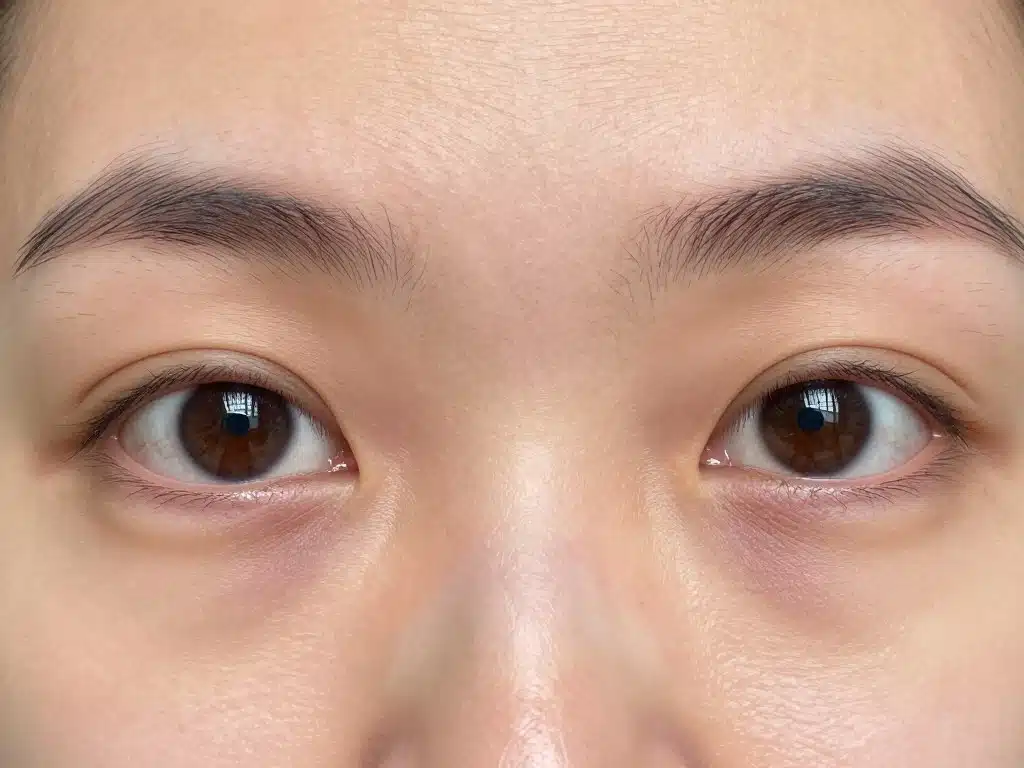
Dark circles under eyes are usually not about sleep. That’s the first useful thing to know, because most people arrive here having already tried sleeping more.
The skin around your eyes is thinner than anywhere else on your body — often under half a millimeter — so blood vessels show through it and pigment shows up on it. What’s actually causing the darkness varies, and the right fix depends entirely on which kind you have.
- Two quick tests identify your type: press test for pigment vs. vascular, light test for shadow from hollowing.
- Allergies are the most fixable cause — histamine dilates vessels and repeated eye-rubbing drives pigmentation over time.
- Tear trough fillers carry a rare but serious risk of vision loss if filler enters a blood vessel near the eye.
- Sudden onset, one-sided swelling, pain or vision change point to something medical rather than cosmetic.
Dark Circles Under Eyes: The Three Types, and How to Tell Which You Have
Dermatologists classify dark circles as pigmented, vascular, structural, or a mix — and most people are a mix.[1] This matters practically: a treatment aimed at the wrong type does nothing.
Pigmented looks brown or gray, and it doesn’t change when you press on it. More common with darker skin tones and where hyperpigmentation runs in the family.
Vascular looks blue, purple or red — blood pooling in vessels beneath thin skin. Pressing gently lightens it briefly.
Structural isn’t discoloration at all. It’s a shadow, cast by hollowing as fat pads shrink and skin loses collagen with age. The tell: it changes dramatically with lighting, and looks worst under overhead lights.
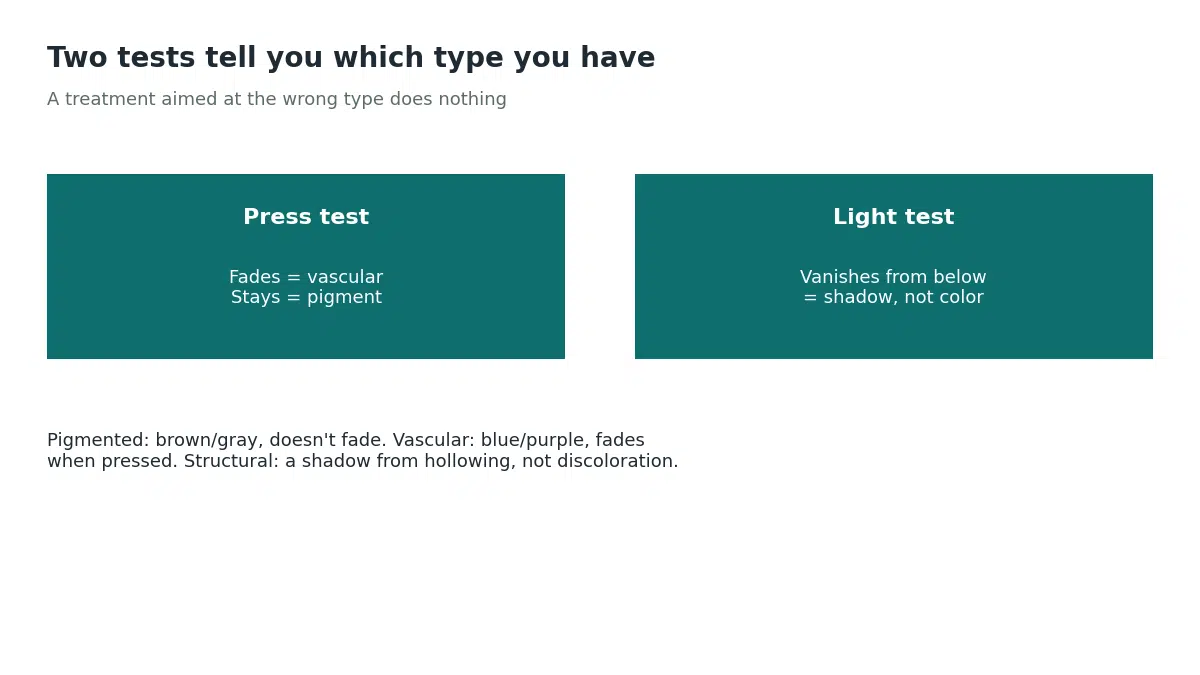
The press test: stretch the skin gently sideways. If the darkness fades, it’s vascular. If it stays, it’s pigment.
The light test: look in a mirror with light coming from directly above, then hold a light at face level. If the darkness largely disappears with the second, you’re dealing with shadow, not color.
What Actually Causes Them
Genetics. If your parents have them, you probably will. This isn’t a failure of self-care.
Age. Collagen declines, fat pads under the eye shrink and shift, and the orbital bone changes subtly. Hollows appear and cast shadows. This typically starts in the 30s.
Allergies — and this is the most fixable cause on the list. Histamine dilates the vessels around the eyes, producing what clinicians call allergic shiners.[3] Allergies also make you rub your eyes, and repeated rubbing drives pigmentation over time. If your circles worsen seasonally or around pets, start here — our guide to seasonal allergy relief covers what’s actually in the air, when it peaks, and what reduces the reaction.
Sun exposure. UV stimulates melanin and breaks down collagen, so it worsens pigmented and structural circles at once. The damage is cumulative and often surfaces in your 30s or 40s — and our guide to summer skincare mistakes covers the application errors that leave this area unprotected.
Sleep genuinely contributes to the vascular type — vessels dilate when you’re tired and skin looks paler, making everything more visible. But if you sleep well and still have circles, sleep isn’t your problem, and no amount of extra rest will change the other two types.
Smoking and alcohol both work against you — the first constricts vessels and degrades collagen, the second dehydrates and disrupts sleep.
What’s Worth Trying at Home
Treat your allergies properly. For vascular circles this is often the single highest-value change, and it addresses the eye-rubbing that causes pigment.
Cold compresses constrict vessels for a few hours. Useful in the morning, when vessels are most dilated. Free, safe, temporary.
Sun protection. Broad-spectrum SPF 30 or higher around the eyes and large sunglasses. This won’t reverse existing pigment but stops it deepening.
Sleep on a slightly raised pillow to reduce overnight fluid pooling.
What doesn’t do much
Cucumber slices are cold and wet — no better than a cold washcloth. Tea bags contain caffeine and tannins, but the effect is slight and brief. Potato slices and lemon juice have no evidence, and lemon juice on eyelid skin is a bad idea.
Extra water beyond adequate hydration won’t erase anything, though dehydration does make hollows look deeper.
Ingredients With Something Behind Them
A 2025 trial of a multi-ingredient under-eye formulation found measurable reductions in pigmentation over six weeks of consistent use — real, but modest.[4] Set expectations accordingly.
Caffeine constricts vessels and reduces puffiness. Best for vascular circles, effect is temporary, needs ongoing use.
Vitamin C reduces pigmentation and supports collagen over weeks to months.
Retinol increases cell turnover and collagen, helping both pigment and the fine lines that cast shadows. Start low, use at night only, expect irritation initially.
Niacinamide is the gentler option for pigmentation, at around 2-5%.
Peptides and vitamin K have thinner evidence — plausible, not established.
What the marketing overstates
Collagen in a cream can’t get through your skin; the molecules are far too large. Hyaluronic acid plumps temporarily and does nothing for pigment or volume loss. “Brightening” products often rely on light-reflecting particles — an optical trick, not a change in your skin.
Apply with your ring finger along the orbital bone, about a grain of rice per eye. Give any product 8 to 12 weeks before judging it, and don’t stack several actives at once around the eye — irritation there makes circles look worse, not better.
Professional Treatments
A 2025 systematic review and meta-analysis of procedural treatments found that lasers, peels and fillers can each produce genuine improvement — depending on which type you have.[2]
Chemical peels for pigmentation, in a series. People with darker skin need an experienced provider, since peels can cause post-inflammatory hyperpigmentation — making the problem worse.
Laser and IPL target either melanin or blood vessels depending on the device. Also multiple sessions, and also skin-type dependent.
Fillers for structural hollowing, placed in the tear trough.
Most discussions of tear trough filler list bruising, swelling, lumpiness and the Tyndall effect — a bluish tint when filler sits too superficially. Those are the common problems.
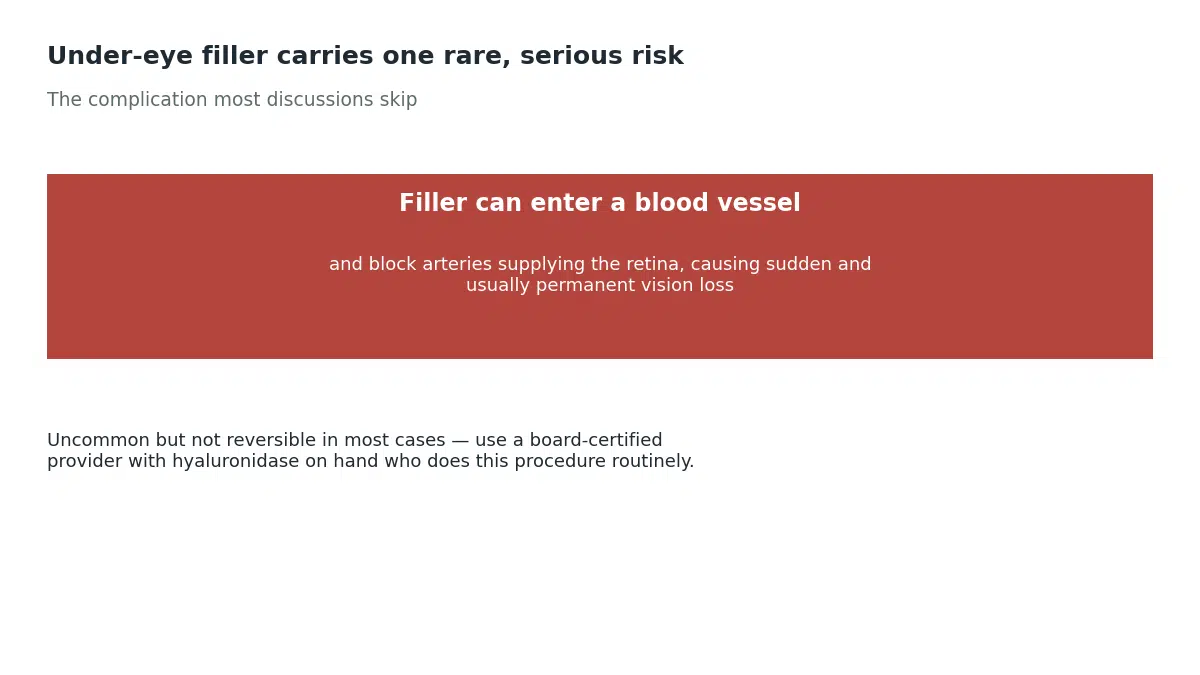
The one that matters most is rare and rarely mentioned: filler injected near the eye can enter a blood vessel and block the arteries supplying the retina, causing sudden and usually permanent vision loss. The area around the eye is considered among the highest-risk sites on the face for this complication.
It is uncommon. It is also not reversible in most cases. That combination is why this particular procedure belongs only with a board-certified dermatologist or oculoplastic surgeon who does it regularly, has hyaluronidase on hand, and knows what to do immediately if something goes wrong — not with whoever is offering a discount.
Sudden vision change, severe pain or skin blanching during or after injection is an emergency.
Prescription topicals — tretinoin, or hydroquinone for pigment. Hydroquinone works but isn’t for indefinite use; prolonged use can cause ochronosis, a blue-black discoloration that’s difficult to treat. It needs supervision.
Surgery (lower blepharoplasty) is reserved for significant structural change, with correspondingly higher risk and weeks of recovery.
None of these are covered by insurance, and costs run from a few hundred to several thousand. Ask how many sessions, what maintenance is needed, and what happens if it doesn’t work.
When It’s Worth Seeing a Doctor
Dark circles are usually cosmetic. Occasionally they’re a signal.
Get checked if: the circles appeared suddenly over days or weeks; there’s swelling that doesn’t settle, especially on one side only; there’s pain, tenderness or warmth around the eye; you have vision changes or difficulty moving the eye; or they come with fatigue, unexplained weight change or breathlessness.
Anemia reduces oxygen delivery, making skin paler and vessels more visible — iron or B12 deficiency are both worth a blood test, and our guide to B12 deficiency covers who’s most at risk.
Thyroid disease affects skin, fluid balance and fatigue. Kidney disease causes fluid retention and skin changes. A basic blood panel covers most of this.
Covering Them in the Meantime
Color correction works on a simple principle: warm tones neutralize cool ones.
Blue or purple circles — peach or salmon on lighter skin, orange or deep red on darker skin.
Brown circles — pink or light peach on lighter skin, deeper peach on medium to dark skin.
Let eye cream absorb first, use a tiny amount of corrector only where the discoloration is, blend with a damp sponge, then concealer roughly one shade lighter than your skin. Set lightly if at all — heavy powder emphasizes every line.
The commonest mistakes are concealer that’s too light, which reads as gray, and too much product, which creases and draws the eye to exactly the place you’re trying to disguise.
Common Questions About Dark Circles Under Eyes
Will more sleep get rid of my dark circles?
Only if poor sleep is driving them, and then only the vascular type. Genetics, aging, allergies and sun damage are usually bigger contributors.
If you already sleep well, look elsewhere.
How do I tell pigment from shadow?
Stretch the skin gently. If the darkness stays, it’s pigment. If it fades, it’s vascular.
And if it largely vanishes when light comes from face level rather than above, it’s shadow from hollowing.
Are tear trough fillers safe?
Generally, in experienced hands — but this area carries a rare risk of filler entering a blood vessel and causing permanent vision loss.
Use a board-certified dermatologist or oculoplastic surgeon who performs it routinely, not whoever is cheapest.
Do cucumber slices or tea bags work?
Barely. They’re cold, which briefly constricts vessels — a cold washcloth does the same.
Neither touches pigmentation or hollowing.
How long before an eye cream shows results?
Caffeine works within hours but fades. Retinol and vitamin C need 8 to 12 weeks of consistent use.
Three months of correct use with no change means it isn’t right for your type.
Can dark circles mean something medical?
Occasionally. Anemia, thyroid and kidney problems can all contribute, and a basic blood test covers them.
Sudden onset, one-sided swelling, pain or vision change all warrant a doctor rather than a cream.
The Bottom Line
Work out which type you have before spending anything. Treat allergies if you have them, protect from sun, and give one or two proven ingredients a proper 12 weeks.
Genetic pigmentation and bone structure can be softened, not erased. Before-and-after photographs are lit, angled and often edited; real improvement is subtler than advertising suggests, and a provider promising to erase your circles entirely is overselling.
Most people have some degree of this. Improving it is a reasonable goal; matching a filtered photograph isn’t.
SOURCESOur Editorial Standards
HealthMagHub is built on primary sources: peer-reviewed research, clinical practice guidelines, and health agencies such as the NIH, CDC, and FDA. Read our editorial standards to see how we research, cite, and update our articles.
- Ranu H, Thng S, Goh BK, Burger A, Goh CL. Periorbital Hyperpigmentation: A Comprehensive Review. The Journal of Clinical and Aesthetic Dermatology. jcadonline.com
- Pour Mohammad A, et al. The First Systematic Review and Meta-Analysis of Pharmacological and Nonpharmacological Procedural Treatments of Dark Eye Circles. Dermatologic Therapy, 2025. onlinelibrary.wiley.com
- Cleveland Clinic. Allergic Shiners: Causes, Symptoms & Treatment. my.clevelandclinic.org
- Brady RT, Shah-Desai S. Clinical Efficacy of a Novel Topical Formulation on Periorbital Dark Circles: An Objective Analysis. Journal of Cosmetic Dermatology, 2025. pmc.ncbi.nlm.nih.gov
Disclaimer: This article is general information, not medical advice. See a doctor if dark circles appear suddenly, involve one-sided swelling, pain or vision change, or come with fatigue or unexplained weight change. Injectable treatments around the eye carry a rare risk of vision loss and should only be performed by an appropriately qualified specialist.