

Is ashwagandha safe? For most healthy adults at typical doses over a few months, yes. The useful part of the answer is the list of people for whom it isn’t, and that list is longer than the marketing suggests.[1]
It’s a real pharmacological agent, not a gentle tonic. It affects thyroid hormone, immune activity, blood pressure, blood sugar and sedation, which is exactly why it interacts with so many medications.
Here’s who should avoid it outright, what side effects to watch for, which drugs it clashes with, and the product-quality problem that’s independent of the herb itself.
- Ashwagandha is probably fine for a healthy adult on no medication, taking a third-party-tested product at a normal dose for a couple of months.
- Avoid it entirely if pregnant, breastfeeding, have hyperthyroidism, an autoimmune disease, liver disease, a hormone-sensitive cancer, or surgery scheduled within two weeks.
- Rare but documented cases of liver injury exist, so stop and seek care for yellowing skin or eyes, dark urine, or severe unexplained fatigue.
- A 2025 lab analysis found most tested ashwagandha products exceeded safe limits for lead and nickel, so look for USP, NSF, or ConsumerLab certification.
What It Is, Briefly
Ashwagandha (Withania somnifera) is a shrub grown in India and parts of Africa, also sold as Indian ginseng or winter cherry. The root and leaves contain withanolides, the compounds thought to be active, and it’s classed as an adaptogen, a plant said to help the body handle stress.
Thousands of years of Ayurvedic use doesn’t establish safety by modern standards, but it does mean this isn’t an untested novelty. Most supplements supply 250 to 600 mg daily, often standardized to a stated withanolide percentage.[2]
Higher doses don’t reliably mean more benefit, and they do mean more risk.
Who Should Not Take It
This is the part that matters most.
Pregnancy and breastfeeding
Don’t take ashwagandha if you’re pregnant. This isn’t routine caution. There’s evidence it may increase miscarriage risk, animal studies show pregnancy loss, and traditional texts describe using the plant to induce abortion.[1] Safety data in breastfeeding is absent, so health authorities advise avoiding it then too.
Thyroid disease
Ashwagandha can raise thyroid hormone levels.[1] With hyperthyroidism that pushes an already overactive gland further. One documented case describes a woman who developed poor appetite, weight loss, tremor and a racing heart after starting ashwagandha and increasing her dose, with thyroid hormone well above normal.[3]
If you take levothyroxine, the combination can push levels higher than intended. Either way, this needs a prescriber’s involvement and more frequent thyroid tests.
Autoimmune conditions
Ashwagandha appears to stimulate immune activity. That’s a problem when the immune system is already attacking your own tissue: rheumatoid arthritis, lupus, multiple sclerosis, inflammatory bowel disease.[1]
Before surgery
Stop at least two weeks before any scheduled operation.[1] Its sedative effect can compound anesthesia and complicate blood pressure control.
Hormone-sensitive cancer
Ashwagandha may raise testosterone.[1][5] NCCIH specifically advises against it for people with hormone-sensitive prostate cancer. Evidence for other hormone-sensitive cancers is thin, which is a reason for caution rather than reassurance, so raise it with your oncologist.
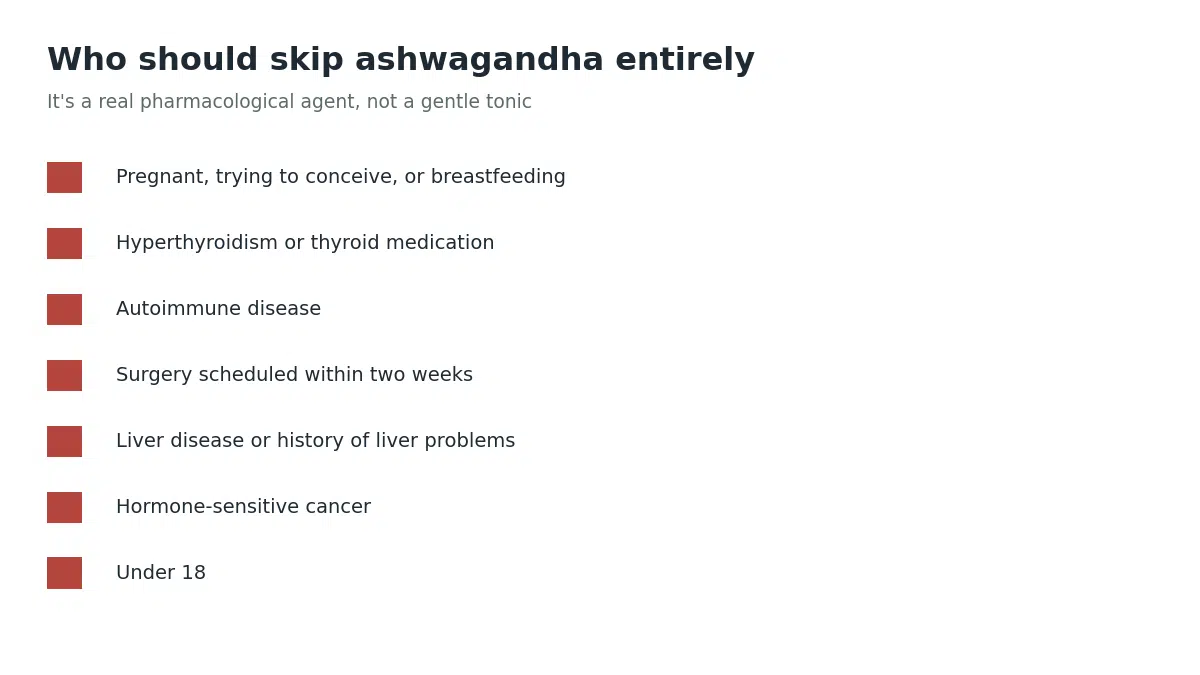
Skip ashwagandha entirely if you are pregnant, trying to conceive, or breastfeeding; have hyperthyroidism or take thyroid medication; have an autoimmune disease; have surgery scheduled within two weeks; have liver disease or a history of liver problems; have a hormone-sensitive cancer; or are under 18, since safety in children isn’t established.
Side Effects Worth Knowing
Digestive upset is the most frequently reported: nausea, diarrhea, stomach discomfort, usually early on or on an empty stomach. Taking it with food and starting low both help.[1]
Drowsiness. Ashwagandha is mildly sedating, which is why some people take it for sleep, and why it can leave you groggy, especially alongside alcohol or other sedating substances. Be careful driving until you know how it affects you.
Skin reactions. Rash and itching are uncommon but documented. Stop if they appear.
The liver signal is the one to take seriously. Case reports of liver injury linked to ashwagandha are documented well enough to have their own entry in LiverTox, the NIH database of drug-induced liver injury.[3] These cases are rare, and most people take ashwagandha without any liver problem.
Stop immediately and contact a doctor if you develop yellowing of the skin or eyes, dark urine, unusual and persistent fatigue, or pain in the upper right abdomen.
You’ll see articles quote precise frequencies for these effects, such as “5-10% of users”. Those numbers aren’t in the underlying safety literature, which reports side effects as common, occasional or rare without reliable percentages. Treat any exact figure with suspicion.
Medications That Don’t Mix
Thyroid medication. Ashwagandha may raise thyroid hormone, so levothyroxine plus ashwagandha can overshoot. Watch for a racing heart, anxiety, insomnia, tremor and unintended weight loss.
Sedatives and sleep medication. Benzodiazepines, prescription sleep aids, some antidepressants and certain painkillers all compound its sedative effect.
Blood pressure medication. Ashwagandha may lower blood pressure further, risking dizziness or fainting.
Diabetes medication. It may lower blood sugar, which can tip into hypoglycemia alongside glucose-lowering drugs.[1]
Immunosuppressants. Its immune-stimulating effect can work directly against these drugs, which is relevant after a transplant or for autoimmune treatment.[1]
Also flag stomach ulcers and chronic digestive disease, existing low blood pressure, and any mental health condition, since a minority of people report worsened anxiety or mood changes rather than improvement.
Is Ashwagandha Safe as a Product, Not Just as a Herb?
Even if the plant suits you, the specific bottle might not. Supplements aren’t reviewed by the FDA before sale, so label accuracy depends entirely on the manufacturer.
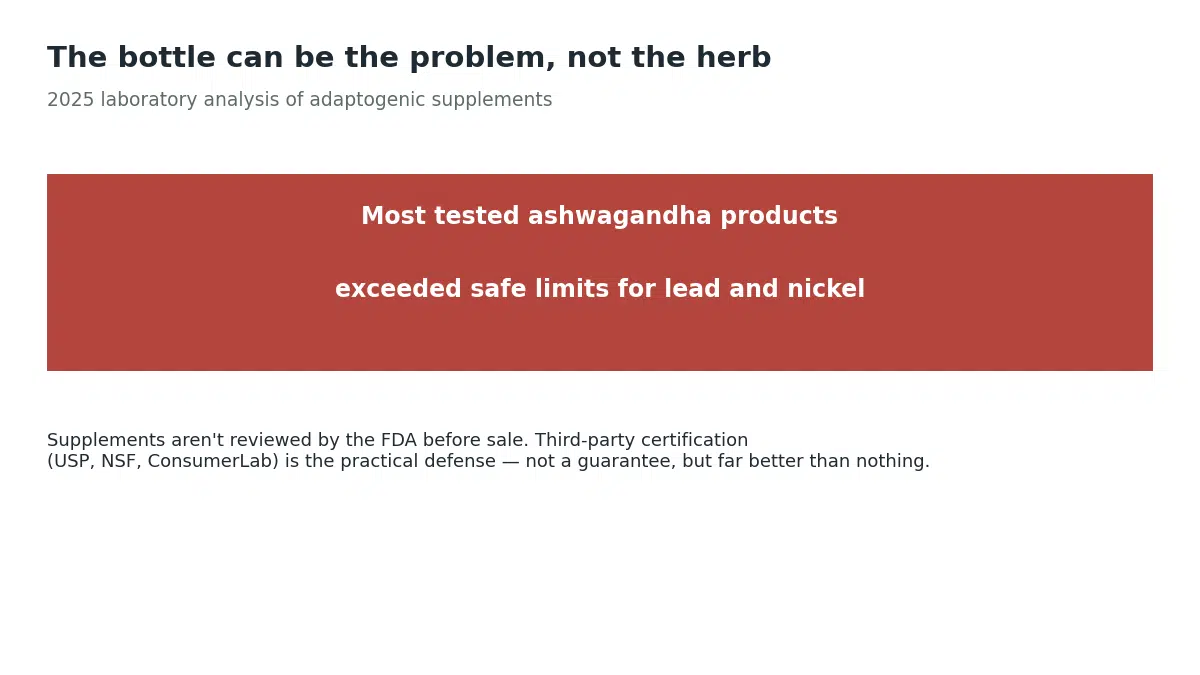
Plants take up whatever is in their soil. A 2025 laboratory analysis of adaptogenic supplements found most tested ashwagandha products exceeded safe limits for lead and nickel.[4] Lead exposure carries neurological and kidney risk that accumulates over time.
Products have also been found under-dosed relative to their label, or adulterated with other plant material. The practical defense is third-party certification from USP, NSF International or ConsumerLab, plus a certificate of analysis on request. Not a guarantee, but far better than nothing. Our look at red yeast rice covers a supplement with the same regulatory gap and a sharper edge to it, and our guide to shilajit covers a mineral-based supplement where the same soil-contamination problem is even more pronounced.
Using It More Safely
Start at roughly half the labeled dose for a week or two before going higher, so side effects show up early and mildly.
Take it with food, ideally a meal containing some fat.
Don’t take it indefinitely. Most safety data covers 8 to 12 weeks, occasionally a few months.[1] Long-term use over years simply hasn’t been studied, so cycling off periodically is the cautious approach.
Tell your doctor and pharmacist. Over-the-counter doesn’t mean irrelevant to your care, and it matters before any new prescription or procedure.
What the Safety Research Doesn’t Cover
Trials generally report ashwagandha as well tolerated with no serious adverse events, which is genuinely reassuring, with caveats.[2] Most enrolled 50 to 100 people, ran 8 to 12 weeks, and excluded pregnant women, people with health conditions, and anyone on medication.
So the evidence describes short-term use by healthy adults. It says little about long-term use, children and teenagers, older adults on several medications, or interactions across the full range of common drugs.
That’s a set of gaps, not a verdict. But it’s why the confident safety claims on supplement packaging outrun what anyone actually knows.
Common Questions About Ashwagandha Safety
Is ashwagandha safe to take every day?
Daily use for 8 to 12 weeks is what the research covers, and most people tolerated it.[2] Continuous use over months or years hasn’t been studied.
Cycling off periodically is the sensible default until longer-term data exists.
Is ashwagandha safe during pregnancy?
No. There’s evidence of increased miscarriage risk, animal studies show pregnancy loss, and traditional texts describe the plant being used to induce abortion.[1]
Avoid it while breastfeeding too, since there’s no safety data either way.
Is ashwagandha safe with thyroid medication?
Not without your prescriber’s involvement. It can raise thyroid hormone levels, so combining it with levothyroxine risks overshooting.
With hyperthyroidism, avoid it. With treated hypothyroidism, it needs closer monitoring and a deliberate decision.
Can ashwagandha damage your liver?
Case reports of liver injury are documented in LiverTox, the NIH database on drug-induced liver injury.[3] They’re rare but real.
Avoid it entirely if you have liver disease, and stop immediately for jaundice, dark urine or severe unexplained fatigue.
Can it make anxiety worse?
For most people it doesn’t, and some find it helps. A minority report worsened anxiety or other mood changes.
If your symptoms worsen after starting it, stop and mention it to whoever manages your mental health care.
How do I know a product is any good?
Look for USP, NSF International or ConsumerLab certification, and ask for a certificate of analysis if it isn’t published.
That matters more here than for most supplements, given how many tested products exceeded safe lead and nickel limits.[4]
Is Ashwagandha Safe for You? The Bottom Line
For a healthy adult on no medication, taking a third-party-tested product at a normal dose for a couple of months, ashwagandha is probably fine.
Change any of those conditions and the answer changes. Pregnancy, thyroid disease, autoimmune conditions, liver problems, upcoming surgery and several common drug classes each make it a poor idea, and the product-quality picture is genuinely concerning.
Start low, take it with food, don’t take it forever, tell your doctor, and stop if something feels wrong. If you’re weighing what it might actually do for you, our guides to ashwagandha and weight and what the research shows for women cover the benefit side.
SOURCESOur Editorial Standards
HealthMagHub is built on primary sources: peer-reviewed research, clinical practice guidelines, and health agencies such as the NIH, CDC, and FDA. Read our editorial standards to see how we research, cite, and update our articles.
- National Center for Complementary and Integrative Health. Ashwagandha: Usefulness and Safety. nccih.nih.gov
- National Institutes of Health, Office of Dietary Supplements. Ashwagandha: Fact Sheet for Health Professionals. ods.od.nih.gov
- LiverTox: Clinical and Research Information on Drug-Induced Liver Injury. Ashwagandha. National Institute of Diabetes and Digestive and Kidney Diseases. ncbi.nlm.nih.gov
- Heavy Metal Contamination in Adaptogenic Herbal Dietary Supplements. PMC. pmc.ncbi.nlm.nih.gov
- Cleveland Clinic. What Is Ashwagandha? health.clevelandclinic.org
Disclaimer: This article is general information, not medical advice. Do not take ashwagandha if you are pregnant or breastfeeding. Speak to a doctor or pharmacist first if you have thyroid, autoimmune or liver disease, a hormone-sensitive cancer, or take thyroid, sedative, blood pressure, diabetes or immunosuppressant medication. Stop immediately and seek medical care for jaundice, dark urine, or severe unexplained fatigue.