
Before anything else: sodium bicarbonate isn’t a safe general home remedy to drink. It’s genuinely useful in specific, measured situations and genuinely dangerous in others. If you have high blood pressure, heart failure or kidney disease, don’t take it by mouth without asking your doctor.
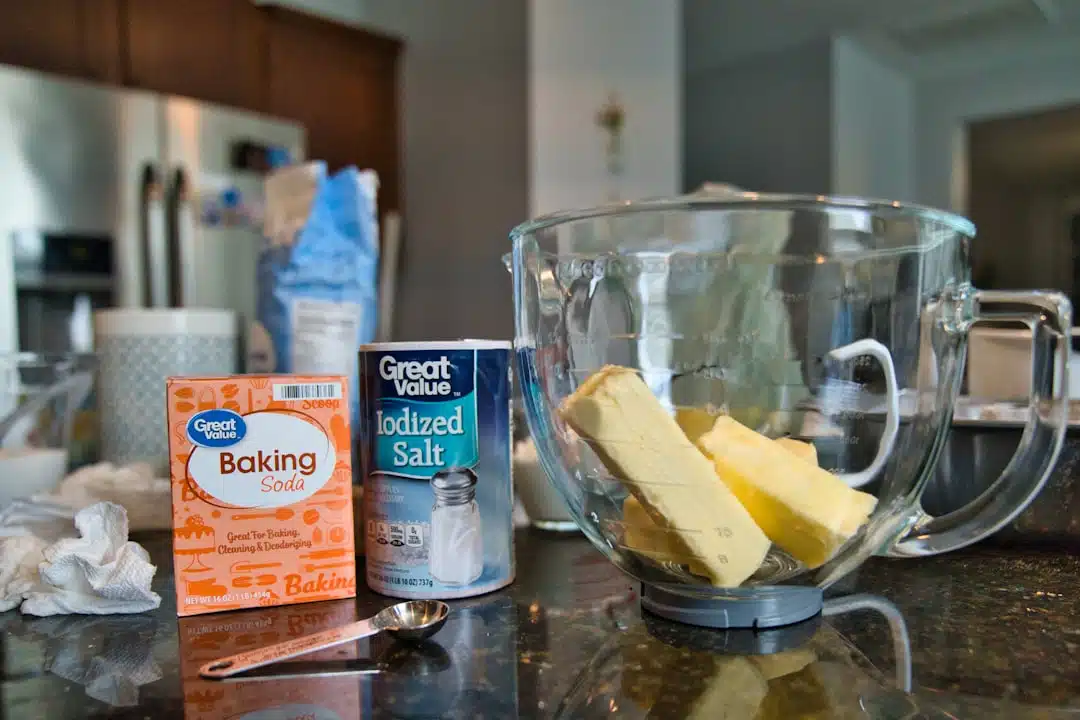
Sodium bicarbonate is baking soda. Same compound, same white powder, whether it comes in a supermarket box, a pharmacy antacid tablet or a hospital drip.
Its chemical formula is NaHCO3, and everything it does in the body follows from one property: it’s a base, so it neutralizes acid. That single fact explains why it settles heartburn, why it fizzes in a cake, why dentists like it, and why swallowing a lot of it can land someone in an emergency department.
- Sodium bicarbonate is baking soda: the same compound in a supermarket box, an antacid tablet, or a hospital drip.
- A teaspoon carries over 1 gram of sodium, a substantial share of a full day’s intake. That makes it risky for anyone with high blood pressure, heart failure, or kidney disease.
- Two distinct dangers: weeks of overuse can cause metabolic alkalosis, and a large dose on a full stomach can rupture it.
- It doesn’t treat cancer, detox anything, or change your body’s overall pH. Those claims are persistent pieces of misinformation.
What sodium bicarbonate actually is
It’s a salt made of sodium, hydrogen, carbon and oxygen. Your body already makes and uses it constantly.
Bicarbonate is the main buffer in your bloodstream, the system that keeps blood pH inside the narrow range your enzymes need. Your kidneys reabsorb almost all the bicarbonate they filter, and your pancreas secretes it into the small intestine to neutralize stomach acid arriving from above. It’s also the value being measured when a blood test reports low carbon dioxide.
So it isn’t a foreign substance. It’s a normal part of your chemistry that also happens to be sold in a cardboard box.
When it meets an acid, it reacts to produce carbon dioxide gas, water and a salt. That reaction is the whole story. It’s why baking makes bread rise, and it’s why swallowing it makes you belch.
Baking soda, baking powder and washing soda aren’t the same thing
Worth clearing up, because people substitute them and occasionally swallow the wrong one.
- Baking soda is pure sodium bicarbonate. It needs an acid to react with.
- Baking powder is sodium bicarbonate with a powdered acid already mixed in, plus starch to keep them apart until liquid arrives. It’s weaker by weight because most of it isn’t bicarbonate.
- Washing soda is sodium carbonate, a different compound that’s far more alkaline. It’s a cleaning product and isn’t safe to eat.
What sodium bicarbonate is used for
In medicine, the legitimate uses are narrower than the internet suggests.
As an antacid. It neutralizes stomach acid within minutes, and this is its main over-the-counter use. Fast, short-lived, and covered in more detail below.
Intravenously, in hospital. Doctors use it to correct severe metabolic acidosis, to alkalinize urine in certain poisonings such as aspirin overdose, and in specific cardiac and toxicology situations. These are monitored decisions based on blood gas results, not something with a home equivalent.
In chronic kidney disease. Some people with reduced kidney function and ongoing acidosis are prescribed oral bicarbonate to correct it. That’s a prescription with monitoring, and it exists precisely because those kidneys can no longer manage the balance alone.
In dentistry. It’s a mild, low-abrasion polishing agent, which is why it appears in toothpaste and why it holds up better than most kitchen whitening ideas. Our guide to natural ways to whiten teeth covers where it sits against the alternatives.
In sport. Athletes have used bicarbonate loading before short, very intense efforts to buffer the acid building in muscle. The research is real, but the effect is small, narrow and unreliable, and the usual outcome is severe stomach upset at exactly the wrong moment.
Everywhere else. Cleaning, deodorizing, pool alkalinity, fire extinguishers. All of that works. None of it is a health claim.
Sodium bicarbonate as an antacid: fast, but not first choice
It works quickly, and that’s its appeal. It also has three drawbacks that make modern guidance prefer other options.[1]
It doesn’t last. Neutralization happens fast and finishes fast, so relief is measured in minutes.
It produces gas. Neutralizing acid releases carbon dioxide in your stomach, which means belching and bloating. In some people it worsens reflux by increasing pressure.
That matters most for anyone reaching for it at bedtime, since lying down is already the worst position for reflux. Our guide to acid reflux at night explains why nighttime episodes last so much longer than daytime ones, and covers two free changes that work better than an antacid.
It’s absorbed. Unlike calcium or magnesium antacids, sodium bicarbonate is systemically absorbed, so it doesn’t just act in the stomach. It changes your blood chemistry. That’s the difference that matters.
Occasional use of a labeled dose in a healthy adult is generally fine. Regular use, or homemade doses measured in spoons rather than by a label, is where the trouble starts. And anyone reaching for it more than occasionally has a different question to answer: why the heartburn keeps happening.
The sodium problem
A teaspoon of baking soda contains well over a gram of sodium.
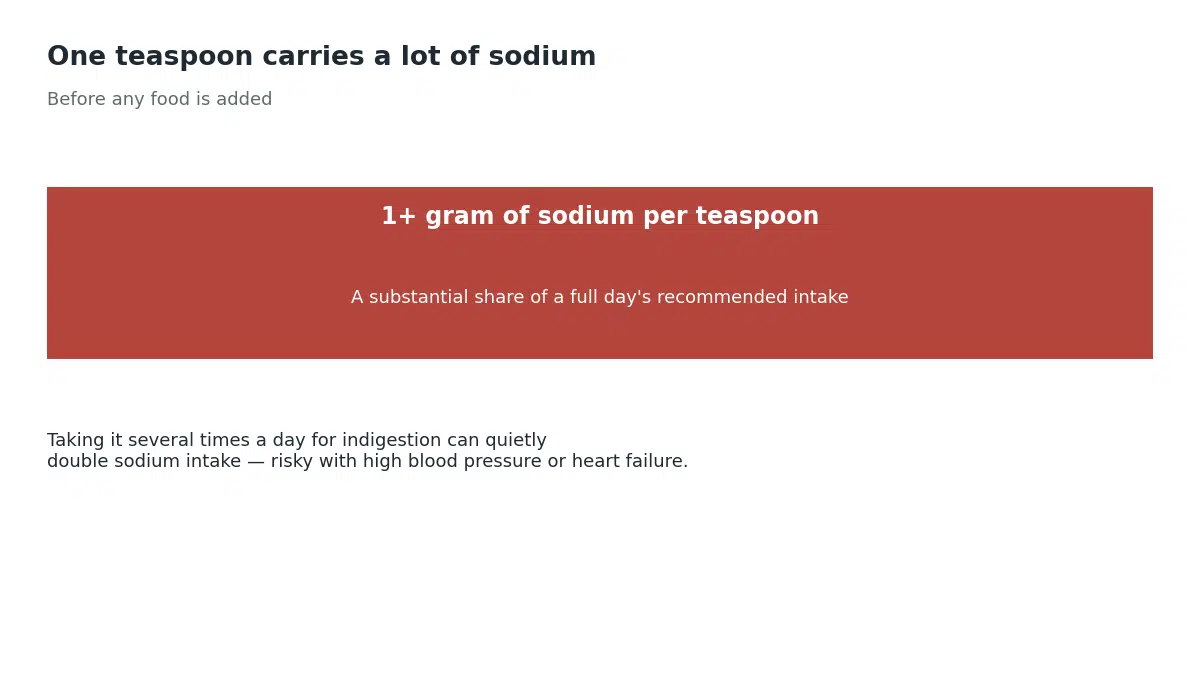
That’s a substantial share of a whole day’s recommended sodium intake in a single spoonful, before any food. Someone taking it several times a day for indigestion can quietly double their sodium intake without ever touching the salt shaker.
That matters most for the people most likely to have indigestion in the first place: older adults, and anyone with high blood pressure, heart failure, liver disease or reduced kidney function. Sodium drives fluid retention, and fluid retention is exactly what those conditions can’t absorb. It’s also why a few high-sodium days can show up as a sudden jump on the scale. Our guide to why you might be gaining weight so fast explains how to tell ordinary fluid from the kind that needs a doctor.
It shouldn’t be given to children as a home antacid. And it isn’t appropriate as a routine remedy in pregnancy. The sodium load worsens the swelling pregnancy already causes, and it can push blood chemistry off balance in both mother and baby. Our guide to heartburn during pregnancy sets out which antacids are used instead, and why calcium carbonate is the usual first choice.
Medicines sodium bicarbonate interferes with
This is the part most articles skip, and it’s one of the broadest interaction profiles of any household substance.
By raising the pH of your stomach, it changes how well other drugs dissolve and get absorbed. By raising the pH of your urine, it changes how fast your kidneys clear certain drugs out.
Practical consequences include reduced absorption of some antibiotics and antifungals, altered lithium levels, changed clearance of aspirin and related salicylates, and interference with other medications where timing or blood levels are critical.[1] The same principle applies to other mineral antacids. It’s why magnesium supplements need separating from certain antibiotics, and why antacids of any kind should be kept a couple of hours away from an iron tablet.
None of that is cause for panic if you took an antacid once. It’s a reason to check with a pharmacist before using it regularly, particularly alongside lithium, an anticoagulant, or medication for the heart or kidneys.
When sodium bicarbonate becomes dangerous
Two patterns show up in the medical literature, and they’re different.
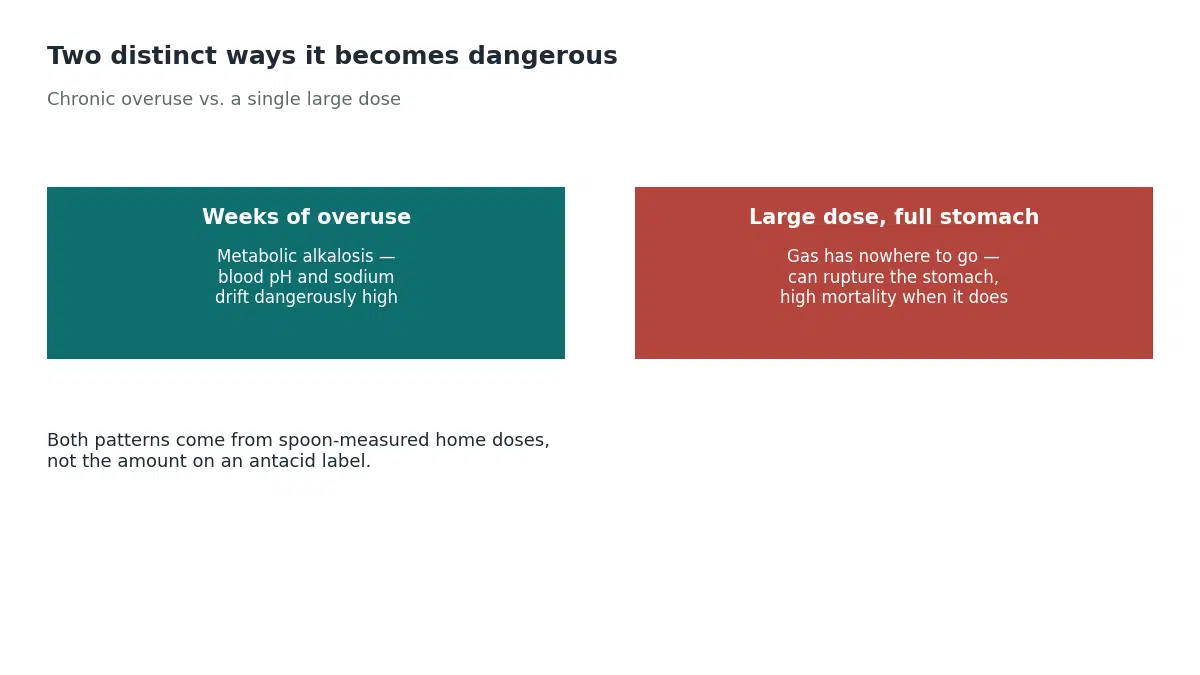
Large amounts over weeks or months drive blood pH up and electrolytes out of balance, a state called metabolic alkalosis. Published case reports describe people arriving in hospital with dangerously high blood pH and sodium after taking large daily amounts, often for indigestion or as a supposed detox or cleanse. A review of reported bicarbonate toxicity found most cases followed exactly this pattern.[2]
A large amount on a full stomach can rupture the stomach. The gas released has nowhere to go, and the pressure can tear the stomach wall. This is rare, and it carries a high mortality rate in the reported cases.[3] It’s the single strongest reason not to reach for a spoonful of baking soda after a very large meal.
Get emergency help for severe abdominal pain after taking sodium bicarbonate, especially following a large meal.
Seek urgent advice for confusion, muscle twitching or spasms, marked weakness, an irregular heartbeat, or vomiting that won’t stop.
One note on that case literature: a substantial proportion of stomach rupture cases have occurred alongside disordered eating.[3] If binge eating is part of your life, or you find yourself using bicarbonate, laxatives or similar products to manage the aftermath of eating, that’s worth raising with a doctor. The National Alliance for Eating Disorders helpline is a starting point, and this particular complication is a serious one.
What sodium bicarbonate will not do
It doesn’t treat cancer, and that claim is one of the more persistent and dangerous pieces of health misinformation online. It doesn’t detox anything. It won’t change your body’s overall pH in any beneficial way, because the systems keeping your blood pH stable are precisely the ones you’d be fighting. That’s the same reasoning that undermines most alkaline water and electrolyte claims.
It isn’t a treatment for urinary tract infections, though it appears in sachets that make bladder discomfort feel briefly better without touching the infection.
And it isn’t a substitute for seeing someone about heartburn that keeps returning.
The one thing to take away
Sodium bicarbonate is a genuinely useful compound with a narrow set of appropriate uses: an occasional antacid, a component of toothpaste, a prescribed treatment in specific kidney and hospital situations.
What it isn’t is a daily supplement, a detox, or a remedy measured out in spoons at home. The gap between a labeled antacid dose and the amount people casually stir into water is the gap the case reports come from.
If you find yourself needing it more than occasionally, the useful question isn’t how much to take. It’s why your stomach keeps needing it.
SOURCESOur Editorial Standards
HealthMagHub is built on primary sources: peer-reviewed research, clinical practice guidelines, and health agencies such as the NIH, CDC, and FDA. Read our editorial standards to see how we research, cite, and update our articles.