
Balance exercises are the part of a workout almost everyone skips, and a study in the British Journal of Sports Medicine gave people a blunt reason to stop. Adults who could not stand on one leg for 10 seconds were close to twice as likely to die over the following seven years as adults who could.
Researchers followed 1,702 people aged 51 to 75 at an exercise medicine clinic in Rio de Janeiro. Each stood unsupported on one foot, arms folded, for 10 seconds. One in five could not manage it.
Over a median of seven years, 17.5% of the people who failed died, against 4.6% of those who passed. Adjusting for age, sex, body mass index and conditions such as heart disease and diabetes narrowed the gap but did not erase it. Failing was still tied to roughly 80% higher risk of death from any cause.
Here is the part that matters more than the headline: wobbling does not kill anyone. Balance is a status report on several systems at once, and when it slips, something else is usually slipping too. The encouraging half of that is that balance exercises can move the number back.
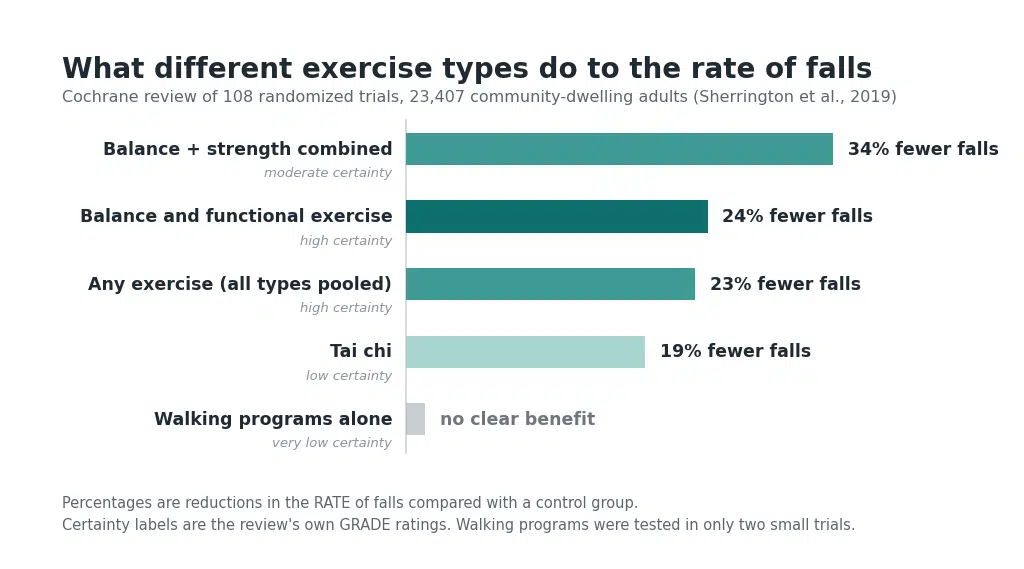
- Balance exercises cut the rate of falls by 24% in a Cochrane review of 108 trials — the strongest evidence in the whole fall-prevention field.
- Walking programs alone showed no clear benefit for falls, so a daily walk does not count as balance training.
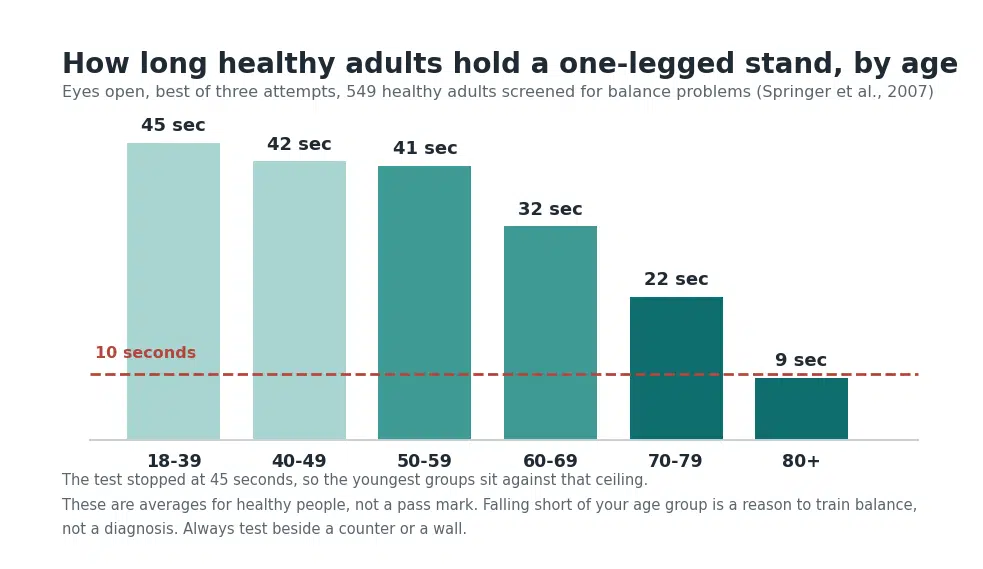
- Healthy adults in their sixties average about 32 seconds on one leg; past 80 the average drops to around 9 seconds.
- The US Preventive Services Task Force recommends exercise to prevent falls in at-risk older adults, and found no benefit from vitamin D for that purpose.
What a 10-second stand actually measures
Standing on one foot looks like a leg-strength test. It is really a coordination test with a very short deadline.
Four systems have to agree in real time. Your inner ear reports which way is up. Your eyes fix on a reference point. Nerve endings in your feet and ankles feed back pressure and joint angle several times a second. Your hip and ankle muscles correct. Take one offline and the whole thing gets shaky, which is why the test fails early in people with nerve damage, inner-ear problems or untreated vision loss. Good balance exercises train all four at once.
That also explains the timing of the decline. Balance holds up reasonably well through the fifties and then falls away faster than strength or flexibility. Nothing dramatic happens at 60. Several systems just lose a little precision at once, which is why balance exercises are worth starting before you feel you need them.
How long should you be able to stand on one leg?
Researchers at Walter Reed Army Medical Center timed 549 healthy adults, screened to exclude anyone with a known balance problem, standing on one foot with eyes open. Those averages give you something honest to measure against before you start balance exercises.
People in their fifties averaged 41 seconds. In their sixties, 32. In their seventies, 22. Past 80, 9. The test was capped at 45 seconds, so the younger groups are pressed against that ceiling rather than showing a true best.
Two cautions before you try it. Stand beside a kitchen counter or in a doorway where you can catch yourself, and take your shoes off on a firm floor rather than carpet. Treat the result as information, not a verdict. Coming in under your age group is a reason to start balance exercises, not a diagnosis.
Balance exercises cut falls by about a quarter
The case for balance exercises for seniors does not rest on a single study. A Cochrane review pooled 108 randomized trials covering 23,407 older adults living at home across 25 countries — an enormous body of evidence by the standards of any lifestyle question.
Exercise of any kind reduced the rate of falls by 23%. Narrow it to balance exercises and functional training and the figure was 24%, rated high-certainty. Add resistance work on top of balance exercises and the reduction reached 34%, though with fewer trials behind it. Tai chi came in at 19% with weaker certainty.
Reductions that size are rare in prevention research, and the US Preventive Services Task Force acted on them. In 2024 it recommended exercise to prevent falls in community-dwelling adults 65 and older at increased risk. Falls are the leading cause of both fatal and non-fatal injury in that age group, and the CDC counts more than 14 million American adults over 65 reporting a fall each year.
Walking is not a balance exercise
This is the finding that catches people out, and it explains why so many active older adults still fall.
In the same review, walking programs on their own showed no clear benefit for falls. Only two small trials tested them, so the honest reading is uncertainty rather than proof of no effect. But there is a mechanical logic to it. Walking on flat ground rehearses what your body already does well. Nothing about it asks you to hold a narrow base of support, shift your weight onto one leg and stay there, or recover from a stumble.
Walking is excellent for your heart, your mood and your blood sugar. It is just not the thing that keeps you upright on an icy step. If your whole activity plan is a daily walk, your balance training is currently zero.
Balance exercises with real trial evidence behind them
The programs that worked share one feature: they push your center of gravity toward the edge of your base of support and keep it there. That is the active ingredient. Which movements you pick matters less than whether they are genuinely hard.
- Feet-together stand. Heels and toes touching, arms folded, 30 seconds. The gentlest entry point.
- Tandem stand. One foot directly in front of the other, heel to toe, as if on a tightrope. Build to 30 seconds each way.
- Single-leg stand. The test itself, used as training. Work toward 30 seconds per leg.
- Heel-to-toe walking. Ten steps along a hallway, fingertips on the wall only if needed.
- Sit-to-stand. Rising from a dining chair without your arms, five to ten times. The strength half of the equation, and the most transferable movement here.
- Step-ups and lateral steps. Onto a low step or over a line on the floor, training the weight transfer a stumble demands.
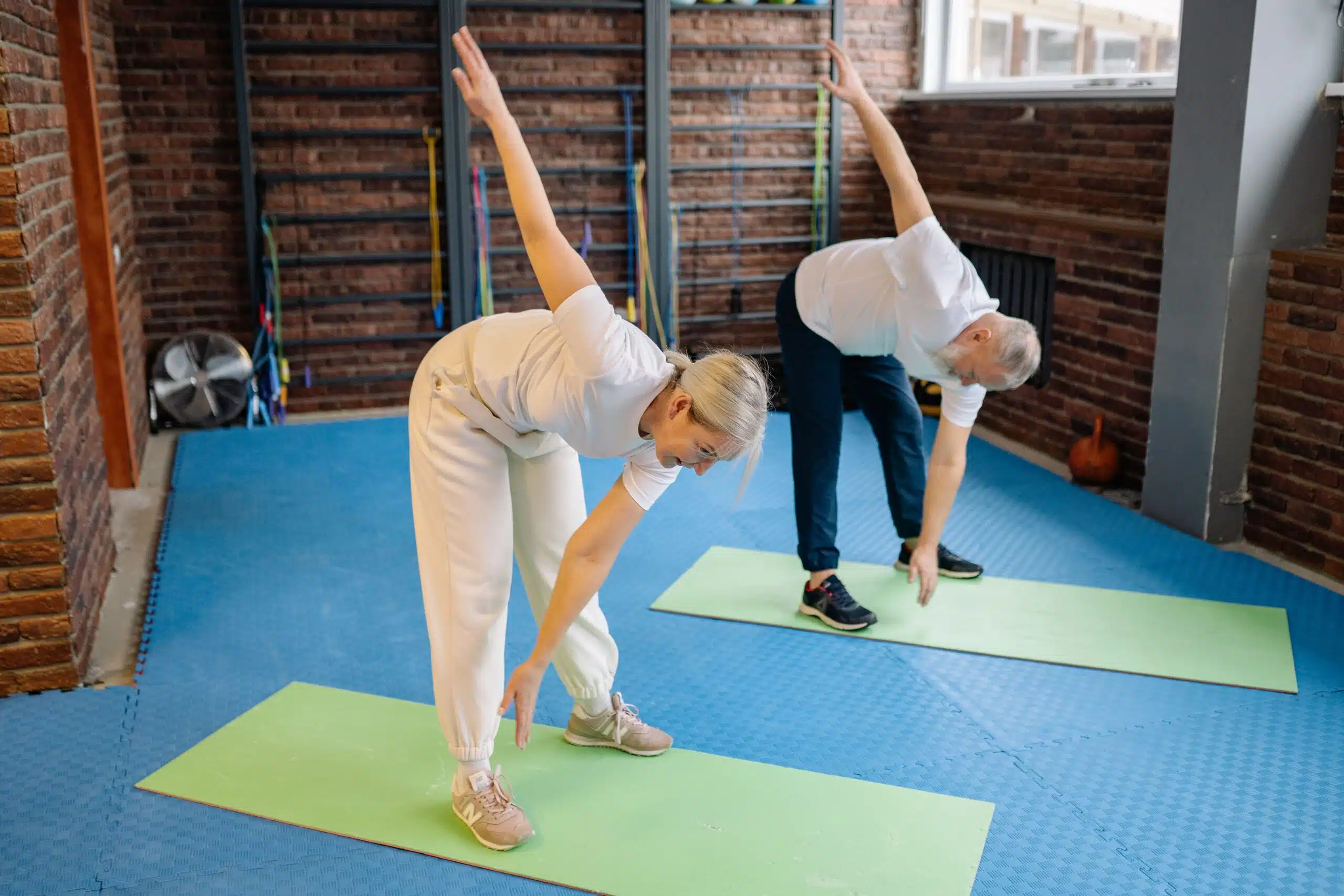
Progression is what turns these balance exercises into training rather than a routine. Once something feels easy, make it harder one of three ways: reduce hand support from two hands to one to a fingertip to none, narrow your base, or turn your head side to side while you hold the position. Head turns are underrated because they remove your visual anchor — exactly what happens when someone calls your name in a parking lot.
Core training has a smaller and more contested role in balance exercises than the fitness industry suggests, for reasons covered in our look at what the research shows about lower abdominal work.
The dose nobody mentions
An earlier analysis by the same group found the biggest effects in programs that both challenged balance and totaled more than three hours a week. That is considerably more than most people picture when they hear “a few balance exercises.”
It becomes manageable once you stop treating it as a workout. Tandem standing while the coffee brews. Single-leg stands while brushing your teeth. Sit-to-stands during commercial breaks. Balance fades when training stops, the same way fitness does, so balance exercises are maintenance rather than a course of treatment.
What works less well than people expect
Vitamin D. After reviewing the trials, the US Preventive Services Task Force concluded that vitamin D supplementation does not prevent falls in community-dwelling older adults, and recommended against taking it for that reason. This does not apply if you have a diagnosed deficiency, osteoporosis, or a doctor who told you to take it for something else.
Balance boards and wobble cushions. Not useless, but not necessary. The trial evidence was built on floors, chairs and low steps. The balance exercises that worked needed no equipment at all.
Doing a course and stopping. The most common failure is not picking the wrong balance exercises. It is finishing an eight-week class and never practicing again.
Things that quietly undermine your balance
Balance exercises cannot fully compensate for a cause that is still active, and several common ones go unexamined for years.
Blood pressure medication. A drop in blood pressure on standing is one of the most treatable causes of unsteadiness, and it often appears after a dose change. If you go gray or swimmy standing up from a chair, measure it rather than tolerate it — our guide to reading your blood pressure numbers properly covers checking it standing as well as sitting.
Sedatives and sleep aids. Benzodiazepines, Z-drugs and sedating antihistamines all raise fall risk, and nighttime trips to the bathroom are when it happens. No amount of balance exercises offsets a drug that dulls your reaction time.
Nerve damage in the feet. Peripheral neuropathy strips out the pressure feedback your ankles depend on, and it causes both poor one-leg stance times and falls. If you have numbness, burning or pins and needles in your hands or feet, raise it with your doctor before you blame your age.
Inner-ear and hearing problems. The balance organ sits beside the hearing organ and shares a nerve, so the two often decline together. New unsteadiness alongside hearing loss in one ear needs assessment, not balance exercises.
Old eyeglasses. Bifocals and progressive lenses blur the ground exactly where your foot is about to land. Some people do better in single-vision distance glasses outdoors.
When to see a doctor instead of training
Balance that fades over years is the normal picture. Balance that changes suddenly is a different problem, and no exercise program addresses it.
- Sudden loss of balance or coordination, especially with slurred speech, facial droop, weakness on one side or a sudden severe headache — call 911, this is stroke until proven otherwise
- The room spinning, particularly with new hearing loss, ringing in one ear, or vomiting
- Any fall you cannot explain, or a faint or blackout
- Unsteadiness that appeared within days or weeks of starting or changing a medication
- Numbness, weakness, or a foot that catches on the floor when you walk
- A fall in which you hit your head, if you take a blood thinner
Mention a single fall to your doctor even if nothing was hurt. Fewer than half of older adults do, and a first fall roughly doubles the odds of another. Ten minutes on medications, vision and footwear is one of the higher-value appointments available.
Frequently asked questions
How often should I do balance exercises?
Most trials ran two or three sessions a week plus home practice, with the strongest results in programs totaling over three hours weekly. Short daily balance exercises scattered through the day are easier to sustain than one long session, and they work just as well.
Am I too old to start balance exercises?
Almost all the trial evidence on balance exercises for seniors comes from people in exactly that age range. The average participant in the Cochrane trials was 76, and the benefit did not depend on being low-risk to begin with. If anything, people who fall more often gain more. Start with feet-together and tandem stands at a counter rather than single-leg work.
Do balance exercises help if I have neuropathy?
They can, but alongside treatment of the underlying cause rather than instead of it. Ask about supervised physical therapy instead of working alone at home. Nerve damage removes the feedback that lets you catch yourself, which raises the stakes on unsupervised practice.
Should I hold on to something while practicing?
Yes at first, and never give up the option entirely. Reduce support gradually — two hands, then one, then fingertips — while always standing somewhere you can grab. Training near a counter is not cheating. Falling during balance exercises defeats the entire purpose.
How long before I notice a difference?
Stance time usually improves within four to twelve weeks of consistent balance exercises. The drop in actual falls takes longer to demonstrate, which is why the trials ran for months. Retest monthly rather than daily.
The one thing to take away
Balance is trainable at any age, and balance exercises for seniors are the only fall-prevention measure carrying high-certainty evidence behind them. You do not need a class, equipment or a gym. You need a counter to stand beside, a few minutes most days, and the willingness to make it harder once it stops feeling difficult.
Try the 10-second stand this week. Whatever number you get is your starting line, not your ceiling.
SOURCESOur Editorial Standards
HealthMagHub is built on primary sources: peer-reviewed research, clinical practice guidelines, and health agencies such as the NIH, CDC, and FDA. Read our editorial standards to see how we research, cite, and update our articles.
- Sherrington C, Fairhall NJ, Wallbank GK, et al. Exercise for preventing falls in older people living in the community. Cochrane Database of Systematic Reviews 2019;1:CD012424. Full review
- Araujo CG, de Souza e Silva CG, Laukkanen JA, et al. Successful 10-second one-legged stance performance predicts survival in middle-aged and older individuals. British Journal of Sports Medicine 2022;56(17):975–980. PubMed 35728834
- Springer BA, Marin R, Cyhan T, Roberts H, Gill NW. Normative values for the unipedal stance test with eyes open and closed. Journal of Geriatric Physical Therapy 2007;30(1):8–15.
- US Preventive Services Task Force. Interventions to prevent falls in community-dwelling older adults: recommendation statement. JAMA 2024;332(1):51–57. PubMed 38833246
- Centers for Disease Control and Prevention. Facts about falls. CDC older adult fall prevention