

Brittle nails split at the tips, peel into layers and catch on every piece of fabric you own — and the advice everyone gives you, take biotin, aims at the least likely cause. For most people the real culprit is far more boring than a vitamin deficiency. It’s water.
Nails absorb water and release it all day, and every swelling-and-shrinking cycle loosens the bonds holding their layers together. Here’s what actually causes brittle nails, what the supplement evidence really shows, and the one nail change that deserves a doctor’s appointment rather than a nail file.
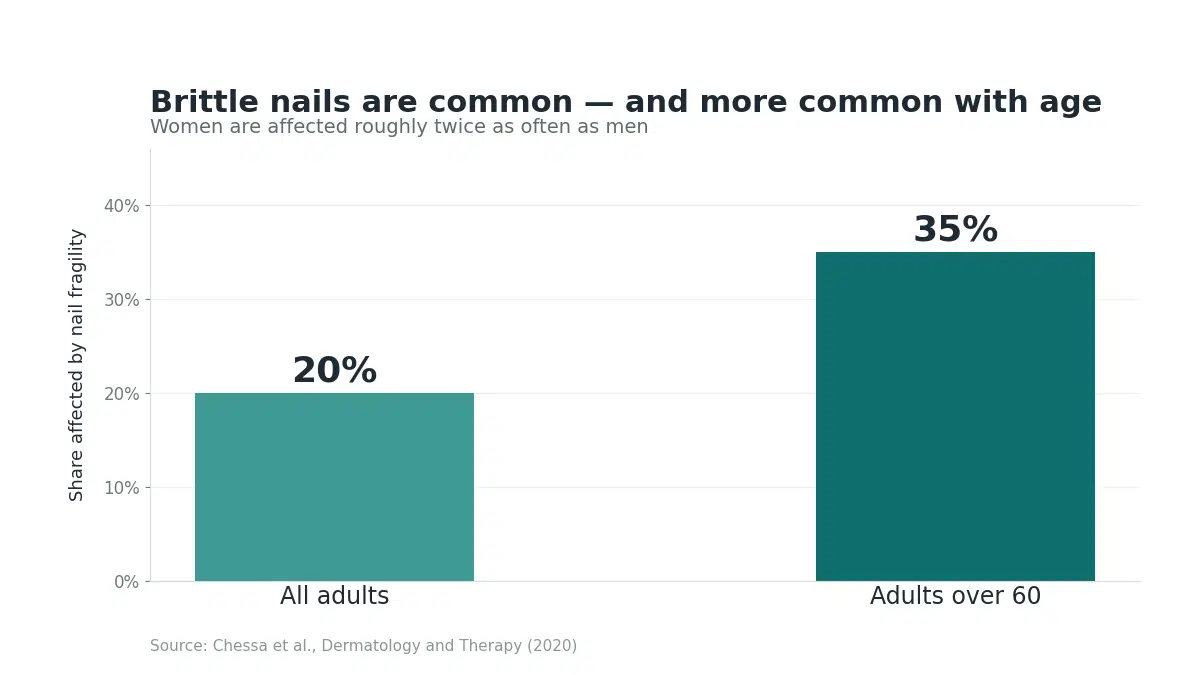
- Water exposure, not vitamin deficiency, is the most common cause — nail fragility affects about 20% of adults, rising to 35% over 60.
- Horizontal splitting at the tip points to water and chemicals; vertical ridges point inward, toward age or a systemic cause.
- Biotin’s evidence rests on three small, old, uncontrolled studies — and it can throw off thyroid and troponin lab results.
- A new dark band on one nail, especially with pigment spreading onto the skin, needs a dermatologist promptly.
What Causes Brittle Nails Most Often? Water, Not Vitamins
A nail plate is made of flattened, dead keratin cells stacked in layers and cemented together. That cement is what fails. Wet the nail and it swells; dry it and it contracts. Do that a few dozen times a day and the layers begin to separate at the free edge.
Which is why the people with the worst brittle nails are usually the ones with their hands in water: nurses, hairdressers, bartenders, cleaners, parents of small children. Add hand sanitizer, hot showers, dish detergent and dry winter air, and the nail never gets a chance to sit at a stable water content.
Acetone polish remover speeds this up — it strips the lipids that slow water loss. Gel and acrylic manicures do it twice over: once from the soak-off, again from the filing that thins the plate before the next set.
Age is the other big driver of brittle nails. Nails grow more slowly as you get older and the plate changes composition. Nail fragility affects roughly 20% of people overall, women about twice as often as men, and the rate climbs to around 35% in people over 60, according to a review in Dermatology and Therapy.
Splitting Across the Tip vs Ridges Down the Nail — Which One Do You Have?
Brittle nails split in two distinct patterns, and which one you have tells you where to look. This is the distinction most articles skip.
If your nail splits horizontally, peeling into thin layers at the tip like a shuffled deck of cards, that’s onychoschizia. It’s a failure of adhesion between layers, and it points outward — at water, chemicals and how you’re treating your hands.
If instead you see vertical ridges running from cuticle to tip, sometimes with a split following one of those grooves, that’s onychorrhexis. That comes from the matrix, the growth zone tucked under the skin at the base of the nail. Ridges point inward — toward age, and occasionally toward something systemic.
Plenty of people have both. But if yours are peeling in layers after a week of hot water, you don’t need a blood test. You need gloves.
When Brittle Nails Are a Sign of Something Systemic
Sometimes brittle nails are reporting on the rest of you. Two causes come up often enough to be worth checking.
Iron. Low iron thins the nail and slows its growth. In severe, long-standing deficiency the plate flattens and the edges curl upward into a shallow spoon shape — koilonychia, which is a genuine prompt to get tested. Milder deficiency just gives you fragility with nothing dramatic to see. The catch is that brittle nails alone can’t diagnose anything; a complete blood count and a ferritin level can. Don’t start iron on a hunch — unnecessary iron causes constipation and stomach upset at best, and real harm in people who over-absorb it.
Thyroid. Both an underactive and an overactive thyroid can leave nails brittle and slow-growing. Nail changes show up in about 5% of hyperthyroidism cases and often reverse once the thyroid is treated. If your nails changed alongside fatigue, weight change, hair thinning or temperature intolerance, that cluster is worth a TSH test rather than another bottle of supplements — and our guide to what an underactive thyroid does and doesn’t explain covers what to expect from treatment.
Skin conditions do it too. Psoriasis, lichen planus and hand eczema all disrupt the nail matrix, and a fungal infection makes nails crumble and thicken rather than simply split — a different problem with a different fix, covered in our guide to over-the-counter toenail fungus treatment.
Does Biotin Actually Work?
Biotin is the default recommendation for brittle nails everywhere you look. Honestly? The evidence behind it is thinner than the marketing.
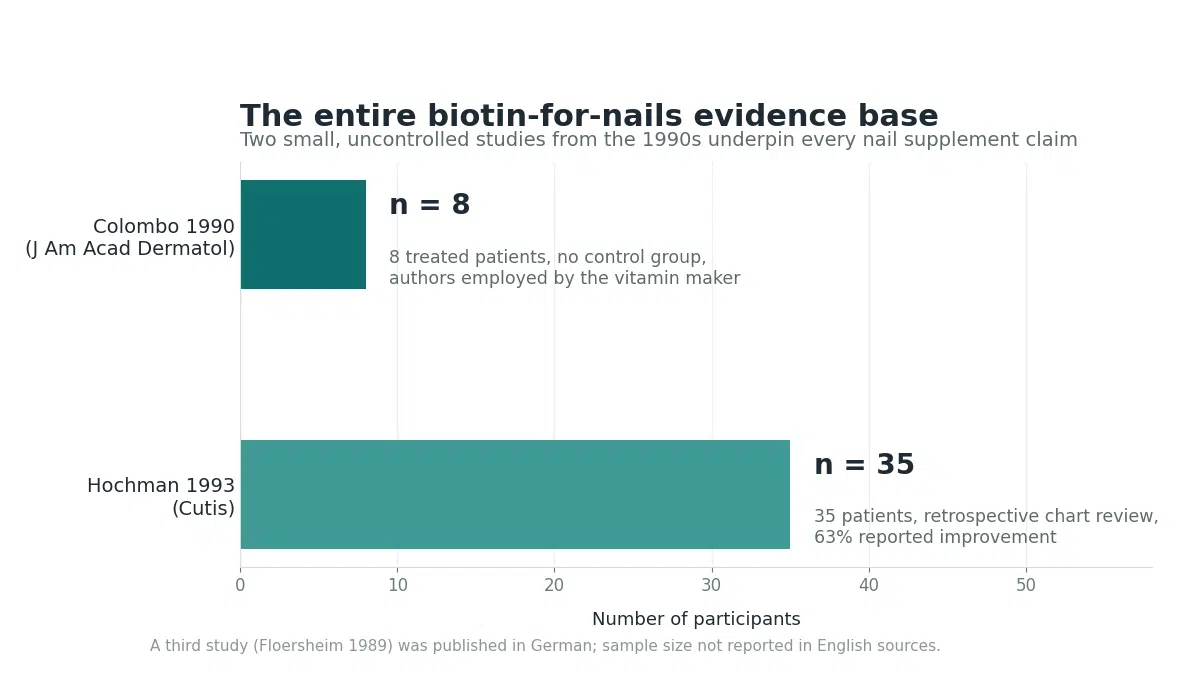
The entire case rests on three small, old studies. A 1990 paper in the Journal of the American Academy of Dermatology used electron microscopy to show thicker, less-split nails after biotin — in eight treated patients, with no proper control group, and with authors employed by the company that made the vitamin. A 1993 retrospective review in Cutis found 63% of 35 patients improved. A German study from 1989 reported something similar.
That’s it. A 2018 review in the Journal of Dermatological Treatment looked at all of it and concluded the trials are few, small and uncontrolled, and that larger controlled studies are needed. Meanwhile genuine biotin deficiency — the state where supplementing obviously helps — is rare in anyone eating a normal diet.
So: biotin is cheap and generally well tolerated, and if you want to try 2.5 mg daily for six months, that’s a reasonable experiment. Just don’t expect it to fix brittle nails caused by dish water, and know what it does to your blood work first.
What Biotin Does to Your Blood Tests
This is the part the supplement aisle doesn’t mention. The U.S. Food and Drug Administration has warned since 2017, with an update in 2019, that biotin interferes with common laboratory tests, producing falsely high or falsely low results depending on the test. The agency is particularly concerned about falsely low troponin — the marker used to diagnose a heart attack — and has received reports of harm, including one death.
Hair, skin and nail supplements can contain up to 650 times the recommended daily intake, which is enough to cause it. Biotin also skews thyroid results — which is a particular problem here, because thyroid disease is on the list of things that cause brittle nails in the first place. Take biotin, get a TSH drawn, and the number may be wrong in a way nobody catches.
None of this means don’t take it. It means tell your doctor and the lab that you’re taking it, and ask whether to pause it before any blood test.
What Genuinely Helps at Home
Most brittle nails improve without buying anything. The interventions with the best return are unglamorous and free.
- Wear gloves for wet work. Dishes, cleaning, bathing kids. Cotton liners under rubber gloves if your hands sweat.
- Cut the acetone. Stretch the gap between manicures and skip the soak-off where you can.
- Moisturize while the nail is damp, straight after washing. Look for urea, lactic acid or plain petrolatum, and work it into the cuticle and nail fold, not just the skin.
- Keep them short. Less lever arm, fewer catches, less splitting.
- File in one direction with a fine-grit file, and skip metal files and formaldehyde hardeners, which make the plate more rigid and more prone to cracking.
Then wait. A fingernail takes roughly six months to grow out from base to tip, so any change you make today shows up in a nail you won’t see for months. Judge results at six months, not six weeks. The same slow timeline applies to supplements — see our piece on how long collagen supplements take to work for how easily that lag misleads people.
If your nails changed around the same time as your skin and hair, hormones may be part of the picture; menopause and your skin covers what shifts and when.
Nail Changes That Need a Doctor
Almost everything above affects all ten nails at once. That’s reassuring. What isn’t reassuring is one nail behaving differently from the rest.
See a dermatologist promptly for:
- A new or changing dark band running down a single nail. Most pigmented bands are harmless, and they’re common and usually normal in people with darker skin tones. But dermatologists take a closer look when a band is 3 mm or wider, has blurred or uneven borders, contains more than one shade, is changing, or sits on the thumb, index finger or big toe.
- Pigment spreading onto the skin around the nail — the cuticle or nail fold. This is called the Hutchinson sign and it’s one of the findings most associated with melanoma under the nail.
- A nail that lifts away from its bed, bleeds, or develops a lump or sore that won’t heal.
- Spoon-shaped nails, or brittleness alongside fatigue, hair loss or feeling cold — get iron and thyroid checked.
- Pain, swelling, redness or pus around the nail fold.
Melanoma under the nail is rare and the odds are strongly in your favor. It’s also very treatable when caught early — which is the whole reason to get a single odd nail looked at rather than watched.
Frequently Asked Questions
How long do brittle nails take to improve?
Give it three to six months. Brittle nails can’t heal in place — nails grow about a millimeter a week, so the damaged part has to grow all the way out before you see clear nail. Toenails take longer still — up to a year, which is also why toenail fungus remedies need the same patience.
Is biotin worth taking for brittle nails?
It might help modestly, but the studies behind it are small and uncontrolled, and real deficiency is rare. It’s a reasonable add-on after you’ve fixed the water exposure, not a substitute for doing that. Tell your doctor you’re taking it before any blood test.
Can low iron cause brittle nails?
Yes, though rarely on its own. Ask for a complete blood count and a ferritin level rather than guessing, and don’t take iron without a result confirming you need it.
Do gel manicures cause brittle nails?
Not directly. The gel itself isn’t what makes nails brittle — the acetone soak-off and the buffing between sets are. If you’re getting them regularly, build in breaks and ask your technician to skip aggressive filing.
Do nails need to “breathe” between polishes?
No. Nails are dead keratin, fed by the blood supply underneath rather than the air. Polish-free breaks help because you’re not using remover during them.
Are vertical ridges normal as you age?
Usually, yes — fine lengthwise ridges are one of the most common age-related nail changes and don’t signal disease on their own. A single deep groove, or a ridge on one nail only, is worth showing to a doctor.
The Bottom Line
Most brittle nails are a hydration problem wearing a nutrition costume. Before you buy anything, put on gloves for wet work, stop the acetone, moisturize after every wash, and keep your nails short — then give it half a year to grow out. If the fragility comes with fatigue or hair changes, get iron and thyroid checked. And if one nail starts behaving differently from the other nine, especially with a dark band, that’s the one to have looked at.
SOURCESOur Editorial Standards
HealthMagHub is built on primary sources: peer-reviewed research, clinical practice guidelines, and health agencies such as the NIH, CDC, and FDA. Read our editorial standards to see how we research, cite, and update our articles.
- Chessa MA, Iorizzo M, Richert B, et al. Pathogenesis, Clinical Signs and Treatment Recommendations in Brittle Nails: A Review. Dermatology and Therapy, 2020. PMC6994568.
- Lipner SR, Scher RK. Biotin for the treatment of nail disease: what is the evidence? Journal of Dermatological Treatment, 2018;29(4):411-414. PubMed 29057689.
- Colombo VE, Gerber F, Bronhofer M, Floersheim GL. Treatment of brittle fingernails and onychoschizia with biotin: scanning electron microscopy. Journal of the American Academy of Dermatology, 1990;23(6 Pt 1):1127-1132. PubMed 2273113.
- Hochman LG, Scher RK, Meyerson MS. Brittle nails: response to daily biotin supplementation. Cutis, 1993;51(4):303-305. PubMed 8477615.
- U.S. Food and Drug Administration. UPDATE: The FDA Warns that Biotin May Interfere with Lab Tests — FDA Safety Communication. November 5, 2019.
- Subungual Melanoma. StatPearls, National Library of Medicine. NBK482480.