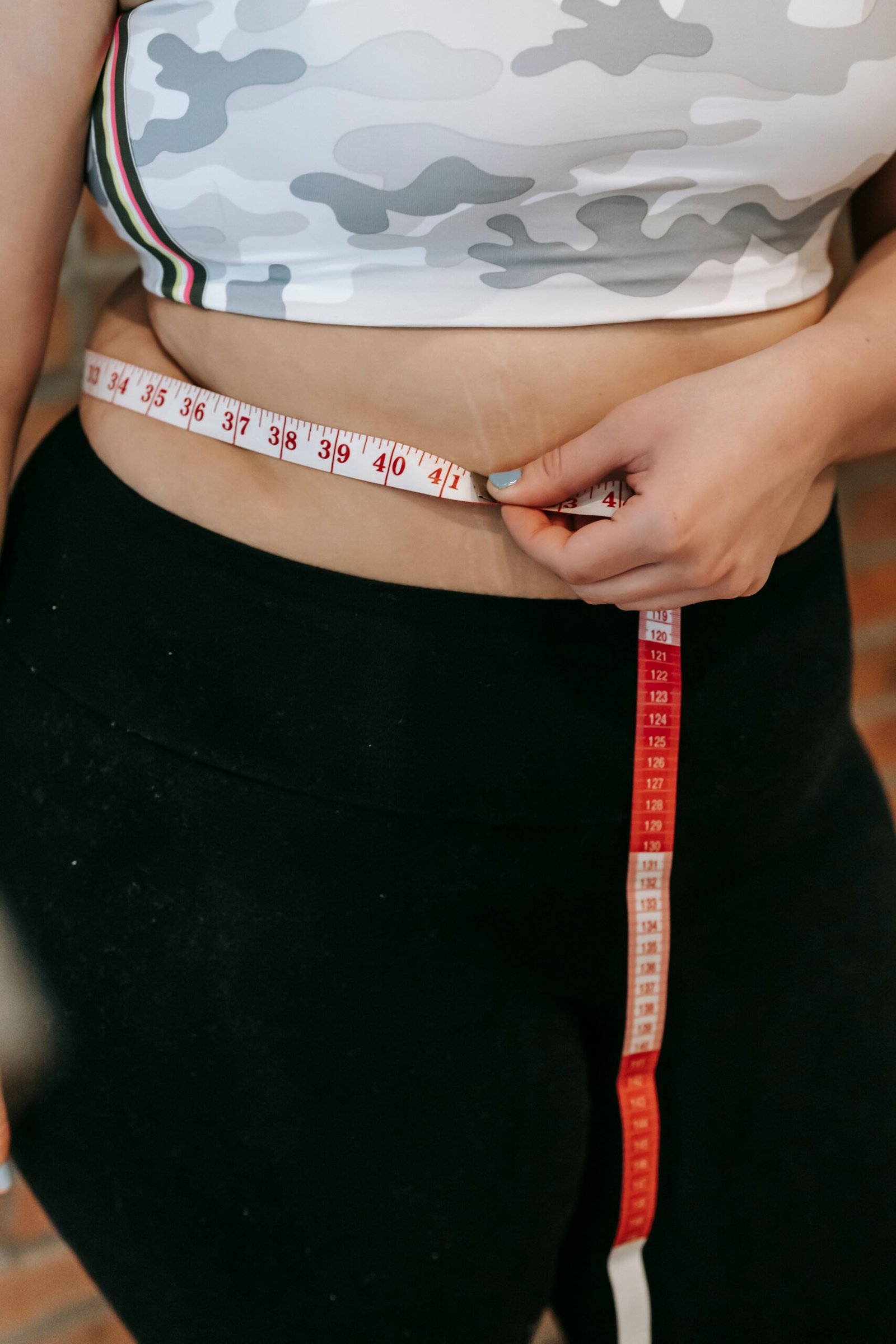
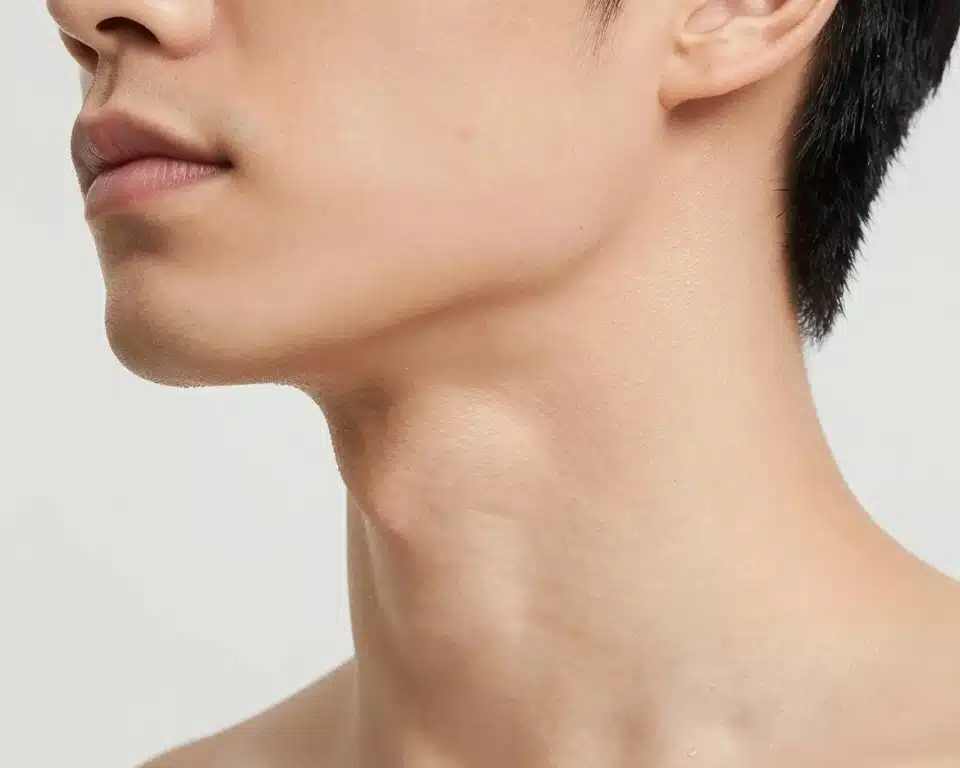
If you’re looking into how to get rid of fat neck, the honest version is short: you can’t target fat in one area, but neck fat does reduce as overall body fat does, and posture and muscle tone change how it looks in the meantime.
Before any of that, though, there’s a measurement worth taking — because neck size is one of the few body measurements that carries real clinical meaning, and most people have never been told why.
- Measure your neck first — above 17 in (men) or 16 in (women) is a recognized sleep apnea risk factor, separate from how it looks.
- Spot reduction isn’t possible — neck fat reduces only as overall body fat does, on a genetically determined schedule.
- Posture is the fastest visible change available, and it’s free.
- Sudden, one-sided, or rapidly growing neck fullness needs a doctor, not a gym plan.
Measure Your Neck Before You Do Anything Else
Take a tape measure around the middle of your neck, just below the Adam’s apple, level all the way round.
Why this number matters
A neck circumference above roughly 17 inches (43 cm) in men or 16 inches (41 cm) in women is a recognized risk factor for obstructive sleep apnea. Fat deposited around the upper airway narrows it, and during sleep, when throat muscles relax, that narrowing can cause repeated pauses in breathing.
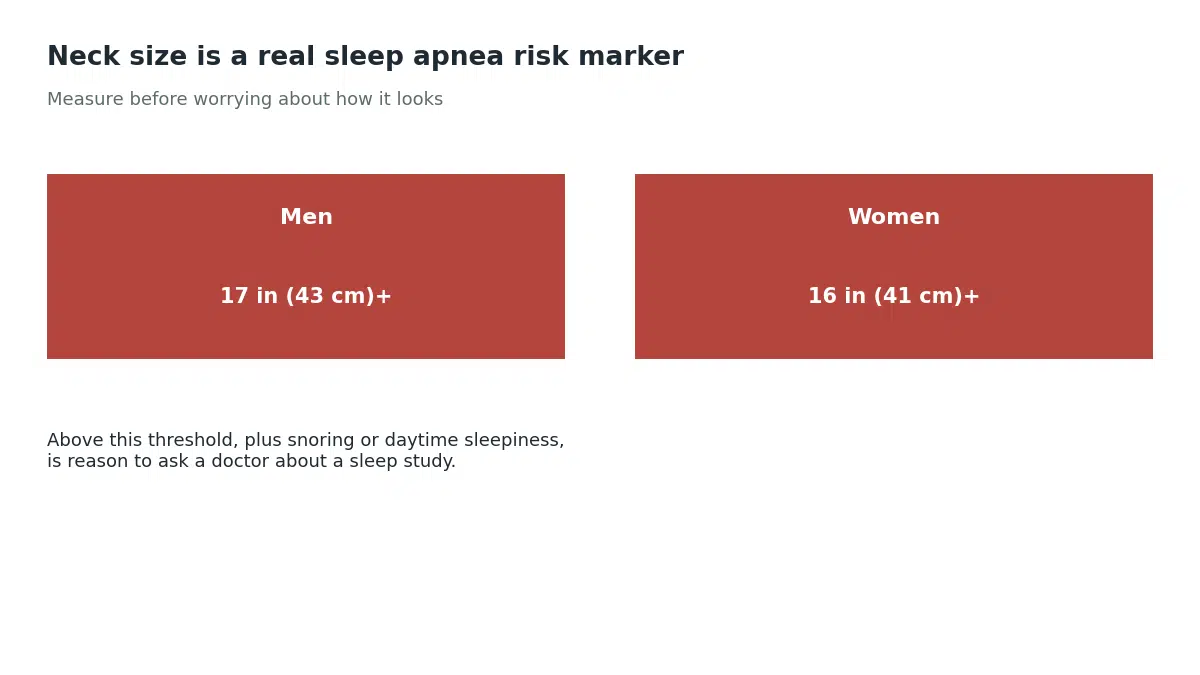
Neck circumference appears in the STOP-BANG screening questionnaire alongside snoring, daytime tiredness, observed pauses in breathing, blood pressure, BMI, age and sex.
If you’re over that threshold and you snore, wake unrefreshed, feel sleepy during the day, or someone has noticed you stop breathing at night, ask your doctor about a sleep study. Untreated sleep apnea raises blood pressure and strains the cardiovascular system — it’s a far more consequential problem than the way a neck looks in photographs.
These thresholds come mainly from North American data and may sit lower in some populations. A neck under the threshold doesn’t rule apnea out either — plenty of people with normal BMI have it.
That’s the reason this page leads with a measurement rather than a mirror. If the aesthetic concern is what brought you here, fine — but rule out the thing that actually affects your health first.
What Causes Neck Fat
Genetics largely determine where your body stores fat. Some people carry it under the chin at any weight, which is why two people of identical build can look quite different in profile.
Overall body fat is the main modifiable factor — gain weight and some lands here.
Age. Skin loses elasticity, the platysma muscle slackens, and fat pads shift. Much of what people read as “neck fat” after 50 is actually skin and muscle laxity, which matters because fat loss won’t fix it.
Posture. Forward head position compresses the space under the chin and makes it look fuller than it is. This one changes instantly.
See a doctor rather than a gym if neck fullness came on quickly. Sudden or one-sided swelling is not fat. Thyroid enlargement, swollen lymph nodes, a lipoma, or the fat redistribution seen in Cushing’s syndrome all present as a changed neck. Get prompt assessment for a lump you can feel, difficulty swallowing, a hoarse voice lasting more than three weeks, or swelling on one side only.
How to Get Rid of Fat Neck: What Actually Reduces It
Spot reduction isn’t a thing. No exercise burns fat from the tissue directly above the working muscle. Chin exercises strengthen the platysma; they don’t remove the layer over it.
What does work is reducing overall body fat, at which point the neck reduces too — on its own genetically determined schedule. For some people the face and neck change early; for others it’s among the last places.
The approach that holds up: a modest calorie deficit rather than an aggressive one, enough protein to preserve muscle while losing fat, mostly whole foods, and a combination of cardiovascular activity and strength training. Nothing here is specific to necks, because nothing about fat loss is.
Around 5–10% of body weight lost is often when facial changes become noticeable, though this varies widely. Rapid loss is worth avoiding here in particular — skin retracts poorly when weight comes off fast, and the loose skin that results is harder to address than the fat was.
If you want a starting point for the training side, our guides to core work and rear delt exercises cover the posture-relevant muscles, and high-protein snacks help with the protein side without much planning. Our guide to a high protein weight loss diet covers the whole approach in more detail.
Posture and Neck Exercises: What They Genuinely Do
Posture is the fastest visible change available. Bring your head back over your shoulders instead of forward, lengthen the back of your neck, drop your shoulders. The area under the chin opens up immediately. Raising screens to eye level and holding your phone higher stops you spending the day in the position that causes the problem.
Chin tucks are the one exercise with a clear rationale: draw your chin straight back, creating a deliberate double chin, hold a few seconds, release. This strengthens the deep neck flexors that hold your head in position, and it’s a standard physical therapy exercise for forward head posture.
A note on the head-tilted-back exercises often recommended for double chins — tongue presses looking at the ceiling, and similar. Prolonged neck extension isn’t advisable for everyone. If you have cervical spine problems, disc disease, arthritis in the neck, dizziness on looking up, or a history of neck injury, skip them and check with a physical therapist. Nothing here is worth aggravating a neck for.
Realistic expectation: these improve tone and posture. They will not remove a fat layer, and articles promising otherwise are selling something.
Skin care is worth extending to the neck — daily sunscreen most of all, since cumulative sun exposure drives much of the crepiness people attribute to fat. Retinoids have reasonable evidence for skin texture. None of it removes fat.
Clinical Options, Honestly Described
These exist and work for the right candidate, which generally means someone near their target weight with a discrete pocket of fat and reasonable skin elasticity — not someone hoping to skip the weight-loss part.
Deoxycholic acid injections (Kybella) are the only FDA-approved injectable for submental fat. Several sessions spaced weeks apart, results building over months, destroyed fat cells don’t return. Swelling and bruising are expected; nerve injury affecting the smile and difficulty swallowing are recognized though uncommon risks.
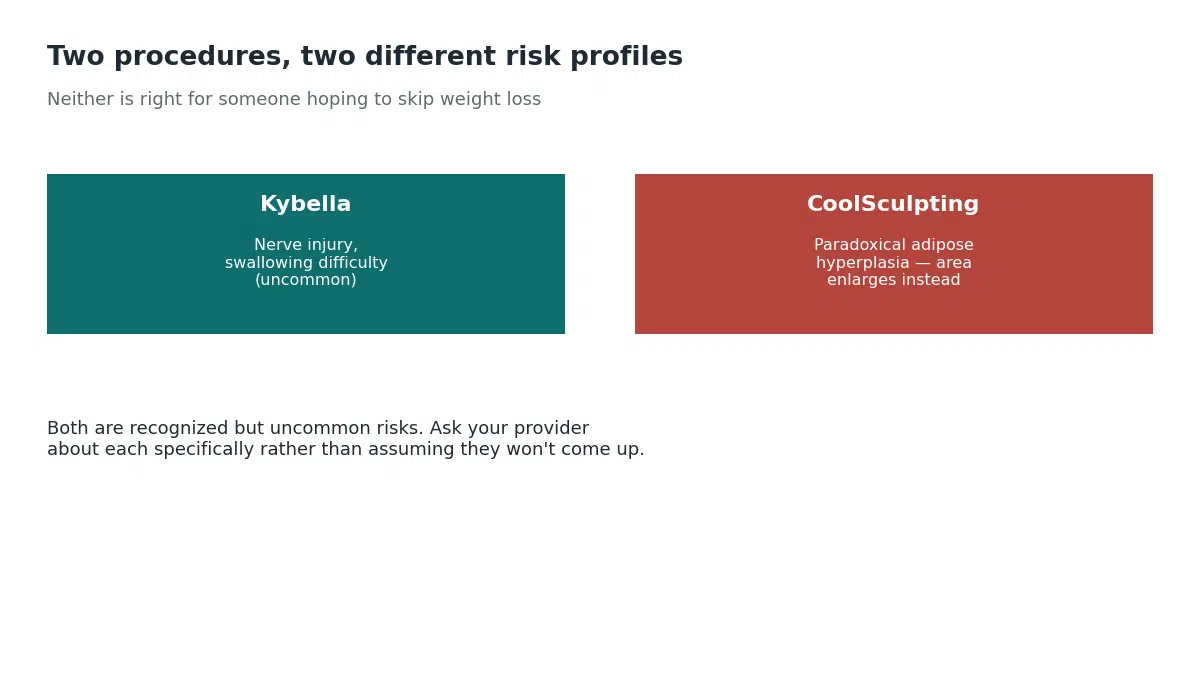
Cryolipolysis (CoolSculpting) freezes fat cells, which the body clears over subsequent months. Worth knowing about: paradoxical adipose hyperplasia, where the treated area enlarges instead of shrinking. It’s uncommon, it doesn’t resolve on its own, and correcting it usually requires liposuction — ask about it specifically rather than assuming it won’t come up.
Liposuction removes fat directly and gives faster, more definitive results, with a compression garment and a few weeks of swelling. It relies on skin contracting afterwards, so it suits younger patients with elastic skin better.
Neck lift addresses loose skin and slack platysma muscle, which is what liposuction alone can’t fix. More recovery, more cost, more durable change.
If you go this route: choose a board-certified dermatologist or plastic surgeon, not whoever is cheapest or running a deal. Ask how many of the specific procedure they’ve done and to see their own before-and-after photos. Insurance doesn’t cover cosmetic work. Costs vary too much by procedure and location to quote meaningfully — get quotes in your area rather than trusting a number in an article.
A Note on Proportion
A fuller neck is a normal variation in human bodies. It correlates with body fat, but plenty of healthy people at healthy weights have one because of how their genes distribute fat and how their jaw is shaped.
Cameras exaggerate it — phone lenses held below eye level distort the jaw considerably, which is why people are often more troubled by photographs than by mirrors.
The health-relevant version of this topic is the sleep apnea question at the top of the page. The aesthetic version is a preference, and it’s a reasonable one to have, but it responds to the same unglamorous inputs as everything else: sustained habits over months, not a technique.
If concern about your appearance is affecting your daily life, mood, or social activity, that’s worth mentioning to a doctor in its own right.
Frequently Asked Questions
How do you get rid of fat neck?
By reducing overall body fat — there’s no way to target one area. A modest calorie deficit, adequate protein, and a mix of cardio and strength training is the whole method.
Posture correction changes how it looks immediately, and neck exercises improve muscle tone, but neither removes fat.
What neck size is a concern for sleep apnea?
Above about 17 inches (43 cm) in men or 16 inches (41 cm) in women is a recognized risk factor, and it’s part of the STOP-BANG screening tool.
If you’re above it and you snore, wake unrefreshed, or feel sleepy during the day, ask about a sleep study. A smaller neck doesn’t rule it out.
Do chin exercises get rid of a double chin?
They strengthen the platysma and deep neck flexors, which improves tone and posture, but they don’t burn the fat above the muscle. Spot reduction isn’t physiologically possible.
Chin tucks are the most worthwhile of them. Skip exercises requiring prolonged head-tilted-back positions if you have any neck problems.
How much weight do I need to lose to see a difference?
Often around 5–10% of body weight, though it varies a lot — some people show facial change early, others late. Genetics decide the order.
Lose it gradually. Rapid loss leaves skin that doesn’t retract, and loose skin is harder to address than the fat was.
When is a fuller neck a medical concern?
When it appears suddenly, affects one side only, or comes with a lump you can feel, difficulty swallowing, or hoarseness lasting more than three weeks. That’s not fat and needs assessment.
Thyroid enlargement, swollen lymph nodes and Cushing’s syndrome all change neck appearance.
Is Kybella or CoolSculpting better?
Both suit someone near their target weight with a discrete fat pocket rather than someone hoping to avoid weight loss. Deoxycholic acid is the only FDA-approved injectable for the area.
With cryolipolysis, ask specifically about paradoxical adipose hyperplasia — the treated area enlarging instead of shrinking. It’s uncommon but doesn’t resolve on its own.
Does posture really make a visible difference?
Yes, and it’s the fastest change available. Forward head position compresses the area under the chin; bringing your head back over your shoulders opens it up instantly.
Raising screens to eye level and holding your phone higher stops you spending all day in the position that causes it.
Do supplements or creams reduce neck fat?
No supplement removes fat from a specific area, and none is approved for it. Products marketed that way are selling the spot-reduction myth.
Sunscreen and retinoids improve skin quality, which affects how the area looks, but they don’t touch the fat underneath.
SOURCESOur Editorial Standards
HealthMagHub is built on primary sources: peer-reviewed research, clinical practice guidelines, and health agencies such as the NIH, CDC, and FDA. Read our editorial standards to see how we research, cite, and update our articles.
- Mayo Clinic. Neck size one risk factor for obstructive sleep apnea. newsnetwork.mayoclinic.org
- Cut-off points of neck and waist circumference as predictors of obstructive sleep apnea. pmc.ncbi.nlm.nih.gov
- U.S. Food and Drug Administration. Kybella (deoxycholic acid) prescribing information. accessdata.fda.gov
- Mayo Clinic. Neck lift. mayoclinic.org
Disclaimer: This article is general information, not medical advice. Speak to a doctor before starting a weight loss program, particularly if you have a chronic condition or take regular medication. Seek medical assessment for neck swelling that appeared suddenly, affects one side only, or comes with a palpable lump, difficulty swallowing or breathing, or hoarseness lasting more than three weeks. If your neck measurement is above the thresholds described above and you snore or feel excessively sleepy during the day, ask your doctor about screening for sleep apnea.