

The rear deltoid is small, it sits behind you where you can’t watch it work, and it gets bullied out of the way by your lats and traps the moment form slips. That combination makes it the muscle people train hardest and feel least.
There’s also one grip detail that’s been tested directly in a lab, and a lot of guides state it backwards. That’s where this starts.
- Most rear delt problems come from too much weight and elbows traveling too close to the body, not the wrong exercise.
- A neutral, thumbs-up grip beats the commonly recommended palms-down grip for posterior deltoid activation, tested directly.
- Two sessions a week, two exercises, three sets each, 10-20 reps covers most of what’s needed — progress is slow and mirror-based judging is unreliable.
- Deep night pain plus shrinking range of motion is frozen shoulder, not a training plateau — stretching through it makes things worse.
What Back Delt Exercises Are Actually Training
The deltoid has three heads. The rear one runs from the shelf of bone across the top of your shoulder blade to the outside of your upper arm.
Because of that line of pull, it does two jobs: it drags your upper arm backward when the arm is out in front of you, and it rotates the arm outward. Every genuinely useful rear delt movement is some version of one or both.
That’s also why it gets skipped. Pressing, front raises and most daily movement work the front of the shoulder. The back of it only gets loaded when you deliberately send your elbow out and back — which almost nothing in ordinary life asks you to do.
The Back Delt Exercises With Research Behind Them
You don’t need nine movements. You need two or three you can feel, done properly.
Reverse pec deck
If you have the machine, start here.
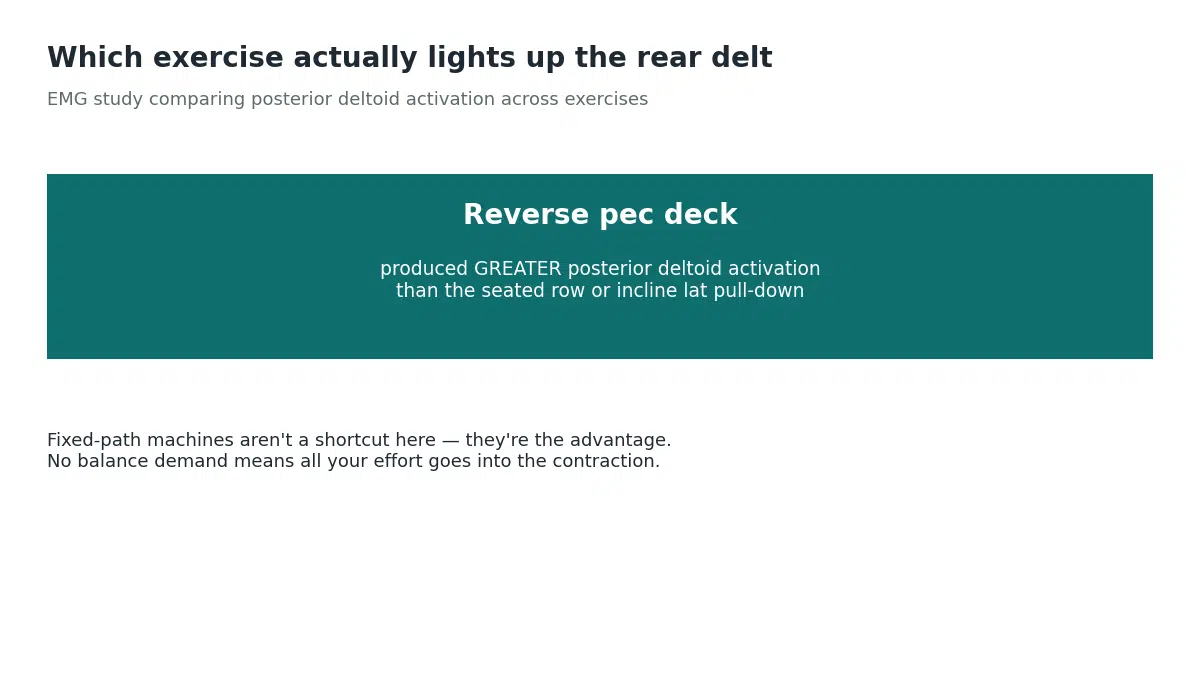
In a study comparing shoulder exercises using surface EMG, the reverse pec deck produced greater posterior deltoid activation than either the seated row or the incline lat pull-down.
The fixed path is the advantage, not a limitation. You’re not spending attention on balance, so you can spend it on the contraction.
Face pulls
A rope on a cable at roughly face height. Pull toward your forehead, elbows high and wide, and let the rope ends separate as your hands finish beside your ears.
Face pulls combine the backward pull with the outward rotation, which is why they show up in shoulder rehab programs as often as in bodybuilding ones.
Bent-over dumbbell reverse fly
Hinge until your torso is close to parallel with the floor, let the dumbbells hang, then raise them out to the sides with a soft elbow.
The honest warning: this is the movement people cheat most. If your torso is rising with the weight, the dumbbells are too heavy. Nobody has ever needed heavy dumbbells here.
Band pull-aparts
The cheapest option and the easiest to do often. Arms out in front at shoulder height, pull the band apart by driving the elbows back.
These work well as a warm-up before pressing, and they’re the one item on this list you can keep in a drawer at home.
Wide-grip row to the upper chest
A standard row with the elbows tucked trains your back. Widen the grip, pull toward the upper chest rather than the belly, and keep the elbows higher than the hands, and a lot more of the work shifts rearward.
Expect to use noticeably less weight than your usual row. That’s the point, not a problem.
The Grip Detail Most Guides Get Backwards
Plenty of articles tell you to point your thumbs down, palms facing the floor, on rear delt raises and machine flyes.
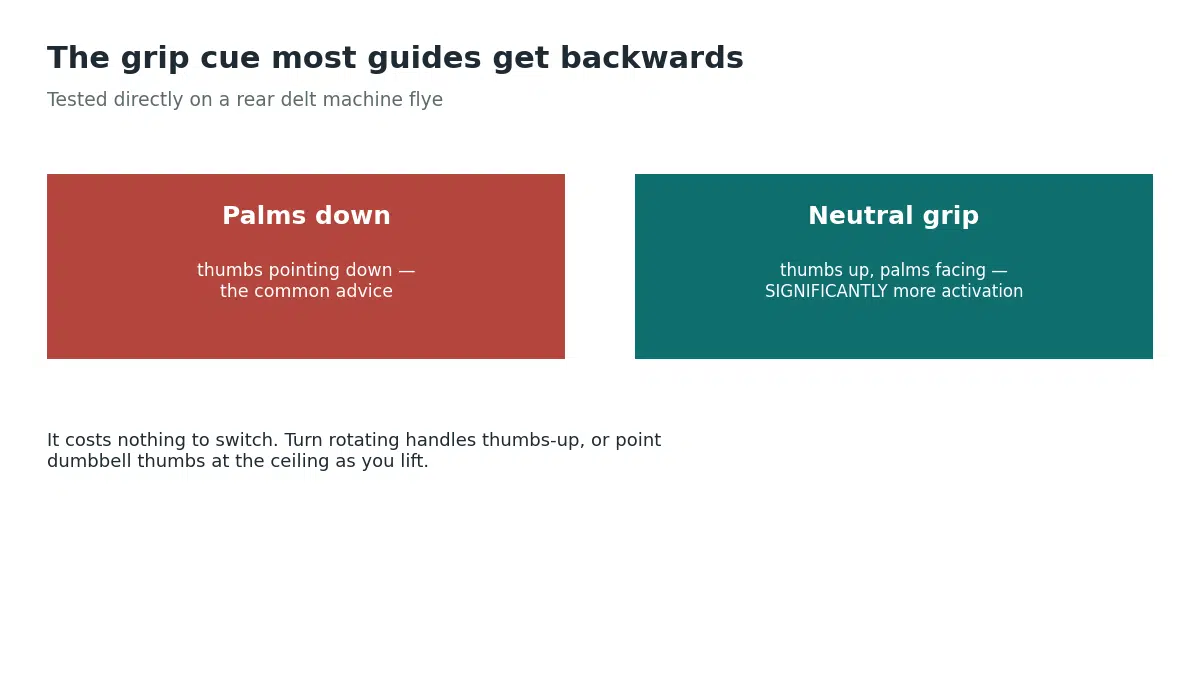
Tested directly, the opposite came out ahead. Research on hand position during a machine rear delt flye found posterior deltoid activation was significantly greater with a neutral grip — palms facing each other, thumbs up — than with a pronated, palms-down grip.
It costs nothing to switch. If your machine has rotating handles, turn them. If you’re holding dumbbells, point your thumbs at the ceiling as you lift.
The related cue that helps most people: think about where your elbows are going, not your hands. Elbows out and back in a wide arc. Hands just come along.
How to Program Back Delt Exercises Without Overthinking It
Two sessions a week, two exercises, three sets each, ten to twenty reps. That’s genuinely most of it.
Rear delts are small and recover quickly, so spreading the work across two or three sessions beats hammering them once. Mayo Clinic’s strength training guidance suggests roughly 48 hours between sessions for the same muscle group, which fits a twice-weekly pattern comfortably.
A few things that matter more than the exact numbers:
- Lower the weight slowly. Two to three seconds down, every rep
- Pause for a beat at the squeezed position rather than bouncing straight back
- Hold the handles firmly enough to be safe and no tighter — a death grip pulls your attention into your forearms
- Put one rear delt movement at the start of a back session occasionally, while you’re fresh and can actually feel it
Progress is slow here in absolute terms. A small muscle adding size takes months, not weeks. Judging by whether the weight on the stack has moved is more reliable than judging by the mirror. The same patience applies to core training, where visible change also lags well behind strength change.
Recovery does the building, and protein is the part people skimp on. Spreading intake across the day is easier than forcing it into one meal — our guide to high-protein snacks covers practical amounts.
Will Rear Delt Work Fix Rounded Shoulders?
This is the claim that sells rear delt training, and it deserves a more honest answer than it usually gets.
A 2024 systematic review and meta-analysis of therapeutic exercise for forward head and rounded shoulder posture found that exercise improved forward head posture — but the evidence for changing rounded shoulder posture specifically was much weaker.
So: training your rear delts is worth doing. Expecting it to reshape how you stand is expecting more than the research currently supports.
Worth adding that posture and pain are not the same conversation. Plenty of people with rounded shoulders have no shoulder pain at all, and plenty with textbook alignment do. Train the muscle because it’s undertrained, not because you’ve been told your posture is broken.
When to Stop and Get the Shoulder Looked At
Burning muscle is fine. These are not: sharp or catching pain at a specific point in the range, rather than a general ache; pain that wakes you at night or won’t settle when you’re resting; weakness lifting your arm to the side or rotating it outward, which can point to a rotator cuff problem rather than a training issue; clicking or clunking that comes with pain; numbness, pins and needles, or pain traveling down the arm; or shoulder pain after a fall or a wrench, especially if you can’t lift the arm normally afterwards.
Stop the movement, don’t try to train around it, and get it assessed. Shoulder problems handled early are far easier to sort out than ones trained through for six months.
One pattern deserves naming, because training through it makes it worse. If the shoulder aches deeply at night and your range of motion is shrinking — to the point where the arm won’t go even when someone else lifts it for you — that’s the signature of frozen shoulder, not a training plateau. Aggressive stretching during its early painful phase is the most common self-treatment mistake there.
If your joints ache broadly rather than in one shoulder, that’s a different question — our guide to joint pain during movement covers when an ache is mechanical and when it needs looking at.
Frequently Asked Questions
Why can’t I feel my rear delts working?
Switching to a neutral, thumbs-up grip helps too — that’s the position that tested better for posterior deltoid activation.
My shoulder is stiff as well as sore. Should I keep training it?
That second pattern, especially alongside night pain, points toward frozen shoulder — where forcing range in the early phase sets you back rather than forward.
How often should I train them?
Around six to fifteen working sets across the week is a sensible range, starting at the lower end.
What rep range works best?
If you’re swinging to finish a set, the weight has already made the decision for you.
Can I train rear delts at home without a gym?
Dumbbells add bent-over reverse flyes. You’ll want light ones, which makes this cheap.
Do rows already cover it?
Even then, a direct movement like a reverse pec deck or face pull gives the rear delt more focused work than any row does.
Should my rear delts be sore afterwards?
Sharp pain is a different signal entirely — see the section above rather than pushing on.
SOURCESOur Editorial Standards
HealthMagHub is built on primary sources: peer-reviewed research, clinical practice guidelines, and health agencies such as the NIH, CDC, and FDA. Read our editorial standards to see how we research, cite, and update our articles.
- Botton CE, et al. Analysis of anterior, middle and posterior deltoid activation during single and multijoint exercises. pubmed.ncbi.nlm.nih.gov
- Sepehri S, et al. The effect of various therapeutic exercises on forward head posture, rounded shoulder, and hyperkyphosis among people with upper crossed syndrome: a systematic review and meta-analysis. BMC Musculoskeletal Disorders, 2024. pubmed.ncbi.nlm.nih.gov
- Mayo Clinic. Strength training: get stronger, leaner, healthier. mayoclinic.org
Disclaimer: This article is general information, not medical advice. Exercise responses vary with training history, injury history and individual shoulder mechanics. Speak to a doctor or physical therapist before starting resistance training if you have an existing shoulder injury, a rotator cuff problem, or any condition affecting your joints. Stop and seek assessment for sharp or catching shoulder pain, pain that disturbs your sleep, weakness lifting or rotating the arm, numbness or pain traveling down the arm, or any shoulder pain following a fall.