

Most articles about natural ways to boost metabolism after age 50 start from a premise that turns out to be wrong. You’ve been told your metabolism slows to a crawl in midlife and that’s why the weight creeps on. It’s a tidy story, and it isn’t what the evidence shows. The real picture is more useful, because it points at things you can actually change.
- The largest study of human energy expenditure found metabolic rate stays flat from age 20 to 60, only declining after that.
- What actually changes in your fifties is lost muscle and less daily movement — both are things you can act on.
- Resistance training two to three times a week is the single most effective lever, supported by adequate protein.
- Green tea extract supplements carry a real liver-injury risk at high doses — the brewed drink does not.
What Actually Changes After 50 — and What Doesn’t
In 2021, a team led by Herman Pontzer published the largest analysis of human energy use ever assembled: 6,421 people from 29 countries, aged eight days to 95, measured with doubly labeled water, the gold-standard method.
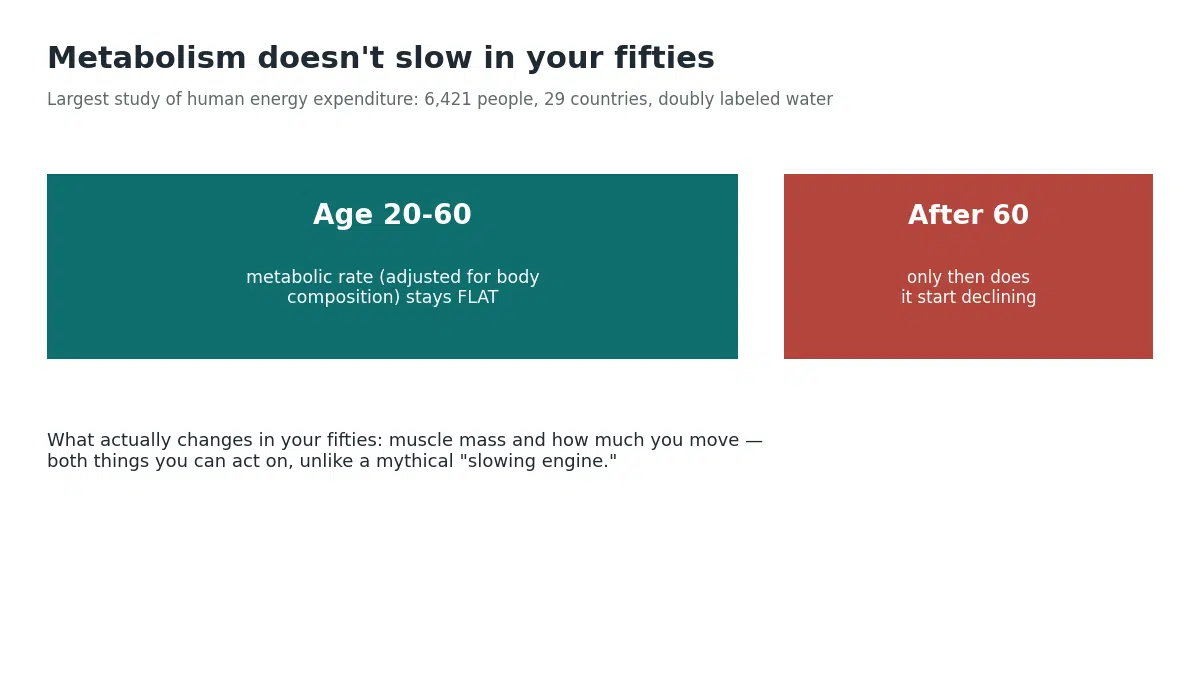
The findings surprised almost everyone. Energy expenditure adjusted for fat-free mass peaks around age one, settles to adult levels by about 20, then stays stable right through to 60 — and only declines after that. Your twenties, thirties, forties and fifties are the most metabolically stable decades of your life.
So why does the weight creep on?
Two things, mostly, and neither is a broken metabolism.
The first is muscle loss. From roughly your forties onward you gradually lose lean tissue — a process called sarcopenia. Muscle burns more energy at rest than fat does, so less muscle means a lower total daily burn. Your cells haven’t become less efficient. There are simply fewer of the metabolically expensive ones.
The second is movement. People generally move less in their fifties than in their thirties, often without noticing. Desk jobs get more sedentary, knees complain, weekends get quieter.
Both of those are addressable. A slowing engine wouldn’t be. That’s why this distinction matters rather than being a technicality.
The Natural Ways to Boost Metabolism After Age 50 That Actually Work
Since the real change is lost muscle and lost movement, the interventions that work are the ones that address those directly. Everything else is a rounding error.
Resistance training comes first
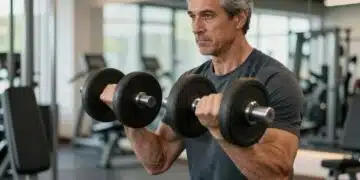
Nothing else on this list comes close. Lifting something heavy two or three times a week is the only reliable way to hold onto — or rebuild — the tissue that sets your resting burn.
You don’t need a gym. Bodyweight squats, wall push-ups, glute bridges and resistance bands all work, and they work in a living room. What matters is that the effort gradually increases: a heavier band, more repetitions, a deeper squat. Muscle responds to being asked for more.
If you have joint problems, a heart condition, or you’ve been inactive for years, get a green light from your doctor before starting — then start easier than you think you need to.
Protein supports the training
Lifting without enough protein is half a plan. Older adults appear to need somewhat more protein than younger ones to trigger the same muscle-building response, and expert consensus for adults over 65 generally lands in the range of 1.0 to 1.2 grams per kilogram of body weight a day — higher than the 0.8 g/kg general adult figure.
A practical shortcut: most people load nearly all their protein into dinner and get almost none at breakfast. Spreading it evenly across meals is usually a bigger win than the total. If you have kidney disease this doesn’t apply to you — reduced kidney function often means limiting protein, not increasing it.
If mornings are rushed, a high protein meal replacement shake is one convenient option, though real food does the job just as well.
Movement Outside the Gym Counts More Than You’d Think
The energy you burn on everything that isn’t formal exercise — walking to the shop, cooking, gardening, fidgeting — has a name: non-exercise activity thermogenesis, or NEAT. For most people it dwarfs the calories burned in their actual workouts, simply because it happens all day.
This is where small changes genuinely add up:
- A short walk after meals, which also helps blood sugar
- Standing for phone calls instead of sitting
- Parking further away, or getting off a stop early
- Doing your own housework and garden rather than outsourcing all of it
None of it feels like exercise. That’s rather the point — it’s sustainable in a way that a punishing gym schedule usually isn’t.
Sleep and Stress Are Not Optional Extras
Short sleep shifts appetite hormones: ghrelin, which tells you to eat, goes up, and leptin, which tells you you’ve had enough, goes down. The result is more hunger and stronger cravings for quick carbohydrates, on a day when you’re too tired to move much.
Chronic stress works similarly through cortisol, which encourages both fat storage and muscle breakdown — the exact opposite of what you’re trying to achieve.
Hormones do shift in midlife, and for men that overlaps with a separate set of questions we cover in the early signs of low testosterone in men over 50. Worth reading if fatigue and muscle loss have arrived together with a drop in sex drive.
You don’t need an elaborate routine. A consistent bed and wake time, a dark cool room, and screens out of the last hour beat any sleep gadget. And if you snore heavily or your partner has noticed you stop breathing at night, get assessed for sleep apnea — common, treatable, and it wrecks everything else on this list.
What About Supplements?
Short answer: they’re a distraction, and one of the popular ones carries real risk.
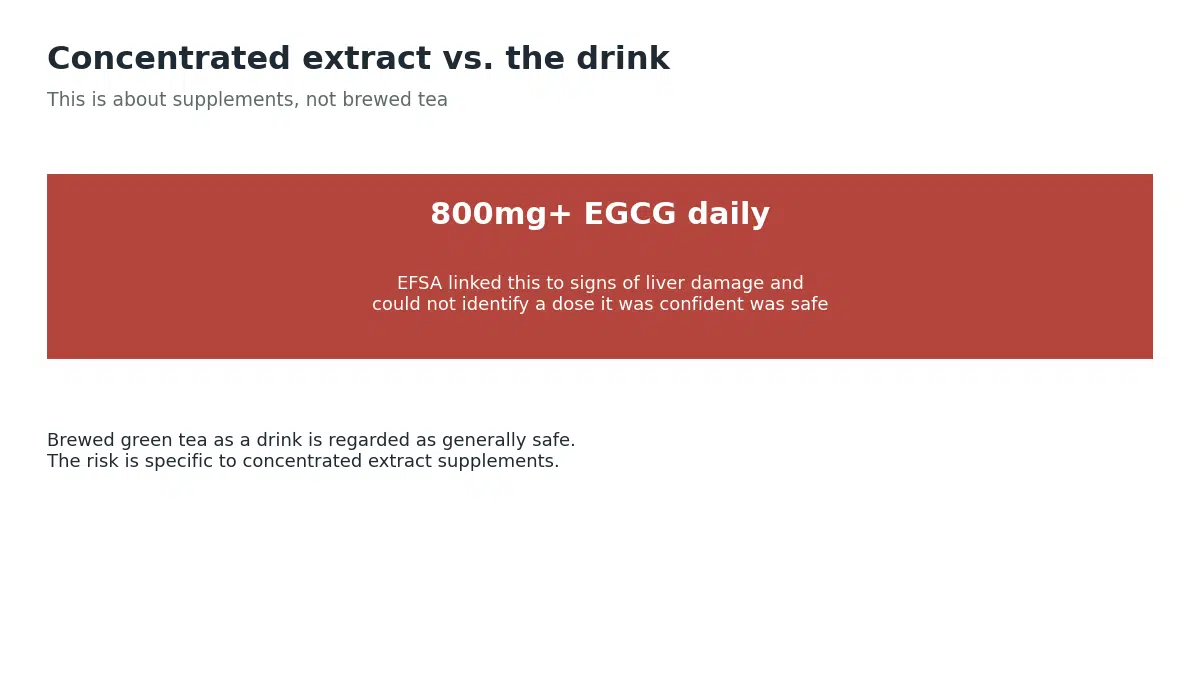
Green tea extract is heavily marketed for metabolism and weight loss, and it has a genuine safety problem. The European Food Safety Authority concluded in 2018 that supplements delivering 800 mg or more of EGCG a day are associated with signs of liver damage, and it could not identify a dose it was confident was safe. Health Canada and the US Pharmacopeia have both required cautionary labeling. Case reports include acute hepatitis and, rarely, liver failure.
Importantly, this is about concentrated extracts, not the drink. Brewed green tea is regarded as generally safe. If you like slimming teas, it’s worth reading what’s actually in them before making them a daily habit.
Vitamin D and the B vitamins are a different case — they matter if you’re deficient, and deficiency is common over 50. But correcting a deficiency isn’t the same as boosting anything. Test first, then supplement if the results call for it, and tell your doctor about everything you’re taking.
When a Slow Metabolism Is Actually a Medical Problem
Sometimes “my metabolism has slowed” is a real medical finding rather than a figure of speech. An underactive thyroid genuinely lowers metabolic rate, and it’s diagnosed with a simple blood test.
Book an appointment rather than buying a supplement if you notice:
- Fatigue, weight gain, constipation, dry skin, hair thinning or feeling cold when others don’t — the thyroid cluster
- Weight loss you didn’t intend. Unexplained weight loss over 50 needs investigating, not celebrating
- Excessive thirst and needing the toilet at night, which can signal diabetes
- Fatigue with breathlessness or unusual paleness, which can point to anemia
- Low mood, lost interest and disturbed sleep alongside the fatigue — depression produces this whole picture
A single blood panel can rule most of this in or out. That’s a far better use of a few weeks than another round of supplements.
Knowing Whether Natural Ways to Boost Metabolism After Age 50 Are Working
The scale is a poor instrument here. If you’re building muscle while losing fat, it can barely move for weeks while your body composition improves substantially.
Better signals: are you lifting or carrying more than you could two months ago? Do you get through the afternoon without flagging? Do stairs feel different? Does your sleep hold up? Strength and stamina are the things you’re actually trying to protect, and they’re the things that predict how the next twenty years go.
If you take one thing from all of this: you can’t do much to speed up your metabolism, but you can build and keep the muscle that sets it. Start with two sessions a week and a decent breakfast.
FAQ
Does metabolism really slow down after 50?
Not in the way most people think. The largest study of human energy expenditure found that metabolic rate adjusted for body composition holds steady from age 20 to 60 and only falls after 60. What changes in your fifties is how much muscle you carry and how much you move.
What are the most effective natural ways to boost metabolism after age 50?
Resistance training two or three times a week, enough protein spread across the day, and more everyday movement. Those three address the actual causes. Sleep and stress management support them. Everything else is minor by comparison.
How much protein do I need over 50?
Expert consensus for older adults generally suggests somewhat more than the 0.8 grams per kilogram figure used for adults in general — commonly cited in the range of 1.0 to 1.2 g/kg. Spreading it across meals matters as much as the total. If you have kidney disease, ask your doctor before increasing protein.
Is green tea extract safe for weight loss?
Concentrated extracts carry a real liver risk. EFSA linked supplements providing 800 mg or more of EGCG daily to signs of liver damage and could not identify a dose it considered safe. Brewed green tea as a drink is a different matter and is regarded as generally safe.
Can drinking cold water speed up my metabolism?
Barely. Your body does use a little energy warming ingested water, but the effect is very small and won’t drive weight change on its own. Staying hydrated is worth doing for other reasons — just don’t count on it as a metabolic strategy.
Is intermittent fasting a good idea after 50?
It can help some people eat less overall, but it does nothing special to your metabolic rate, and skipping meals makes hitting your protein target harder — which works against preserving muscle. If you try it, keep the window generous and prioritize protein within it.
When should I see a doctor about a slow metabolism?
If fatigue and weight change come with feeling cold, dry skin, constipation or hair thinning, ask about a thyroid test. Unintentional weight loss over 50 always warrants a check. Persistent fatigue with low mood may be depression rather than metabolism.
SOURCESOur Editorial Standards
HealthMagHub is built on primary sources: peer-reviewed research, clinical practice guidelines, and health agencies such as the NIH, CDC, and FDA. Read our editorial standards to see how we research, cite, and update our articles.