

Ringing in ears and high blood pressure do turn up together more often than chance would predict. What almost every article on the subject skips is that this doesn’t mean one caused the other, and that for some people the pills treating the blood pressure are the more likely suspect.
There’s also a version of ringing in ears that changes the conversation entirely: a sound that keeps time with your heartbeat. That one isn’t a nuisance to manage. It’s a reason to get scanned.
- Hypertension raises the odds of tinnitus by about 37% in pooled data. That’s a real but modest association, not proof of cause and effect.
- ACE inhibitors, thiazide diuretics, potassium-sparing diuretics, and calcium channel blockers all appear more often in people with tinnitus, which is worth raising with your prescriber rather than stopping on your own.
- Tinnitus that beats in time with your heartbeat (pulsatile tinnitus) is an imaging indication rather than something to monitor, and a cause is found in 70-80% of cases.
- Ordinary steady tinnitus in both ears, with no other symptoms, does not need routine scanning.
Does High Blood Pressure Cause Ringing in Ears? What the Numbers Show
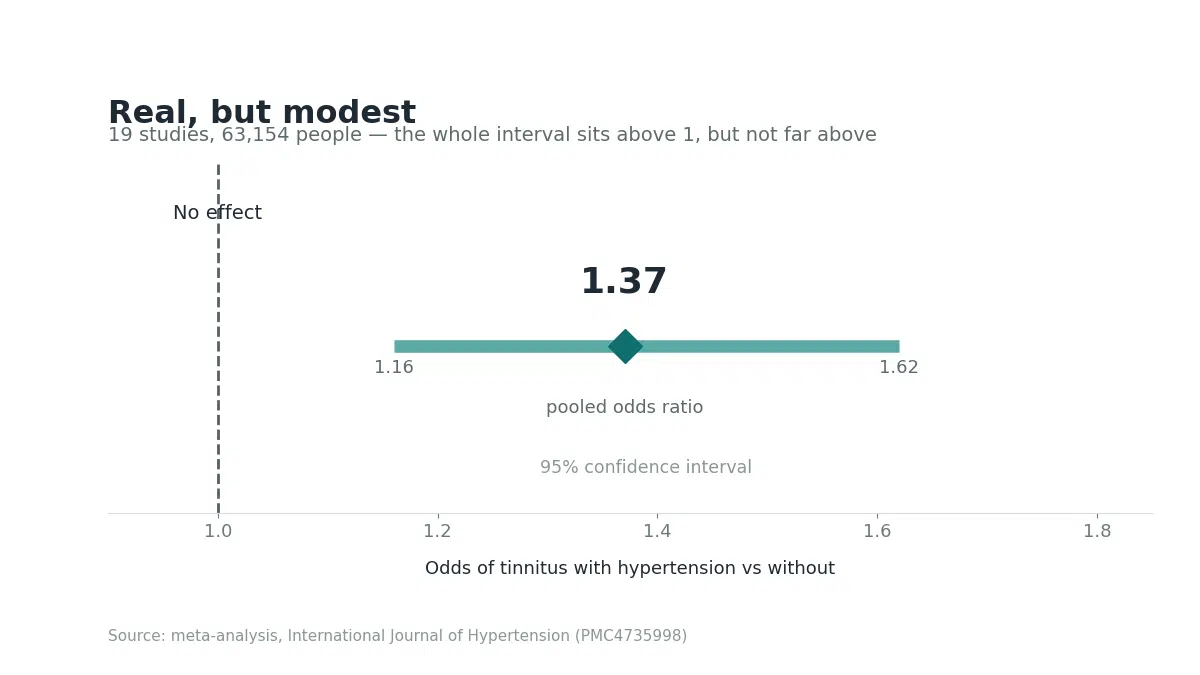
The best available answer comes from a meta-analysis pooling 19 studies and 63,154 people. It found that having hypertension raised the odds of reporting tinnitus by a factor of 1.37, with a confidence interval running from 1.16 to 1.62.[1]
Read that honestly and it’s a real signal, not a dramatic one. It sits well clear of no effect, so the connection isn’t imaginary. But 1.37 is a long way from the “high blood pressure causes ringing in ears” framing you’ll find on most pages covering this.
A systematic review in European Archives of Oto-Rhino-Laryngology found something more revealing.[2] Studies that counted how many tinnitus patients had hypertension generally found a link. Studies that went the other way, counting how many hypertensive patients developed tinnitus, generally didn’t. Its authors concluded that an association exists but cause and effect remain uncertain.
That asymmetry is the tell. If high pressure were driving the sound, you’d expect it to show up from both directions. Instead the pattern looks like two conditions that share territory: both get commoner with age, both track with vascular health, and roughly a quarter of adults report ringing in ears at some point regardless.
When Your Medication Is Causing the Ringing in Ears
This is where it gets uncomfortable for the simple story.
Researchers comparing 144 people with tinnitus against 140 without found hypertension in 44.4% of the tinnitus group versus 31.4% of the controls, which is the association again. But they also broke it down by which drug people were taking, and several classes stood out: ACE inhibitors, thiazide diuretics, potassium-sparing diuretics, and calcium channel blockers were all significantly more common among those with tinnitus.[3]
Their own reading was cautious and worth repeating: this raises the possibility that ototoxicity from the medications is part of the picture, a hypothesis needing proper testing rather than a settled finding.
Two other drugs belong in any honest version of this list. High-dose aspirin produces ringing in ears reliably enough that it was historically used to gauge when someone had taken too much, and it usually reverses when the dose comes down. Loop diuretics such as furosemide, prescribed for blood pressure and heart failure, are also recognized as ototoxic, particularly at high doses.
None of this is a reason to skip a dose. Untreated hypertension carries risks that dwarf an annoying noise. It’s a reason to raise the timing with your prescriber. If the ringing in ears began within weeks of a new prescription or a dose increase, say that out loud, because alternatives exist within every one of those drug classes.
The Sound That Changes Everything: When It Beats With Your Pulse
Stop and listen to the quality of the noise, because this distinction matters more than anything else on this page.
Most ringing in ears is a steady tone, hiss or buzz. It doesn’t have a rhythm. Pulsatile tinnitus is different: a whooshing or thumping that keeps time with your heartbeat, and it usually means you’re hearing turbulent blood flow somewhere near the ear rather than a fault in the hearing system.
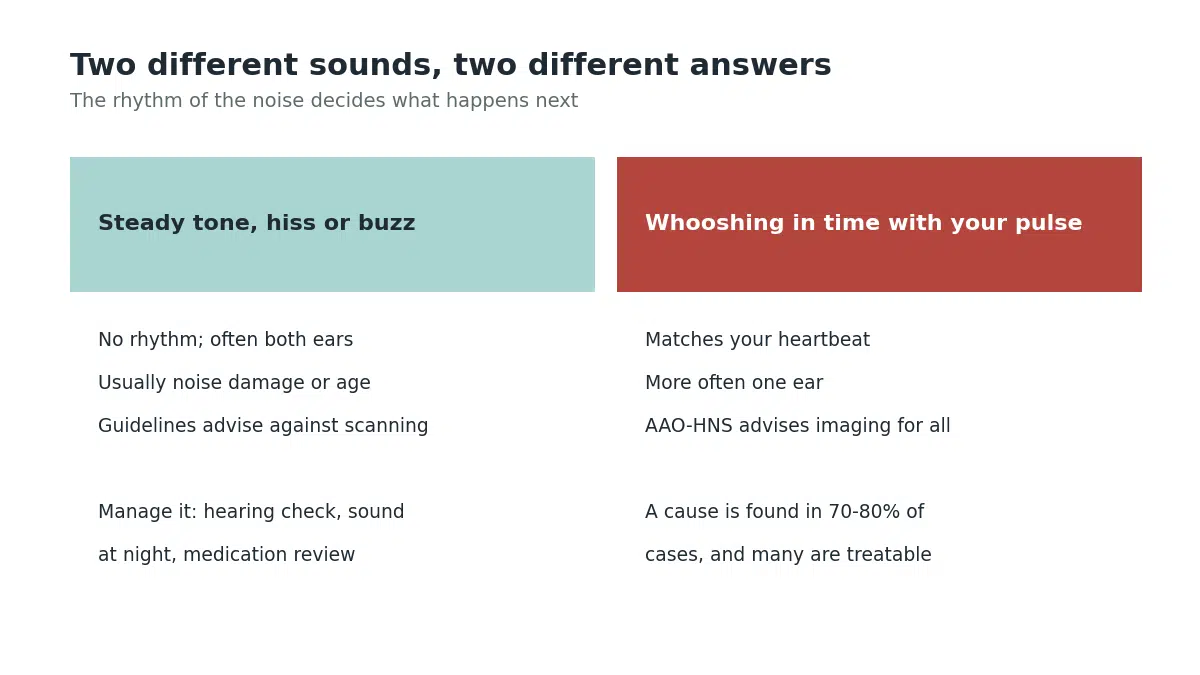
The American Academy of Otolaryngology–Head and Neck Surgery treats this as an imaging indication rather than something to monitor. The reason is the list of things it can represent: a dural arteriovenous fistula, a narrowed or dissected artery, a tumor near the middle ear, or raised pressure inside the skull. Several of those end in stroke or vision loss if nobody looks.
The encouraging part is that looking usually works. A cause is identified in 70 to 80% of cases, and many of those causes are treatable once named.[4] CT angiography of the head and neck finds an answer roughly 86% of the time and is a common first choice.[5]
One detail worth carrying into the appointment: if pressing gently on the side of your neck changes or stops the sound, mention it. That points toward a vein rather than an artery and genuinely alters what gets investigated first.
What Actually Helps
For ordinary, non-pulsatile ringing in ears, expectations should be set carefully. Nothing reliably switches it off, and anyone promising otherwise is selling.
- Get your blood pressure measured properly if you haven’t recently. Not because lowering it will silence the noise, but because it’s worth knowing either way, and one study found undiagnosed hypertension was several times more common in people with tinnitus.[3]
- Protect what hearing you have. Noise damage is the biggest driver of tinnitus overall, and it’s the one thing on this list you can genuinely prevent.
- Review the medicine cabinet with your doctor or pharmacist, including anything you buy yourself.
- Treat the hearing loss if there is any. Hearing aids often reduce how intrusive the ringing in ears feels by restoring the input the brain was missing.
- Sound enrichment at night: a fan, an app, a radio kept low. It doesn’t fix anything, but silence makes ringing in ears louder, and sleep is where most of the suffering lands.
Supplements are the obvious place people start and the least likely to help. Cochrane found ginkgo no better than placebo, which our review of the tinnitus supplement evidence covers in detail.
If the sound sits behind a blocked-up feeling, that’s worth ruling out first, since a blocked ear has a much simpler fix. And if speech has been getting harder to follow in noisy rooms, ringing in ears commonly travels alongside high frequency hearing loss rather than existing on its own.
When to See a Doctor
Guidelines are unusually specific here. Four features move tinnitus from routine to needing assessment:
- It pulses in time with your heartbeat. This warrants imaging, per AAO-HNS guidance
- It’s only in one ear. One-sided symptoms carry a higher chance of a structural cause, and our guide to hearing loss on one side explains why that asymmetry matters
- Hearing is worse on one side than the other
- Anything neurological alongside it: weakness, facial numbness, trouble with balance or speech
Sudden hearing loss over hours or a day is a same-day emergency in its own right; steroid treatment works best when it starts early, and the window is short.
Worth stating the other side too: for tinnitus that’s in both ears, steady, and unaccompanied by any of the above, the same guidelines recommend against routine scanning. Most ringing in ears genuinely doesn’t need imaging.
Frequently Asked Questions
Can high blood pressure cause ringing in ears?
The two are associated, and pooled data puts the odds about 37% higher in people with hypertension, but the evidence doesn’t establish that one causes the other. Treating your blood pressure is worth doing regardless; expecting it to stop the noise is optimistic.
Can blood pressure medication cause ringing in ears?
Possibly. ACE inhibitors, thiazide and potassium-sparing diuretics and calcium channel blockers all appear more often in people with tinnitus, and loop diuretics are recognized as ototoxic. If the timing lines up with a new prescription, tell your prescriber rather than stopping the drug.
What does pulsatile tinnitus sound like?
A whoosh, thump or swish that matches your pulse, often clearer at night or when your head is on the pillow. If you can tap along with it, that’s the one to get looked at.
Does ringing in ears mean my blood pressure is high right now?
No. It isn’t a usable gauge of what your pressure is doing at any moment, and treating it as one leads people to ignore readings that matter. Use a cuff.
Will lowering my blood pressure stop the ringing?
It might reduce it for some people, and there’s no strong evidence it reliably does. Lower it for your heart, kidneys and brain, and treat any effect on your ears as a bonus rather than the plan.
Is ringing in ears ever an emergency?
Ringing in ears is rarely an emergency, but there are exceptions. Sudden hearing loss alongside it needs same-day care. So does tinnitus with new weakness, facial numbness, severe headache or vision change.
The Bottom Line
Ringing in ears and high blood pressure share more company than chance explains, but the evidence stops well short of one causing the other, and the pages telling you otherwise are overreading a modest association.
What deserves your attention instead: whether the noise started when a medication did, and whether it beats along with your pulse. The first is a conversation with your prescriber. The second is a scan.
SOURCESOur Editorial Standards
HealthMagHub is built on primary sources: peer-reviewed research, clinical practice guidelines, and health agencies such as the NIH, CDC, and FDA. Read our editorial standards to see how we research, cite, and update our articles.
- Yang P, Ma W, Zheng Y, et al. A Systematic Review and Meta-Analysis on the Association between Hypertension and Tinnitus. International Journal of Hypertension, 2015. PMC4735998
- Figueiredo RR, Azevedo AA, Penido NO. Tinnitus and arterial hypertension: a systematic review. European Archives of Oto-Rhino-Laryngology, 2014. PubMed 25190255
- Figueiredo RR, Azevedo AA, Penido NO. Positive Association between Tinnitus and Arterial Hypertension. Frontiers in Neurology, 2016;7:171. PubMed 27761128
- Hwa TP, Espahbodi M, Roehm P, et al. Evaluation and Management of Pulsatile Tinnitus. AAO-HNS Bulletin, 2024. bulletin.entnet.org
- American Academy of Family Physicians. A Sound Approach: Diagnostic Imaging for Pulsatile Tinnitus. 2025. aafp.org