That’s why it gets mistaken for other people mumbling. You can still hear that someone is talking. What’s gone are the consonants that make the words mean something.
- High frequency loss removes the consonants that carry meaning, so you hear that someone’s talking, just not what they’re saying.
- The hair cells that detect high pitches don’t regenerate, so this damage is permanent. Hearing aids restore clarity but don’t reverse it.
- The main randomized trial (ACHIEVE) found no overall dementia-prevention benefit from treating hearing loss. The 48% figure came from one higher-risk subgroup.
- Hearing that drops suddenly over hours or a day, usually in one ear, is a different problem and an emergency, and the treatment window is measured in days.
What High Frequency Hearing Loss Actually Is
Trouble hearing sounds above roughly 2,000 Hz. Speech spans about 250 to 6,000 Hz, but the consonants that carry clarity (s, f, th, sh) live at the top of that range.
So volume is intact and meaning isn’t. Someone speaks, you hear them speaking, and the words arrive smoothed into mush.
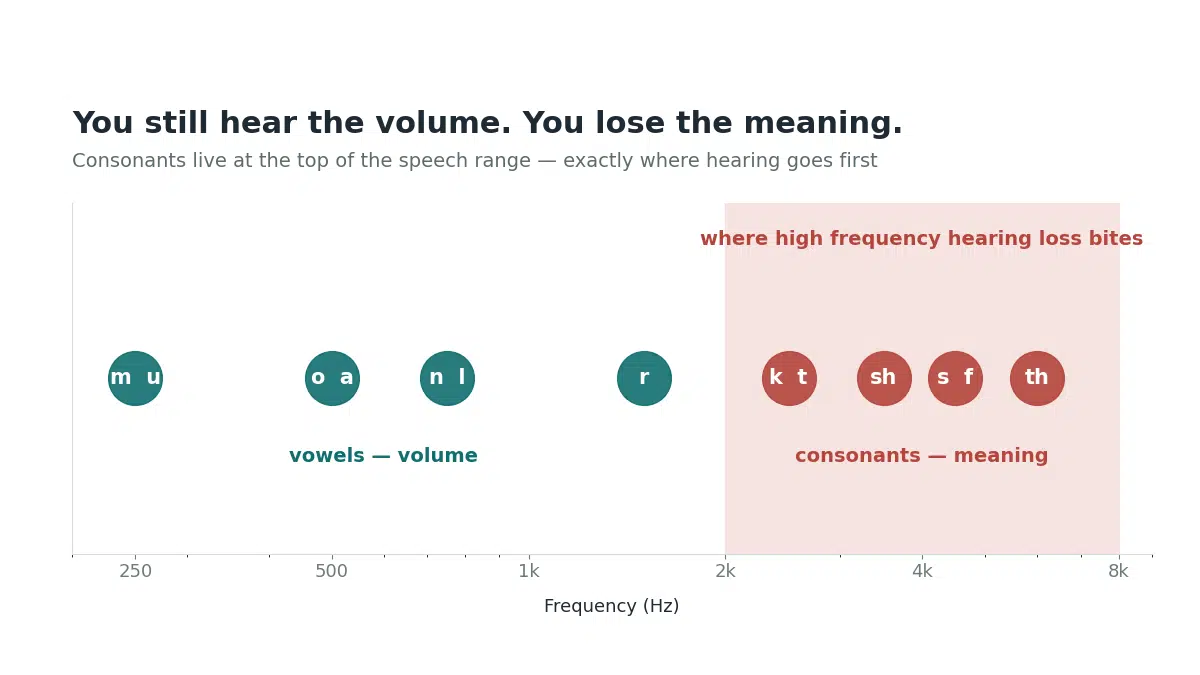
What fades first: birdsong, women’s and children’s voices, phone ringtones, microwave and alarm beeps, and those consonants. What stays: men’s voices, bass, engines, rumble.
The hair cells that detect high pitches sit at the entrance of the cochlea and take the brunt of every loud sound you’ve ever been exposed to. They’re the most vulnerable, and they don’t regenerate.
Why It Happens
Noise, cumulatively. One gunshot or explosion can do it instantly, but far more often it’s decades of accumulation: headphones, workshops, concerts, lawnmowers. Sustained exposure above 85 decibels starts causing damage, and the safe exposure time falls sharply as volume rises.[3]
Age. Presbycusis affects roughly one in three people aged 65 to 74, and it takes the high frequencies first.[1] It can begin in your forties without being noticeable for years.
Medications. Some drugs are ototoxic: aminoglycoside antibiotics, certain chemotherapy agents, loop diuretics, and very high doses of aspirin. Damage may be temporary or permanent depending on drug and dose, so report hearing changes during treatment rather than after.
Also: genetics, head injury, chronic ear infection or meningitis, smoking (it reduces blood flow to the inner ear), and diabetes and cardiovascular disease, both linked to higher rates through the same circulatory route.
The Signs, and Why They Get Dismissed
The pattern is specific enough to recognize:
- You hear that people are talking but can’t make out words
- Women’s and children’s voices are hardest, especially in noise
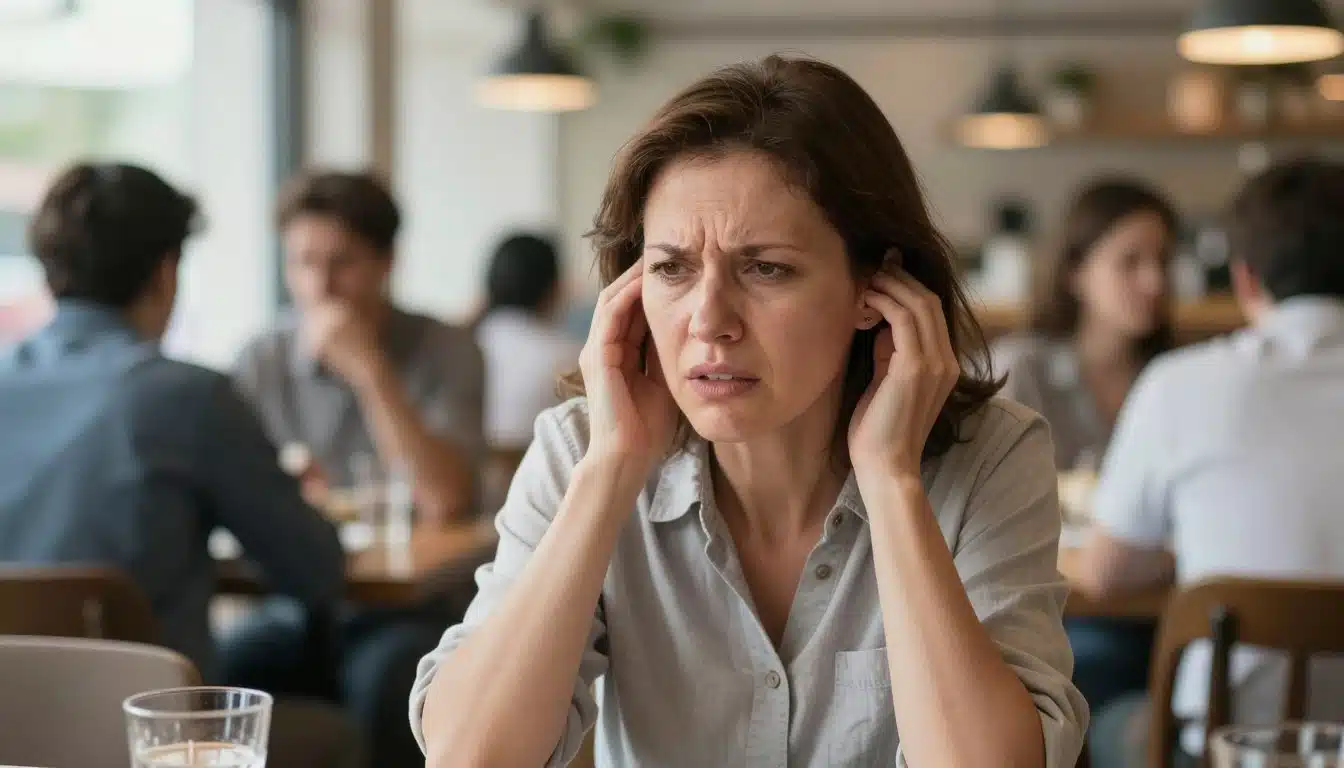
- Restaurants and group conversations are exhausting rather than just difficult
- Phone calls are harder than face-to-face
- You’ve started watching faces more than you used to
- Microwave beeps, alarms and indicators go unheard
- Birds and crickets have got quieter, or stopped
People typically wait years before acting, because each individual instance has an innocent explanation: bad phone audio, a noisy room, someone who mumbles.
Tinnitus usually comes along
Ringing, buzzing or hissing, often pitched in the same range you’ve lost. The leading explanation is that the brain generates phantom signal where real input stopped arriving.
It’s frequently the first thing people notice, and worth treating as a prompt to get tested. Our guide to supplements for tinnitus covers what the evidence does and mostly doesn’t support there.
Two other things are worth checking rather than assuming. If the sound beats in time with your pulse, that is a different problem needing imaging. And if you have been told your blood pressure is high, our piece on ringing in ears and blood pressure sets out what that connection actually amounts to, including the medications that can cause the noise themselves.
The one that can’t wait
Everything above develops gradually. Hearing that drops suddenly, over hours or a day and usually in one ear, is a different problem and an emergency. Steroid treatment works best started early, and the window is measured in days.
Our guide to hearing loss on one side only covers it properly. Also get seen urgently for hearing loss after a head injury, with severe vertigo, with facial weakness, or with discharge or bleeding.
Hearing Loss and Dementia: What the Evidence Says
You’ll see the claim that treating hearing loss halves cognitive decline. It’s worth being precise about this, because the real picture is more interesting and more useful.
The 2020 Lancet Commission identified hearing loss as the largest potentially modifiable risk factor for dementia.[4] That part is a strong association, drawn from observational data.
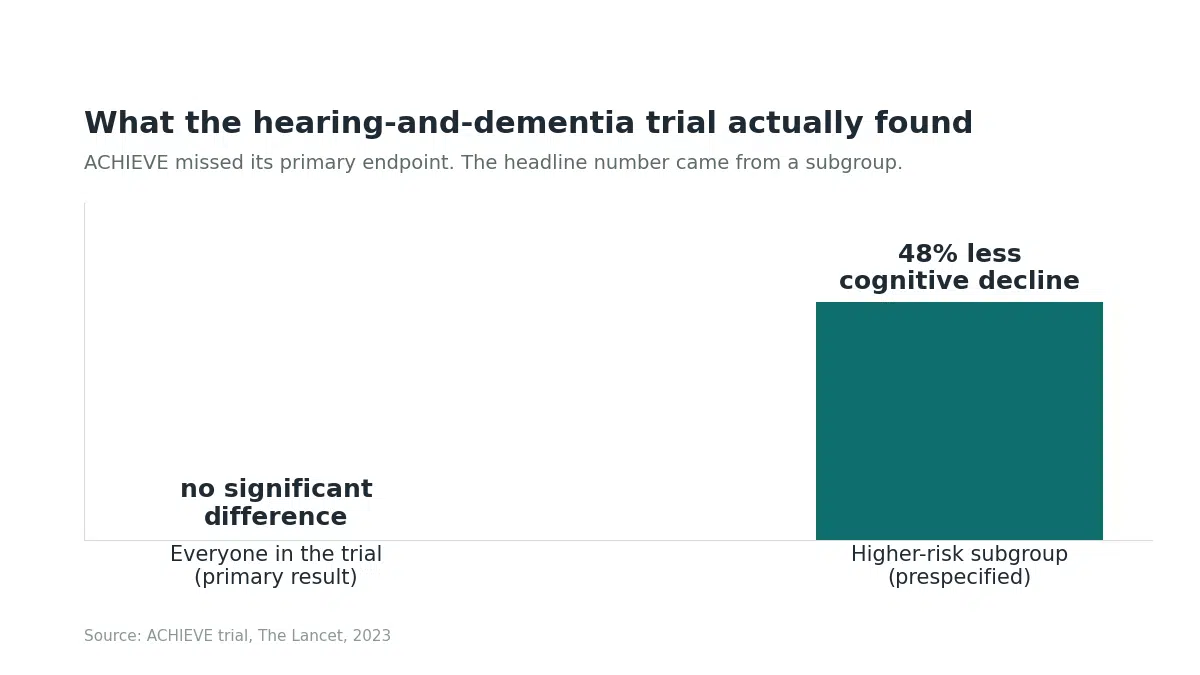
ACHIEVE, published in 2023, was the randomized trial that tested whether treating it actually helps. Its primary result was null: across the whole study population, hearing intervention produced no significant difference in three-year cognitive change compared with health education.[2]
The much-quoted 48% reduction came from a prespecified subgroup at higher baseline risk. That’s a genuine and encouraging finding, and subgroup results are hypothesis-generating rather than conclusive, which is exactly how the investigators framed it.
So the honest version: hearing loss is strongly associated with cognitive decline, treating it may help most in those at higher risk, and the trial evidence isn’t yet definitive. That’s still a good reason to treat hearing loss. It just isn’t the reason usually given.
The better-established reasons are immediate. Untreated hearing loss drives social withdrawal, and the effort of decoding unclear speech is genuinely tiring. And there’s a practical safety point: smoke alarms, carbon monoxide detectors and reversing sensors are all pitched high, precisely where your hearing has gone.
Getting Tested
You can’t self-diagnose this usefully. Pure-tone audiometry is the core test: tones at each frequency and volume, each ear separately, in a soundproof booth, plotted on an audiogram.
High frequency loss appears as a slope down the right-hand side, with normal hearing at low pitches and thresholds worsening as frequency climbs. Severity runs from mild (26-40 dB) through moderate, severe, to profound (91+ dB), and you can sit in different categories at different frequencies.
Speech audiometry tests how well you understand words, which predicts real-world benefit better than tones do. Tympanometry checks the middle ear, ruling out fluid or a perforation as the cause. Our guides to stuffy ears and earwax cover the reversible versions of muffled hearing.
Loss that’s much worse in one ear, or accompanied by one-sided tinnitus, usually prompts an ENT referral and sometimes an MRI, because that asymmetry is what warrants ruling out an acoustic neuroma.
See a licensed audiologist or an ENT. Retailer screenings are a reasonable first step but aren’t diagnostic.
What Helps
The damage is permanent. That doesn’t mean untreatable. Amplification restores a great deal of clarity.
Hearing aids are the main answer, and modern ones are programmed to lift only the frequencies you’ve lost, leaving the rest alone. That matters for this pattern specifically: you don’t want low sounds made louder, because those are fine.
Receiver-in-canal designs suit high frequency loss particularly well, since the ear canal stays relatively open for the low frequencies you still hear normally. Behind-the-ear units are more powerful; in-canal and completely-in-canal styles are less visible but fit fewer features and less battery.
Over-the-counter hearing aids are FDA-approved for mild to moderate loss and cost a fraction of prescription devices. They aren’t custom-programmed, but if cost is what’s stopping you, they’re a legitimate starting point rather than a compromise.
Prescription aids typically run $1,000 to $4,000 per ear with fitting and follow-up included. Medicare traditionally doesn’t cover them, though some Advantage plans do.
Expect an adjustment period of weeks, not days. Your brain has to relearn sounds it hasn’t processed properly in years, and the first few days can feel harsh and overloaded. Most aids include programs that ramp amplification gradually for this reason.
Assistive options alongside or instead: remote microphones for meetings, captioned phones, loop systems in theaters, live transcription apps, and visual or vibrating alerts for doorbells and smoke alarms.
Cochlear implants come in for severe to profound loss where aids don’t give enough benefit.
Protecting What You Have
You can’t undo the damage. You can absolutely slow what follows.
Hearing protection for concerts, power tools, shooting, motorcycles and noisy work. Foam plugs cut around 30 decibels for pennies; musician’s plugs lower volume while keeping sound quality, which makes them far more likely to actually be worn.
The 60/60 rule for headphones: no more than 60% volume for no more than 60 minutes at a stretch. Over-ear beats earbuds, and noise-cancelling helps because it removes the reason to turn things up. If someone beside you can hear it, it’s too loud.
Give your ears recovery time after loud exposure rather than stacking it.
Manage the vascular stuff: blood pressure, diabetes, smoking. All three affect the inner ear’s blood supply.
Get a baseline test in your forties or fifties. It’s what makes later change measurable rather than arguable.
Common Questions About High Frequency Hearing Loss
Can high frequency hearing loss be reversed?
Hearing aids restore a great deal of clarity, and protecting your ears prevents further loss.
Why can I hear people talking but not understand them?
It’s the single most characteristic sign of this pattern.
Does treating hearing loss prevent dementia?
Worth treating regardless, for the immediate benefits to communication and safety.
Are over-the-counter hearing aids any good?
They aren’t custom-programmed, so severe or asymmetric loss still needs an audiologist.
How long until hearing aids feel normal?
Most devices ramp up gradually to make that easier.
Is tinnitus a sign of hearing loss?
New tinnitus in one ear only is worth getting checked rather than accepting.
The Bottom Line
If you can hear that people are speaking but not what they’re saying, that’s the pattern, and it’s worth a test rather than another year of assuming everyone mumbles.
The damage doesn’t reverse, but amplification works well for this specific shape of loss, and protecting your remaining hearing genuinely changes what the next decade looks like.
And hearing that disappears suddenly on one side is a different thing entirely. That one gets seen today.
SOURCESOur Editorial Standards
HealthMagHub is built on primary sources: peer-reviewed research, clinical practice guidelines, and health agencies such as the NIH, CDC, and FDA. Read our editorial standards to see how we research, cite, and update our articles.
- Age-Related Hearing Loss (Presbycusis). National Institute on Deafness and Other Communication Disorders, NIH. nidcd.nih.gov
- Lin FR, et al. Hearing Intervention Versus Health Education Control to Reduce Cognitive Decline in Older Adults With Hearing Loss (ACHIEVE): a Multicentre, Randomised Controlled Trial. The Lancet, 2023. thelancet.com
- Understand Noise Exposure. National Institute for Occupational Safety and Health, CDC. cdc.gov
- Livingston G, Huntley J, Sommerlad A, et al. Dementia Prevention, Intervention, and Care: 2020 Report of the Lancet Commission. The Lancet, 2020;396(10248):413-446. PubMed 32738937
Disclaimer: This article is general information, not medical advice, and doesn't replace a hearing assessment. Seek same-day care for hearing that drops suddenly, hearing loss after a head injury, or hearing loss with severe vertigo, facial weakness, discharge or bleeding. Tell your doctor about hearing changes while taking any medication rather than stopping it yourself.