
That’s what separates B12 from most nutrients. It isn’t a supplement you take hoping to feel a bit better. It’s one where a genuine deficiency, left long enough, does harm that treatment can’t fully undo.
The catch is that your liver stores years’ worth, so a shortfall builds silently. By the time symptoms are obvious, the reserves are usually well down. That makes knowing your risk more useful than waiting to feel something.
- B12 maintains nerve insulation, and a long-standing deficiency can cause nerve damage that treatment doesn’t fully reverse.
- High folic acid intake corrects the anemia of B12 deficiency but does nothing for the nerve damage, which can then progress silently.
- Over 50, plant-based, on metformin or acid-suppressing medication, or after gut surgery are the groups most likely to run short.
- Tingling, unsteadiness, or memory changes need a blood test this month, not a supplement and a wait.
The B12 Benefits Your Body Actually Depends On
B12, or cobalamin, does four jobs that nothing else covers.[1]
It maintains the myelin sheath, the insulation around your nerves. When it degrades, signals misfire: tingling in the hands and feet, unsteadiness, memory trouble. This is the one that can become irreversible.
It lets red blood cells mature properly. Without enough, your bone marrow turns out cells that are too large and misshapen to carry oxygen well. That’s megaloblastic anemia, and it explains the breathlessness and exhaustion.
It’s needed for DNA synthesis, which is why requirements rise in pregnancy, when a baby’s nervous system is being built.
It helps clear homocysteine, alongside folate and B6. High homocysteine is associated with cardiovascular risk, though lowering it with supplements hasn’t been shown to reduce heart attacks.
What B12 doesn’t do is give you energy. It’s part of the machinery that releases energy from food. If you’re not short of it, more does nothing, and the “B12 for energy” shelf in every pharmacy is selling to people who mostly don’t need it.
Who Actually Runs Short
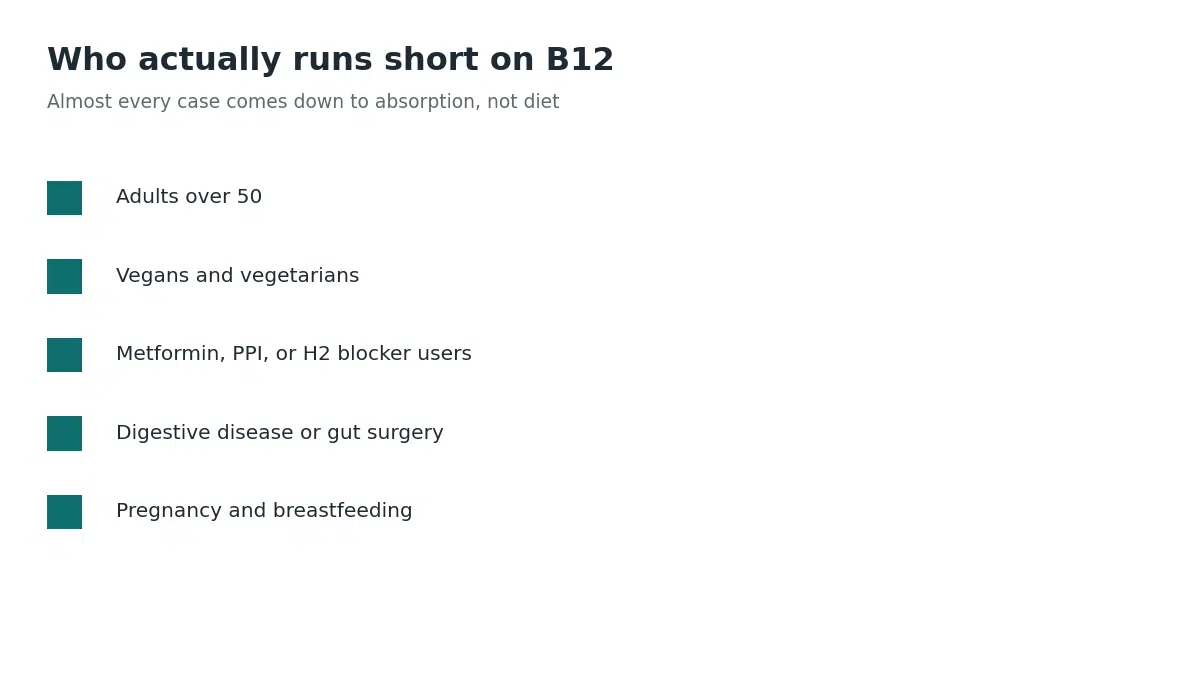
Absorption explains almost every case. Stomach acid has to release B12 from food protein, then a stomach protein called intrinsic factor carries it to the small intestine. Break either step and diet stops mattering.[1]
Adults over 50. Stomach acid production falls with age, and a substantial minority absorb food-bound B12 poorly. The fix isn’t more meat. It’s fortified food or a supplement, where the B12 is already free.
Vegans and vegetarians. B12 occurs naturally only in animal products. Supplementation isn’t optional here; it’s the whole strategy.
Anyone on metformin, a proton pump inhibitor, or an H2 blocker. All three reduce absorption, and all three are taken for years at a time. This is the commonest overlooked cause.
Digestive disease or gut surgery. Crohn’s, celiac disease, bacterial overgrowth, gastric bypass or bowel resection all impair uptake, sometimes permanently. Our guide to fermented foods for gut health covers supporting digestion more broadly.
Pernicious anemia. An autoimmune condition that stops you making intrinsic factor at all. No amount of dietary B12 gets absorbed normally, and treatment is lifelong.
Pregnancy and breastfeeding, particularly on a plant-based diet, since infants born to deficient mothers can develop serious neurological problems.
Nitrous oxide use. Nitrous oxide inactivates B12 in the body. Heavy recreational use has produced severe, sometimes lasting nerve damage in otherwise healthy young people, and it’s frequently missed because nobody thinks to ask.
The Folate Trap Nobody Mentions
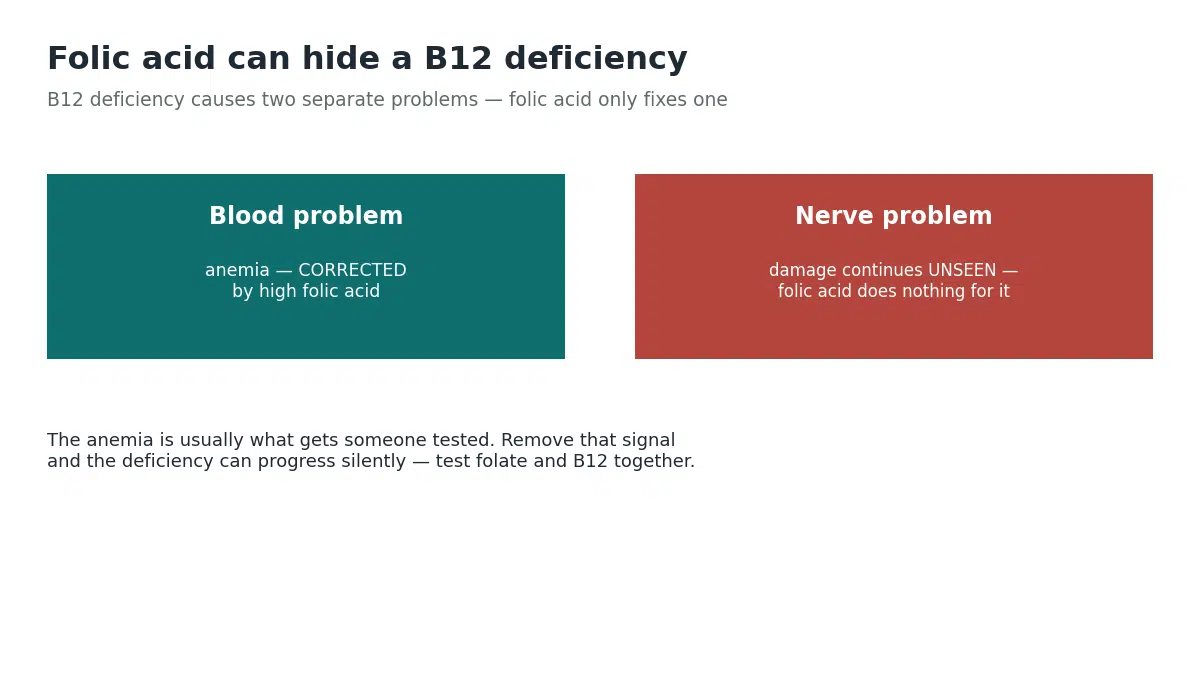
Folic acid can hide a B12 deficiency while the nerve damage continues. B12 deficiency causes two separate problems: a blood problem (megaloblastic anemia) and a nerve problem. High folic acid intake corrects the blood problem but does nothing for the nerve problem.[1]
That matters because the anemia is usually the signal that gets someone tested. Remove the signal and the deficiency can run silently.
This is precisely why folic acid has an upper limit of 1,000 micrograms a day from supplements and fortified foods. That ceiling exists because of the interaction with B12, not because folate is toxic.
One honest caveat: whether high folic acid actively worsens the neuropathy, rather than merely concealing it, is still debated. A 2024 review argued the evidence points that way;[2] a 2019 analysis concluded the historical record doesn’t support it.[3] The masking itself isn’t in dispute.
The practical upshot: test folate and B12 together rather than one alone, and be aware that a normal blood count doesn’t rule B12 deficiency out if you take a supplement containing folic acid. Our guide to what folic acid does covers the other side of that relationship, and most multivitamins contain both.
How Much You Need, and Where It Comes From
The requirement is small: 2.4 micrograms a day for adults, 2.6 in pregnancy, 2.8 while breastfeeding.[1]
Animal foods carry it, and a few carry a great deal:
| Food | Serving | B12 (mcg) |
| Clams, cooked | 3 oz | 84.1 |
| Beef liver, cooked | 3 oz | 70.7 |
| Trout, cooked | 3 oz | 5.4 |
| Salmon, cooked | 3 oz | 4.9 |
| Tuna, canned | 3 oz | 2.5 |
| Beef, cooked | 3 oz | 1.5 |
| Milk, low-fat | 1 cup | 1.2 |
| Yogurt, plain | 1 cup | 1.1 |
| Egg, large | 1 | 0.6 |
For plant-based eaters, fortified foods are the alternative: breakfast cereals, plant milks, some nutritional yeast (check the label, since not all brands are fortified), and some meat substitutes.
Spirulina, mushrooms and sea vegetables don’t count. They contain B12 analogues the body can’t use, and relying on them doesn’t correct a deficiency.[4]
One absorption quirk worth knowing: you can only take up roughly 2 micrograms of food-bound B12 at a single sitting. Spreading intake across the day does more than one large serving.
Supplements: Form, Dose and Whether You Need Injections
B12 is water-soluble and excess is excreted, so no upper limit has been set and no toxicity is established in healthy people.[1] That’s a reason not to fear it, but not a reason to take megadoses that do nothing.
Form barely matters. Cyanocobalamin is cheapest, most stable, and best studied. Methylcobalamin and hydroxocobalamin are active forms, but no trial has shown either works better for most people. One exception: people with Leber’s hereditary optic neuropathy should avoid cyanocobalamin specifically.
Dose depends on why you’re taking it. Around 25 to 100 mcg daily covers ordinary prevention. Over 50, or vegan, 250 to 1,000 mcg daily makes sense, because at high doses a passive absorption route takes over that doesn’t need intrinsic factor.
Injections are rarer than people assume. High-dose oral B12 works even in pernicious anemia, precisely because of that passive route. Injections are for severe deficiency, failed oral treatment, or when absorption is entirely absent.
Testing, and Why the Standard Test Can Mislead
A serum B12 test is cheap and widely available. Most labs treat anything below 200 to 250 pg/mL as low.[5]
But serum B12 measures what’s circulating, not what’s reaching your cells, and people with results in the normal range can still be functionally deficient. If symptoms suggest deficiency and the number looks fine, two follow-up tests settle it: methylmalonic acid, which rises when cells aren’t getting usable B12, and homocysteine. Intrinsic factor antibodies test for pernicious anemia.
Ask for folate on the same panel, for the reason in the section above.
Symptoms That Need a Doctor, Not a Supplement
The neurological symptoms are the ones with a clock on them. Self-treating and waiting to see is how reversible damage becomes permanent.
See a doctor promptly for:
- Tingling, numbness or pins-and-needles in hands or feet. Our guides to nerve pain in feet and hands and to what causes tingling hands and arms cover the wider differential
- Unsteadiness, or difficulty walking that’s developed recently
- Memory problems or confusion. Severe B12 deficiency can mimic dementia, and unlike dementia it’s treatable
- A smooth, sore, red tongue
- Breathlessness or palpitations during ordinary activity
- Vision changes
And get tested rather than guessing if you’re over 50, plant-based, on metformin or long-term acid suppression, or have had gut surgery.
Common Questions About B12 Benefits
Will B12 give me more energy?
If you’re genuinely low, energy usually improves over weeks as red blood cell production normalizes, not immediately.
Can folic acid hide a B12 deficiency?
That interaction is why folic acid has a 1,000 mcg upper limit. Test folate and B12 together.
Do I need injections, or will tablets do?
Injections are reserved for severe deficiency or when oral treatment hasn’t corrected it.
Is methylcobalamin better than cyanocobalamin?
The exception is Leber’s hereditary optic neuropathy, where cyanocobalamin specifically should be avoided.
Can vegans get B12 from plants?
Fortified foods and supplements are the only reliable sources, and for a vegan diet they aren’t optional.
How long does correcting a deficiency take?
Neurological symptoms take longer and may not fully resolve if the deficiency ran for years, which is the reason not to wait.
The Bottom Line
If you eat animal products, aren’t on metformin or acid-suppressing medication, and have a healthy gut, you’re almost certainly fine and don’t need a supplement.
If you’re over 50, plant-based, on those medications, or have a digestive condition, a cheap daily tablet removes the risk entirely, and the risk it removes is nerve damage, not tiredness.
And if you already have tingling, unsteadiness or memory changes, that’s a blood test this month, not a supplement and a wait.
SOURCESOur Editorial Standards
HealthMagHub is built on primary sources: peer-reviewed research, clinical practice guidelines, and health agencies such as the NIH, CDC, and FDA. Read our editorial standards to see how we research, cite, and update our articles.
- National Institutes of Health, Office of Dietary Supplements. Vitamin B12: Fact Sheet for Health Professionals. ods.od.nih.gov
- Miller JW, Smith A, Troen AM, et al. Excess Folic Acid and Vitamin B12 Deficiency: Clinical Implications? Food and Nutrition Bulletin, 2024. pubmed.ncbi.nlm.nih.gov
- Lack of historical evidence to support folic acid exacerbation of the neuropathy caused by vitamin B12 deficiency. Am J Clin Nutr, 2019, the counter-argument. pubmed.ncbi.nlm.nih.gov
- Harvard T.H. Chan School of Public Health, The Nutrition Source. Vitamin B12. nutritionsource.hsph.harvard.edu
- MedlinePlus, National Library of Medicine. Vitamin B12. medlineplus.gov
Disclaimer: This article is general information, not medical advice. B12 deficiency is diagnosed with a blood test, not from symptoms, and the neurological effects can become permanent if treatment is delayed. Speak to a doctor if you have numbness, tingling, unsteadiness or memory changes, and before starting high-dose supplements if you are pregnant, have kidney disease, or take regular medication.