

Everything else folic acid does is real but less dramatic. It builds red blood cells, it’s needed every time a cell divides, and running short causes a specific anemia.
Here’s what it does, how much you need, the interaction that makes it risky at high doses, and who genuinely needs a supplement.
- Folic acid taken before conception prevents up to 70% of neural tube defects, but the window usually closes before most people know they’re pregnant.
- The body absorbs about 85% of folic acid from supplements or fortified food, versus about 50% of natural folate from a meal.
- The 1,000 mcg daily upper limit exists because high folic acid can mask the anemia of a B12 deficiency while nerve damage continues silently.
- Anyone who could become pregnant, people with malabsorption conditions, those on folate-depleting medication, and heavy drinkers are the clearest candidates for a supplement.
Folate and Folic Acid Are Not the Same Thing
Folate is what occurs naturally in spinach, lentils and beans. Folic acid is the manufactured version added to fortified foods and supplements. Your body converts both into the same active form.
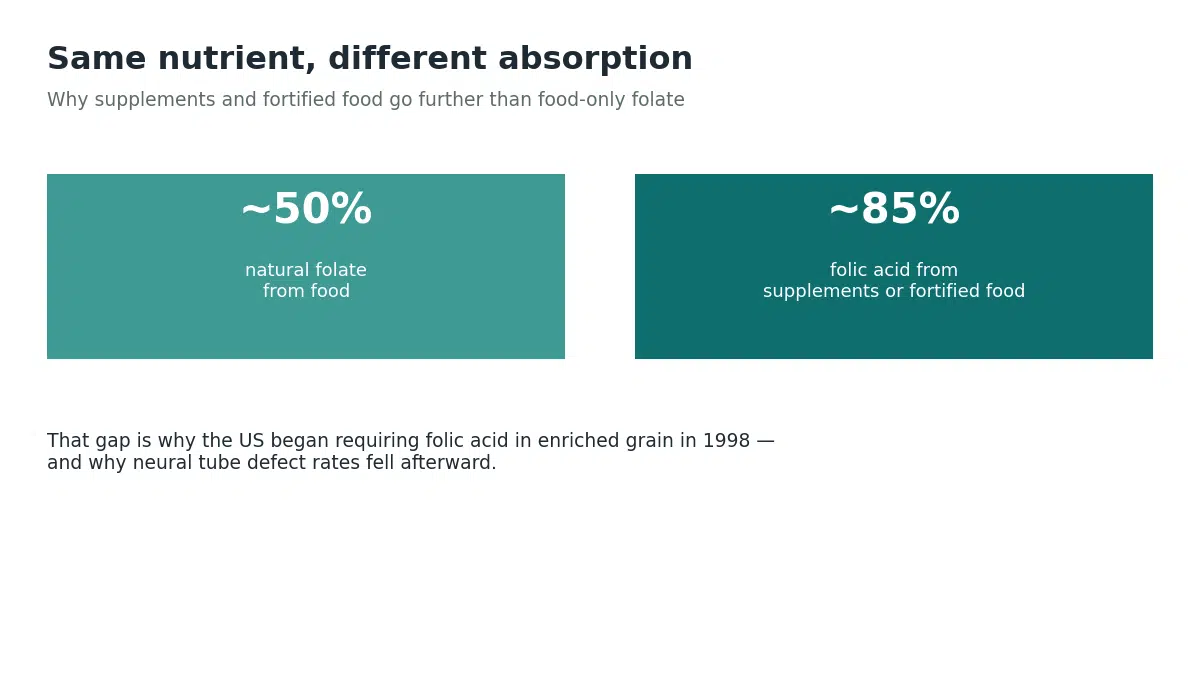
The practical difference is absorption. You take up roughly 85% of folic acid from a fortified food or supplement, against about 50% of the folate in a meal.[1] That gap is why the United States began requiring folic acid in enriched grain products in 1998, and why neural tube defect rates fell afterwards.
This is also why labels use dietary folate equivalents (DFE), which adjust for the difference. One microgram of folic acid counts as 1.7 mcg DFE. You don’t need to do the arithmetic; just know that a supplement goes further than the same number from food.
What Folic Acid Actually Does
It prevents neural tube defects. The neural tube, which becomes the brain and spinal cord, closes within about 28 days of conception. Adequate folate at that moment prevents up to 70% of defects like spina bifida and anencephaly.[3] Since most pregnancies aren’t confirmed until week five or six, and roughly half are unplanned, the tube has usually closed before anyone starts a supplement. That timing problem is the entire argument for taking it in advance.
It builds red blood cells. Without enough, your bone marrow produces cells that are too large and can’t carry oxygen properly, a condition called megaloblastic anemia. Fatigue, pallor and breathlessness follow.
It’s required for DNA synthesis. Every dividing cell needs it, which is why demand rises during pregnancy, infancy and adolescence, and why the fast-replacing tissues (gut lining, bone marrow) suffer first when it runs short.
It helps clear homocysteine, alongside B6 and B12. Folic acid reliably lowers homocysteine; whether that lowers heart attack risk has not been demonstrated in trials. Worth stating plainly rather than implying more.
How Much You Need
Adults need 400 mcg DFE a day.[1] Most people in countries with fortified grain reach that without trying.
The numbers that differ are for pregnancy:
| Group | Daily amount |
| Adults generally | 400 mcg DFE |
| Anyone who could become pregnant | 400-800 mcg as a supplement |
| Pregnant | 600 mcg DFE |
| Breastfeeding | 500 mcg DFE |
| Previous pregnancy affected by a neural tube defect | 4,000 mcg, prescription and supervision only |
The US Preventive Services Task Force recommends 400 to 800 mcg daily for everyone planning or capable of pregnancy, not only those actively trying.[2] Our companion guide covers folic acid during pregnancy in detail, including how it fits with prenatal vitamins.
That 4,000 mcg figure is ten times the standard dose and belongs to a doctor, not a shopping basket.
The Folic Acid and B12 Problem
Why folic acid has an upper limit
The ceiling for folic acid from supplements and fortified foods is 1,000 mcg a day, and it exists because of vitamin B12, not because folate is toxic.
B12 deficiency causes two problems: anemia and nerve damage. High folic acid intake corrects the anemia and does nothing for the nerves. Since the anemia is usually what prompts testing, masking it can let a B12 deficiency run silently while the neurological damage progresses, and that damage can become permanent.[4]
This matters most for the people most likely to be short of B12: adults over 50, vegans and vegetarians, and anyone on metformin or long-term acid-suppressing medication. Our guide to what B12 does covers that side.
Practical rule: if you take a folic acid supplement and fall into any of those groups, ask for B12 on the same blood panel. Don’t test one alone.
Where to Get It
Legumes and leafy greens carry the most natural folate:
- Lentils, cooked, 1 cup: 358 mcg
- Spinach, cooked, 1 cup: 263 mcg
- Black beans, cooked, 1 cup: 256 mcg
- Asparagus, 4 spears: 89 mcg
- Broccoli, cooked, 1 cup: 104 mcg
- Orange juice, 1 cup: 74 mcg
- Avocado, half: 59 mcg
Fortified foods carry folic acid: enriched bread, pasta, rice, corn masa flour, and breakfast cereals, some of which supply an entire day’s requirement in one bowl.
One cooking note: folate is water-soluble and heat-sensitive. Boiling leaches a substantial share into the water. Steaming or microwaving keeps more, or use the cooking liquid in the dish.
Who Actually Needs a Supplement
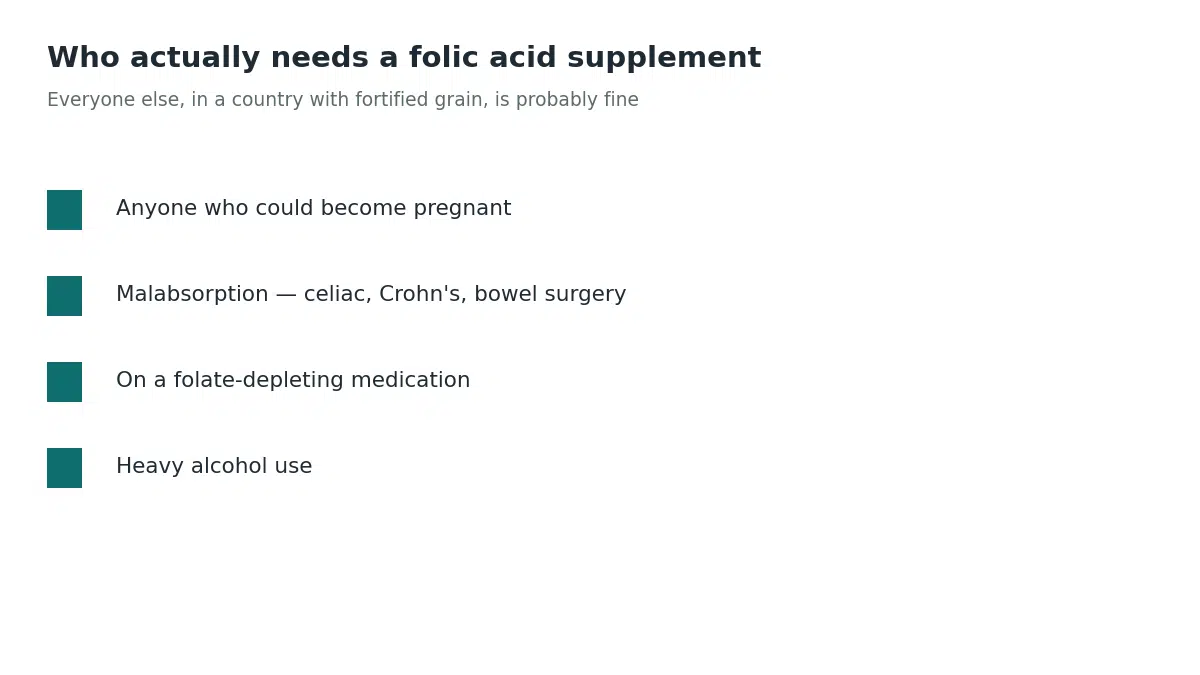
Anyone who could become pregnant. This is the clear case, and it applies whether or not pregnancy is planned.
People with malabsorption from celiac disease, Crohn’s, chronic diarrhea, or bowel surgery.
Anyone on a folate-depleting medication, covered below.
Heavy drinkers. Alcohol impairs absorption, increases urinary loss and disrupts how the liver activates folate.
Everyone else, in a country with fortified grain, is probably fine. We don’t recommend specific products. Look for a USP Verified or NSF Certified mark, check the dose matches your situation, and ignore the price difference between store brands and premium ones.
On methylfolate: it’s the active form, marketed hard at people with MTHFR gene variants. For the overwhelming majority, ordinary folic acid converts perfectly well and costs a fraction as much. It’s a reasonable choice if your doctor has a reason to recommend it, not a default upgrade.
Medication Interactions That Matter
Methotrexate works by blocking folate metabolism, which is precisely how it treats rheumatoid arthritis and psoriasis. Doctors usually prescribe folic acid alongside it to reduce side effects, but on different days from the methotrexate dose. Never rearrange that schedule yourself.
Antiepileptic drugs including phenytoin, carbamazepine and valproate lower folate levels, and high-dose folic acid can in turn reduce their effectiveness. This one needs a prescriber balancing both.
Sulfasalazine, for inflammatory bowel disease, blocks folate absorption; long-term users often need supplementation.
Trimethoprim interferes with folate metabolism. Short courses are rarely an issue; long-term use warrants monitoring.
When to See a Doctor Rather Than Supplement
Folate deficiency and B12 deficiency cause the same anemia, and treating the wrong one is how nerve damage happens.
See a doctor rather than self-treating if you have:
- Persistent fatigue with pallor or breathlessness on ordinary exertion
- A sore, smooth, red tongue, or recurring mouth ulcers
- Tingling or numbness in hands or feet, or unsteadiness. These point to B12, not folate, and are the reason not to guess
- Memory or concentration changes that have developed recently
A blood test measures serum folate, red cell folate (a better picture of long-term status) and B12 together. That’s the right first step, not a supplement and a wait.
Common Questions About Folic Acid
Is folic acid only for pregnant women?
The pregnancy emphasis exists because the consequences of running short at that specific moment are severe and almost entirely preventable.
Can you take too much folic acid?
The reason for the ceiling is that high folic acid can hide a B12 deficiency while nerve damage continues.
Is natural folate better than synthetic folic acid?
Folate-rich foods still earn their place for the fiber and everything else they carry, but not because the folate itself is superior.
Do I need methylfolate instead?
It’s a reasonable option if a doctor has a specific reason to suggest it, not a default upgrade.
Does folic acid improve fertility?
That’s valuable, but it’s a different claim from the one fertility supplements tend to make.
Does cooking destroy it?
Using the cooking liquid in soups or sauces recovers most of what would otherwise be lost.
The Bottom Line
If you could become pregnant, take 400 to 800 mcg daily starting now rather than when you decide to try. That single habit is one of the most effective preventive measures in medicine, and its window has usually closed by the time a test comes back positive.
If you can’t become pregnant, eat beans and greens, keep supplements under 1,000 mcg, and get B12 checked alongside folate if you’re taking one.
And if you have tingling or numbness rather than just tiredness, that’s a blood test, because the vitamin causing it probably isn’t this one.
SOURCESOur Editorial Standards
HealthMagHub is built on primary sources: peer-reviewed research, clinical practice guidelines, and health agencies such as the NIH, CDC, and FDA. Read our editorial standards to see how we research, cite, and update our articles.
- National Institutes of Health, Office of Dietary Supplements. Folate: Fact Sheet for Health Professionals. ods.od.nih.gov
- US Preventive Services Task Force. Folic Acid Supplementation to Prevent Neural Tube Defects: Preventive Medication. uspreventiveservicestaskforce.org
- Centers for Disease Control and Prevention. Folic Acid. cdc.gov
- Miller JW, et al. Excess Folic Acid and Vitamin B12 Deficiency: Clinical Implications? Food and Nutrition Bulletin, 2024. pubmed.ncbi.nlm.nih.gov
Disclaimer: This article is general information, not medical advice. Folate and B12 deficiency cause the same anemia but need different treatment, and getting that wrong risks permanent nerve damage. Speak to a doctor before taking more than 1,000 mcg of folic acid daily, if you take methotrexate, antiepileptic medication or sulfasalazine, or if you have had a pregnancy affected by a neural tube defect.