
If you are searching for high cholesterol symptoms, here is the answer nobody wants to give you: there aren’t any. High cholesterol produces no sensation at all. You cannot feel it, and no amount of paying attention to your body will reveal it.
That is not a technicality. It is the entire reason high cholesterol matters. The CDC puts it plainly — the only way to know is a blood test, and because there is nothing to feel, most people with a problem have no idea.
Between 2017 and 2020, about 86 million American adults over 20 had a total cholesterol of 200 mg/dL or higher. Nearly 25 million were above 240, the threshold the CDC calls high. Of the people who could benefit from cholesterol medication, just over half are taking it.
There are three physical signs worth knowing about, though. They are uncommon, they point to something specific, and most articles either skip them or bury them under a list of invented symptoms.
- High cholesterol has no symptoms — the CDC is explicit that a blood test is the only way to detect it.
- Three physical signs are real: yellowish deposits on the eyelids, a pale ring around the cornea before 45, and thickened tendons at the heel or knuckles.
- Those signs point toward familial hypercholesterolemia, which affects roughly 1 in 250 people and is diagnosed in well under 10% of them.
- Most healthy adults should be tested every 4 to 6 years, starting at 20 — and children between 9 and 11.
Why there is nothing to feel
Cholesterol is a waxy substance your body needs and makes. High cholesterol means too much of the wrong kind is circulating, and the trouble it causes starts silently.
Excess LDL works its way into the wall of an artery, where it gets trapped and triggers inflammation. Over years, that becomes plaque — a firm deposit narrowing the channel blood flows through. Arteries have no pain fibers reporting on their own diameter. Nothing about this process generates a signal you could notice.
An artery can narrow considerably before anything changes. And plaque does not have to close a vessel to cause harm. A deposit can rupture, a clot forms on the raw surface within minutes, and the vessel shuts. That is a heart attack or a stroke, and for a great many people it is the first evidence they had a cholesterol problem at all.
Decades of nothing, then everything at once. That is the shape of it.
The three signs of high cholesterol that are real
When cholesterol runs extremely high for a long time, it can deposit in places you can see. These are not symptoms in the usual sense — they don’t hurt and they don’t announce themselves — but they are visible, and they mean something.
Xanthelasma. Soft yellowish patches on the eyelids, usually near the inner corner, often on both sides. They are painless and grow slowly. This is the sign people find when they search for signs of high cholesterol on the face, and it is genuine — but only partly. Studies of people with xanthelasma have found abnormal blood lipids in anywhere from roughly a tenth to two thirds of them, so it is a reason to get tested rather than a diagnosis. It carries more weight in someone young.
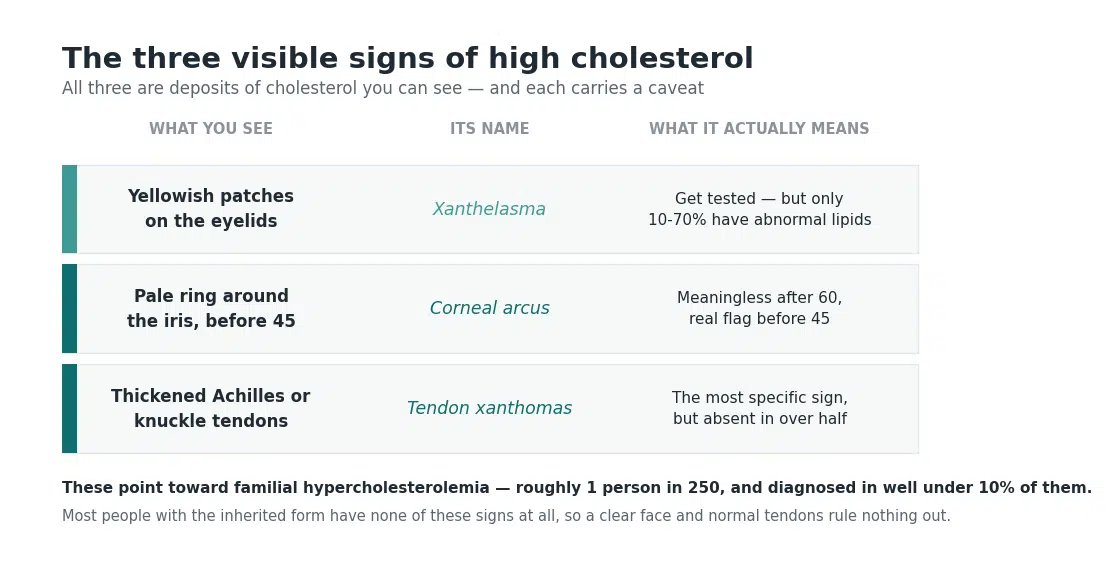
Corneal arcus. A pale gray or white ring forming around the edge of the colored part of the eye. Here the age cutoff is everything. In someone over 60 this ring is extremely common and means very little on its own. Under 45, it is a genuine flag for high cholesterol and worth investigating.
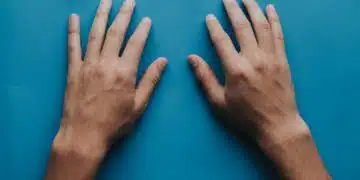
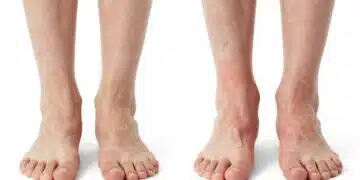
Tendon xanthomas. Firm lumps in the tendons themselves, most often the Achilles at the back of the heel or the extensor tendons on the backs of the hands. A thickened, knobbly Achilles that isn’t sore and wasn’t injured is the classic finding. This is the most specific of the three by a distance — but it appears in fewer than half of people who have the underlying condition, so its absence proves nothing.
What those signs are pointing at
All three point toward the same thing: familial hypercholesterolemia, an inherited condition in which the body cannot clear LDL from the blood properly.
It affects roughly 1 person in 250. That makes it one of the more common genetic conditions there is, and it is badly underdiagnosed — in many countries fewer than one in ten of the people who have it know. Because the cholesterol has been high since childhood rather than since middle age, the arteries have decades more exposure, and untreated it raises the risk of early heart disease many times over.
The honest caveat: most people with the common inherited form have none of these physical signs. The deposits show up mainly in the severe cases. So a clear face, clear eyes and normal tendons tell you nothing reassuring.
What does raise suspicion is family history. Heart attacks or strokes in close relatives before about 55 in men and 65 in women, or a parent on cholesterol medication from a young age, is worth mentioning to your doctor whatever your own numbers look like.
The high cholesterol symptoms that aren’t
Search results are full of symptom lists. Most of them attach ordinary complaints to a condition that does not cause them.
Fatigue. Not caused by high cholesterol. It has a long list of real causes worth investigating on their own terms.
Headaches. No established link.
Tingling in the hands or feet. A nerve or circulation question, not a lipid one.
Cold or discolored feet. Worth taking seriously, but as a circulation symptom rather than a cholesterol one — the difference matters, and our guide to what’s actually behind cold hands and feet works through the real list.
There is one exception worth stating carefully. Cramping pain in the calves that comes on while walking and stops when you rest is a real symptom — but of narrowed leg arteries, which is the consequence of years of plaque rather than a symptom of the cholesterol itself. Same with chest tightness on exertion. By the time these appear, the disease has already happened.
What is happening while you feel fine
The damage from high cholesterol is not evenly distributed. It shows up wherever the plaque happens to be.
Heart. Narrowed coronary arteries cause angina; a ruptured plaque causes a heart attack.
Brain. A clot or fragment blocking a brain artery causes a stroke.
Legs. Peripheral arterial disease, which brings the walking pain above and slower wound healing.
Eyes. A fragment of plaque can lodge in the artery feeding the retina, causing sudden painless loss of sight in one eye. That is an emergency-room problem rather than an eye-appointment one, as we explain in our piece on sudden vision loss in one eye.
The only way to actually know
A lipid panel. A single blood draw measuring total cholesterol, LDL, HDL and triglycerides.
The CDC’s guidance is that most healthy adults get it every four to six years, starting at 20. The National Heart, Lung and Blood Institute goes further with age: every five years through your twenties and thirties, then every one to two years for men from 45 and women from 55, and annually past 65.
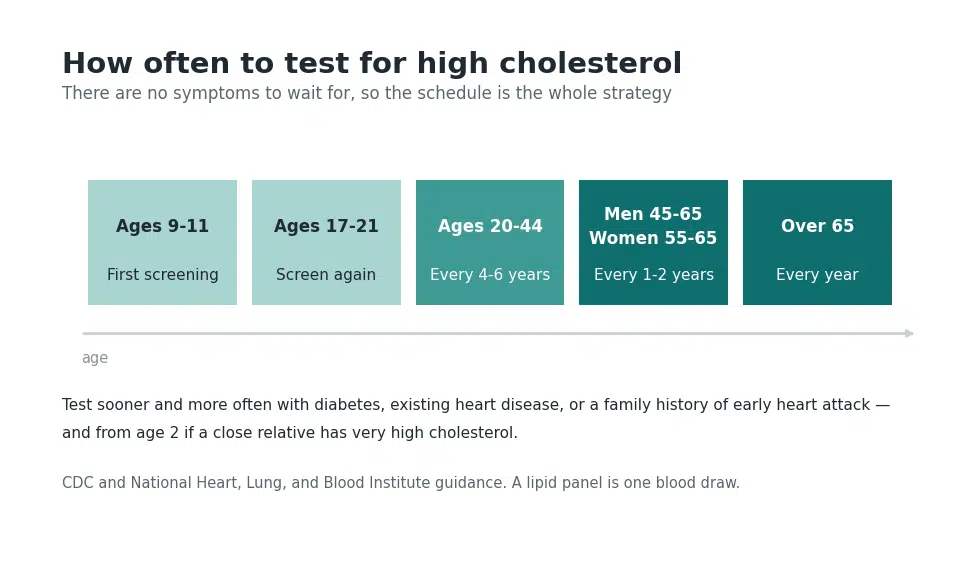
Children get checked too, which surprises people. The recommended first screening is between 9 and 11, with another between 17 and 21 — and as early as age 2 where there is a family history of very high cholesterol or early heart attacks. That timing exists precisely to catch the inherited form before the arteries have had thirty years of exposure.
Anyone with diabetes, existing heart disease, or a family history needs testing more often than the general schedule.
The number that isn’t on your standard panel
Worth knowing about, because almost nobody is told. Lipoprotein(a) — written Lp(a) — is a particle that raises cardiovascular risk independently, and its level is set largely by genetics rather than diet.
The NHLBI notes it is not usually included in a routine lipid panel, and that a high level can mean elevated risk even when every other number looks fine. It only needs measuring once in a lifetime. If you have a strong family history of early heart disease and normal-looking cholesterol, this is a reasonable thing to ask about.
When to see a doctor
There is no version of high cholesterol that is itself an emergency. Its complications are.
- Chest pain or pressure, breathlessness, sweating or nausea — call your local emergency number
- Sudden weakness or numbness on one side, facial droop, garbled speech, or a sudden severe headache — call your local emergency number
- Sudden painless loss of vision in one eye, even if it comes back
- Cramping calf pain that reliably starts when you walk and stops when you rest
- Yellowish patches on the eyelids, or a pale ring around the cornea before 45
- A thickened Achilles tendon or lumps on the backs of the hands, without injury
- A parent or sibling who had a heart attack or stroke unusually young
- Simply not having had a lipid panel in more than five years
That last one is the most common reason to book. It is also the least dramatic, which is exactly why it gets postponed.
Frequently asked questions
What are the warning signs of high cholesterol?
For the overwhelming majority of people, there are none. The three visible signs — eyelid deposits, an early corneal ring, and thickened tendons — occur mainly in severe inherited cases. Any list promising ten warning signs is padding.
Can you see high cholesterol in your eyes?
Sometimes. Xanthelasma on the eyelids and corneal arcus around the iris are both cholesterol deposits. The ring is only meaningful before about 45, because after 60 it is common in people with entirely normal levels.
Are high cholesterol symptoms different in women?
No — the absence of symptoms is the same. What differs is timing. Levels often rise around menopause as estrogen falls, so a reading that was fine at 45 can look different at 55, which is why the recommended testing interval tightens for women from that age.
Can you have high cholesterol and be thin?
Yes, easily. Weight and cholesterol are related but not the same thing, and the inherited form has nothing to do with body size or diet. Being slim is not a reason to skip the test.
Do supplements lower high cholesterol?
Most do very little. Red yeast rice is the notable exception, and only because it contains a compound chemically identical to a prescription statin — which brings the same side effects and interactions without the dose control. Our guide to red yeast rice side effects covers why that matters.
The one thing to take away
Looking for high cholesterol symptoms is the wrong search. There is nothing to find, and the effort spent looking is effort not spent on the one thing that works.
Check the eyelids and the Achilles tendons once, since it costs nothing. Then book the blood test. Everything useful about high cholesterol is a number on a page rather than a feeling in your body.
SOURCESOur Editorial Standards
HealthMagHub is built on primary sources: peer-reviewed research, clinical practice guidelines, and health agencies such as the NIH, CDC, and FDA. Read our editorial standards to see how we research, cite, and update our articles.
- Centers for Disease Control and Prevention. High cholesterol facts. CDC cholesterol data and statistics
- Centers for Disease Control and Prevention. Testing for cholesterol. cdc.gov
- National Heart, Lung, and Blood Institute. Blood cholesterol: diagnosis. nhlbi.nih.gov
- Familial Hypercholesterolemia. GeneReviews, National Library of Medicine. NCBI Bookshelf
- Familial Hypercholesterolemia. StatPearls, National Library of Medicine. NCBI Bookshelf