

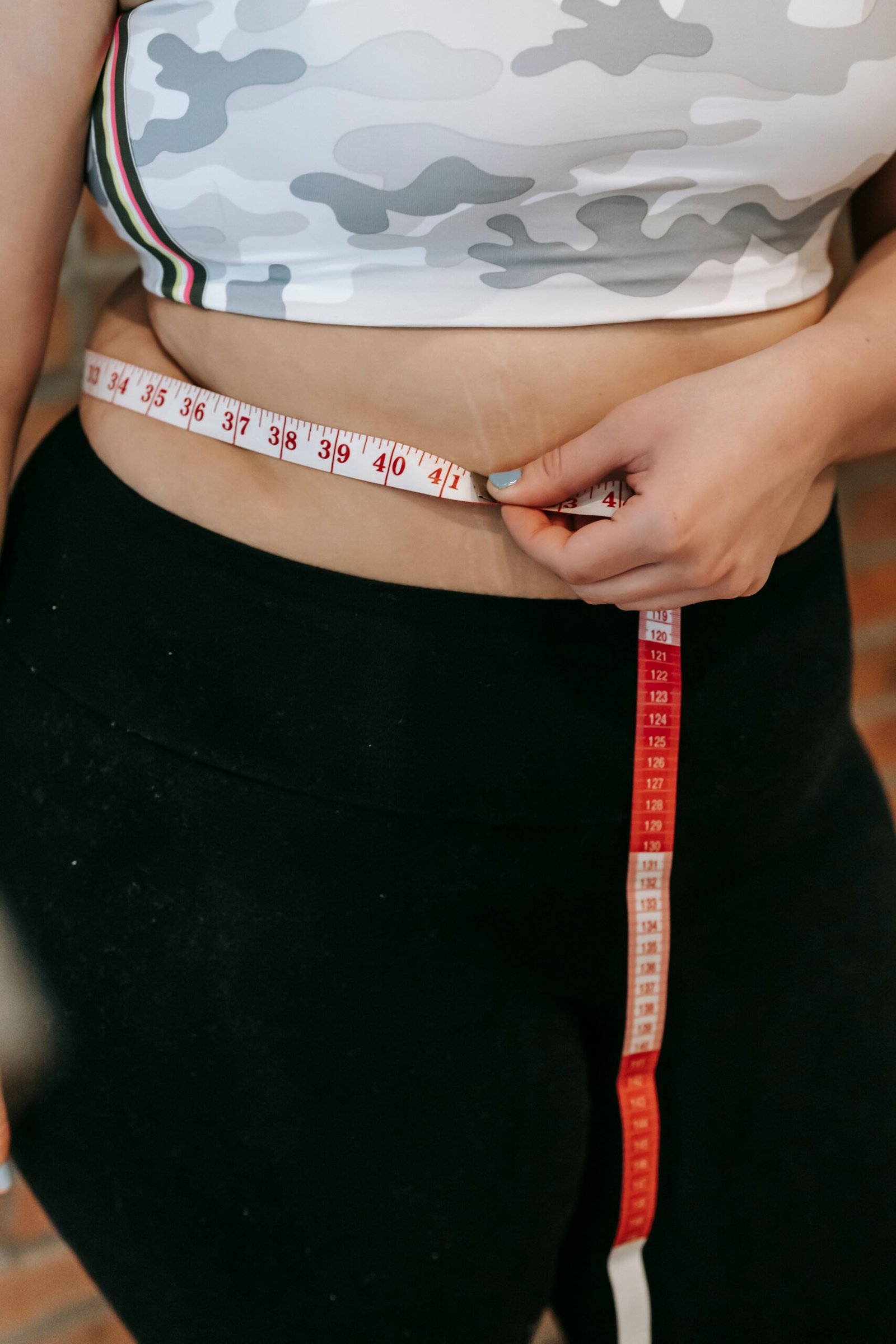
If you are gaining weight fast enough to notice it week to week, here is the first thing worth knowing: it is almost certainly not fat. The arithmetic does not allow it.
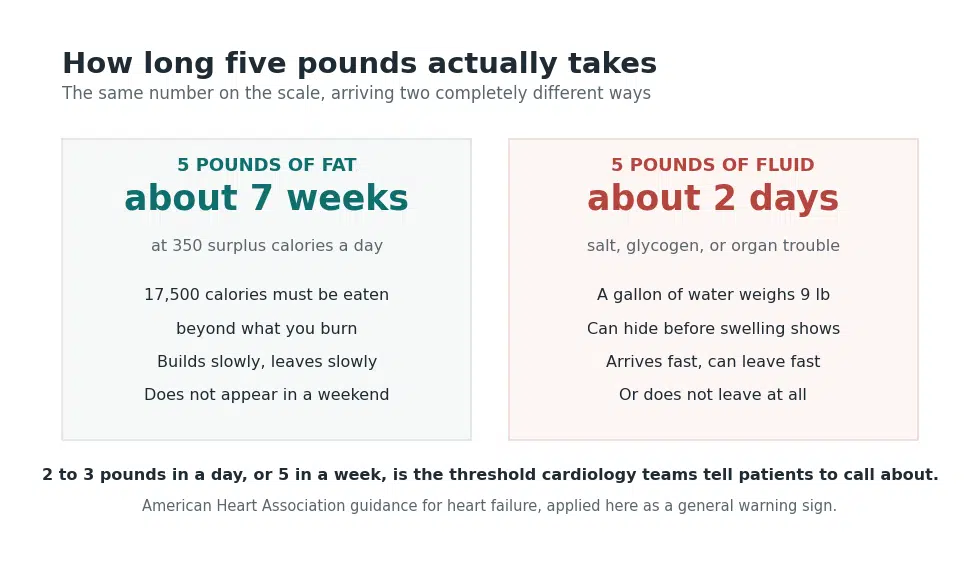
A pound of body fat stores roughly 3,500 calories. To put on five pounds of actual fat in a week, you would have to eat about 17,500 calories beyond what you burned — around 2,500 extra calories every single day, on top of everything you already eat. Almost nobody does that by accident.
So when the scale jumps four or five pounds in a few days, something else is going on. Gaining weight that quickly is usually fluid. Sometimes it is a medication. Occasionally it is a sign that an organ is struggling, and that version needs attention this week rather than next month.
- Gaining weight rapidly means fluid, not fat — a pound of fat takes about 3,500 surplus calories to build, so five pounds in a week is physiologically implausible.
- The American Heart Association treats a gain of 2 to 3 pounds in a day, or 5 pounds in a week, as a reason to call your doctor.
- A gallon of retained water weighs about 9 pounds, and the body can hide a fair amount of it before any swelling shows.
- Medication is the most commonly missed reason for gaining weight, and the list of drugs is longer than most people expect.
Why gaining weight quickly is almost always water
Your body holds a surprising amount of fluid, and how much it holds changes daily. That daily swing is what most people are actually seeing when they think they are gaining weight overnight.
Salt is the biggest lever. Sodium pulls water into your tissues and bloodstream, so one heavily salted meal can show up on the scale by morning. Carbohydrate matters too. Your muscles and liver store carbohydrate as glycogen, and every gram of glycogen is stored alongside roughly three grams of water. Eat more carbohydrate than usual for a few days and you can carry several pounds of extra water without a single gram of extra fat.
Then there are the ordinary triggers nobody counts. Constipation. The week before a period. A long flight. A hot day. Sitting still. Any of them can look like gaining weight and none of them are.
To give the numbers some scale, the American College of Cardiology points out in its patient materials that a gallon of water weighs about nine pounds, and the body can tuck away a fair volume of it in the belly and legs before any obvious swelling appears. That is why a sudden jump on the scale can be the earliest sign of a fluid problem, showing up before you look or feel any different.
The scale swings even when nothing is wrong
Before deciding you are gaining weight at all, make sure you are comparing like with like. Most people weigh themselves inconsistently and then panic at the noise.
Weigh at the same time each morning, after using the bathroom, before eating or drinking, wearing about the same amount of clothing. This is exactly the routine cardiology teams give heart failure patients, and it exists because casual weighing produces swings big enough to hide a real signal or invent a fake one.
One reading tells you very little. A direction held over five or six days tells you whether you are genuinely gaining weight or just watching your body’s daily tide come in.
When gaining weight fast needs a doctor now
This is the part most articles bury, so it goes near the top here.
The American Heart Association tells people with heart failure that gaining more than two or three pounds in a day, or more than five pounds in a week, is a signal to contact their care team. Mayo Clinic’s heart failure action plan uses the same thresholds, and treats more than five pounds in a week alongside worsening symptoms as an emergency-room situation.
Those numbers were written for people already diagnosed. But the underlying logic applies to anyone: gaining weight that fast means fluid, and fluid arriving that fast means the heart, kidneys or liver may not be clearing it.
Treat gaining weight this quickly as urgent when it comes with any of these:
- Shortness of breath, especially lying flat, or waking at night needing to sit up
- Swelling in both legs, ankles or feet, or a belly that feels tight and full
- A cough that will not settle, or new wheezing
- Chest pain or pressure
- Passing much less urine than usual, or urine that looks foamy
- Yellowing of the eyes or skin
Swelling in one leg only is a different problem again — that pattern points toward a clot and needs same-day assessment, which we cover in our guide to swelling in the feet and ankles.
The cause almost everyone forgets to check
Medication. It is the single most overlooked reason people find themselves gaining weight without any change in how they eat, and the giveaway is timing: gaining weight starts within weeks of a new prescription or a dose change.
The Obesity Medicine Association lists several classes with a known effect on weight:
- Antipsychotics — olanzapine and clozapine have the largest effect, though most in the class do something
- Some antidepressants — paroxetine, mirtazapine and the older tricyclics, while others in the same category are weight-neutral
- Corticosteroids — prednisone and relatives, particularly on longer courses
- Certain diabetes medicines — insulin and sulfonylureas, and pioglitazone
- Beta blockers — partly by slightly lowering how much energy you burn at rest
- Mood stabilizers — lithium and valproate
- Hormonal contraceptives and progestins, where much of the early change is fluid
Two things matter here. First, gaining weight is not a reason to stop a medication — some of these drugs are doing important work, and stopping one abruptly can be genuinely dangerous. Second, within most of these classes there are alternatives with different weight profiles. That is a conversation to have, not a decision to make alone.
Bring the actual list to the appointment, including anything over the counter. Sedating antihistamines belong on it too.
Conditions behind slower, steadier gain
If you have been gaining weight over months rather than days, the list shifts.
Underactive thyroid. Real, but smaller than its reputation. The American Thyroid Association puts thyroid-attributable gain at roughly five to ten pounds, most of it retained salt and water rather than fat. Worth testing, not worth pinning thirty pounds on — we went through the numbers here.
Menopause and perimenopause. The shift is as much about where weight sits as how much there is, with more of it moving to the middle. Covered further in our look at menopause and belly fat.
Cushing’s syndrome. Uncommon, but it has a distinctive shape worth recognizing. The NIH describes weight settling around the abdomen while the arms and legs stay thin, a rounded red face, a fat pad across the upper back, wide purple stretch marks about half an inch or more across, bruising without any bump, and weakness in the muscles closest to the trunk — struggling out of a low chair or reaching overhead. That combination is not ordinary weight gain and deserves a proper workup.
Poor sleep. Short sleep pushes appetite hormones in the direction of eating more, and it is one of the few causes of gaining weight on this list you can act on directly.
Stopping smoking. Gaining weight afterwards is typical and it is a fair trade. The cardiovascular benefit of quitting outweighs it comfortably.
How to work out which one you are dealing with
You can narrow this down considerably before anyone examines you. How you started gaining weight tells you more than how much you gained.
Days, with swelling or breathlessness. Fluid. This is the urgent lane.
Days, no other symptoms, and it settles. Almost certainly salt, carbohydrate or hormonal cycling, which means you were never really gaining weight. Watch the trend across a week rather than reacting to a morning.
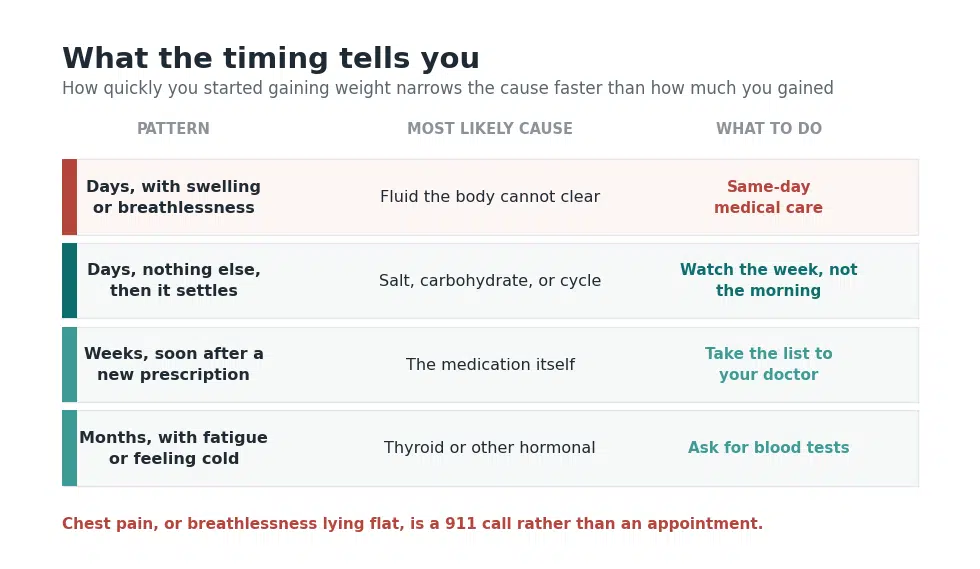
Weeks, starting near a new prescription. Look hard at the medication before anything else, because gaining weight on a drug is common and often fixable.
Months, with fatigue, cold intolerance or changed periods. Worth blood tests — thyroid at minimum.
Blood pressure is worth knowing in all of these, partly because several of the causes push it up and partly because some blood pressure medicines affect fluid themselves. Our guide to reading your blood pressure numbers covers measuring it properly at home.
When to see a doctor
- More than 2 to 3 pounds in a day, or more than 5 pounds in a week, particularly with swelling or breathlessness
- Any weight gain alongside shortness of breath, chest discomfort or a tight abdomen
- Gain that began within weeks of a new medication or a dose change
- Steady gain with fatigue, feeling cold, hair thinning or changes to your periods
- Weight settling centrally while your arms and legs thin, with wide purple stretch marks or easy bruising
- Gaining weight steadily for no clear reason, despite nothing changing in how you eat or move
One more thing worth saying plainly. If watching the scale has started to occupy a lot of your attention, or if your relationship with eating feels harder than it used to, that is worth raising with a doctor or a registered dietitian in its own right — separately from whatever the number is doing. It is a common thing to experience and a reasonable thing to ask for help with.
Frequently asked questions
Can you really gain five pounds overnight?
You can see five pounds more on the scale overnight, yes. It will be food still in your digestive tract, fluid, or both. It cannot be five pounds of fat, because building that much fat takes weeks of a very large surplus.
Why am I gaining weight without eating more?
The three usual answers for gaining weight without eating more are fluid, medication and a change in hormones. If it arrived in days it is fluid. If it started near a new prescription it is likely the drug. If it built quietly over months, thyroid and other hormonal causes are worth testing for.
Does drinking more water make you retain more?
Generally the opposite, assuming healthy kidneys. Drinking adequately helps your body let go of sodium rather than hold it. Restricting fluid to stop retention usually backfires. If a doctor has put you on a fluid limit for a heart or kidney reason, follow that instead.
Am I gaining weight or just retaining water?
Salt-driven fluid usually settles within a few days once intake returns to normal. Fluid from a heart, kidney or liver problem does not resolve on its own and needs the underlying cause treated.
The one thing to take away
Speed is the clue. Fat is slow to arrive and slow to leave, so gaining weight quickly always means fluid — and fluid has causes ranging from last night’s dinner to a heart that needs help. The pattern over a week, plus your medication list, will get you and your doctor most of the way to an answer.
If it came with breathlessness or swelling, do not wait for next week’s reading. Make the call.
SOURCESOur Editorial Standards
HealthMagHub is built on primary sources: peer-reviewed research, clinical practice guidelines, and health agencies such as the NIH, CDC, and FDA. Read our editorial standards to see how we research, cite, and update our articles.
- American Heart Association. Managing heart failure symptoms. Warning signs and daily weight monitoring
- Mayo Clinic. What is a heart failure action plan? Mayo Clinic expert answers
- Eunice Kennedy Shriver National Institute of Child Health and Human Development. What are the symptoms of Cushing syndrome? NICHD
- Obesity Medicine Association. Medications that may increase weight. Medication classes associated with weight gain
- American College of Cardiology, CardioSmart. Heart failure: checking your weight daily.