

The evidence here is smaller and newer than the marketing suggests. Three trials do most of the work, and in the best of them, people slept better without their insomnia going away.
Here’s what those trials found, which forms are worth paying for, and when poor sleep needs something other than a supplement.
- Bisglycinate has the best sleep-specific evidence: a university-funded trial found significant improvement in insomnia scores over four weeks.
- The benefit was largest in people whose dietary magnesium intake was already low, so topping up a shortfall matters more than the form you choose.
- Magnesium L-threonate’s sleep evidence comes from industry-funded trials, one of which required a corrigendum to disclose sponsor conflicts.
- Anyone with reduced kidney function should check with a doctor first, because the kidneys clear excess magnesium and accumulation can cause dangerous heart and breathing problems.
What the Evidence for a Magnesium Supplement for Sleep Actually Shows
Three pieces of research carry this topic. They point the same direction, but none of them is large.
The meta-analysis. Mah and Pitre pooled every randomized trial of oral magnesium for insomnia in older adults and found just three trials covering 151 people. Those who took magnesium fell asleep about 17 minutes faster than those on placebo. The authors’ own conclusion was blunt: the quality of the literature is substandard for making confident recommendations.[1]
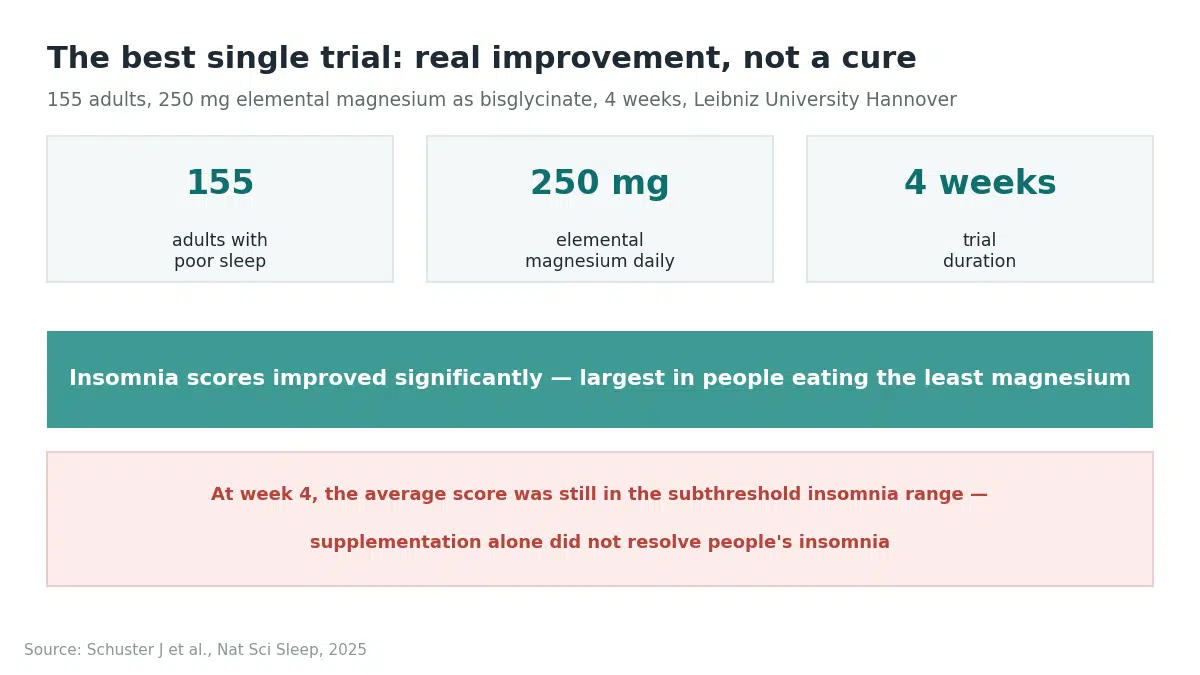
The best single trial. Schuster and colleagues at Leibniz University Hannover randomized 155 adults with poor sleep to 250 mg of elemental magnesium as bisglycinate or placebo for four weeks. Insomnia severity scores improved significantly.[2] Two details matter more than the headline: the benefit was largest in people whose dietary magnesium intake was low to begin with, and at week four the average score was still in the subthreshold insomnia range. Supplementation alone did not resolve people’s insomnia.
The threonate trials, with a caveat worth knowing. Magnesium L-threonate is marketed on its ability to reach the brain, and two trials report sleep benefits. Both were funded by companies selling the ingredient. The 2024 trial needed a published corrigendum in 2025 to disclose that the sponsor had commissioned it and holds patents on the compound, a conflict that wasn’t properly declared the first time.[3] The 2026 trial was funded by another company that also supplied the product. That doesn’t make the results wrong. It does mean they need independent replication before anyone pays a premium on the strength of them.
Why “Which Form?” Is the Wrong First Question
Every comparison chart online ranks the forms. Almost none of them ask the question the Hannover trial actually answered: who benefits?
The people who improved most were those eating the least magnesium. That fits how nutrients generally work: topping up a shortfall does something, while adding more on top of enough usually doesn’t.
So before comparing salts, it’s worth asking whether your diet is short. Leafy greens, pumpkin seeds, almonds, black beans, whole grains and dark chocolate are the reliable sources. If you eat almost none of them, a supplement has more room to help. If you eat plenty, expect less.
One complication: a standard blood test won’t settle this. Most of your magnesium sits in bone and inside cells, so serum levels can read normal while intake is poor.[5] That’s why most trials recruit on symptoms rather than bloodwork.
Choosing a Magnesium Supplement for Sleep, Form by Form
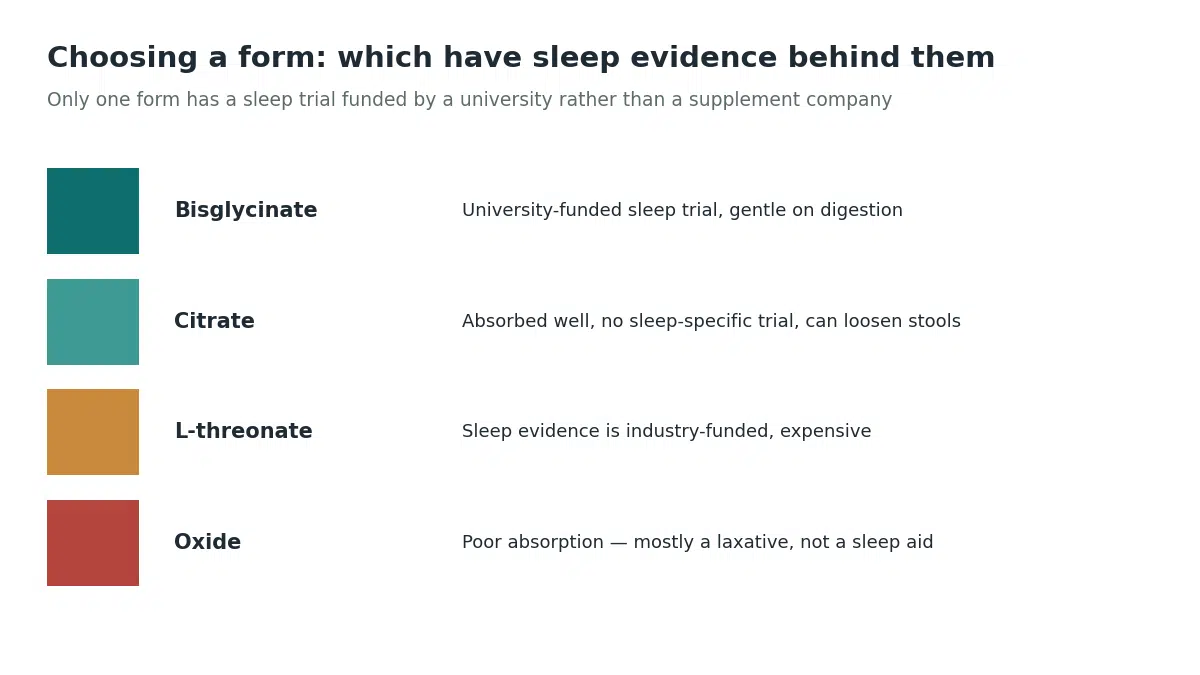
Bisglycinate (magnesium glycinate) is the reasonable default. It has the only sleep trial funded by a university rather than a supplement company, it’s absorbed well, and it’s the gentlest on digestion. Glycine itself is mildly calming, which may add something, though no trial has separated the two ingredients.
Citrate is absorbed well and costs less. Its drawback is a laxative effect at higher doses, which is useful if you’re prone to constipation and unhelpful if you’re not. It has no sleep-specific trial behind it, but nothing suggests the magnesium itself works differently.
L-threonate is the expensive option, typically several times the price. Its sleep evidence is real but industry-funded and, in one case, poorly disclosed. If cognition is your goal it may earn its cost; for sleep alone, it’s a lot of money for a weaker evidence base than bisglycinate.
Oxide is the one to skip. It’s cheap and it’s what fills most multivitamins, but absorption is poor, only a few percent of the dose. It works as a laxative because most of it stays in the gut. Buying it for sleep is mostly buying a bowel movement.
Taurate, malate, chloride and sulfate all have their uses, none of them sleep-specific. Epsom salt baths are magnesium sulfate; skin absorption is poorly quantified, so treat a bath as a pleasant wind-down rather than a dose.
If you want the detail on tolerability, our guide to magnesium glycinate side effects covers who runs into trouble with it.
Branded sleep blends usually wrap one of these forms in a proprietary mix and charge a premium for it. Before paying that premium, check what the individual ingredients would cost bought separately and whether each one has trial evidence behind it on its own. Magnesium bisglycinate is often the ingredient actually doing the work, at a fraction of the price.
How Much to Take, and When
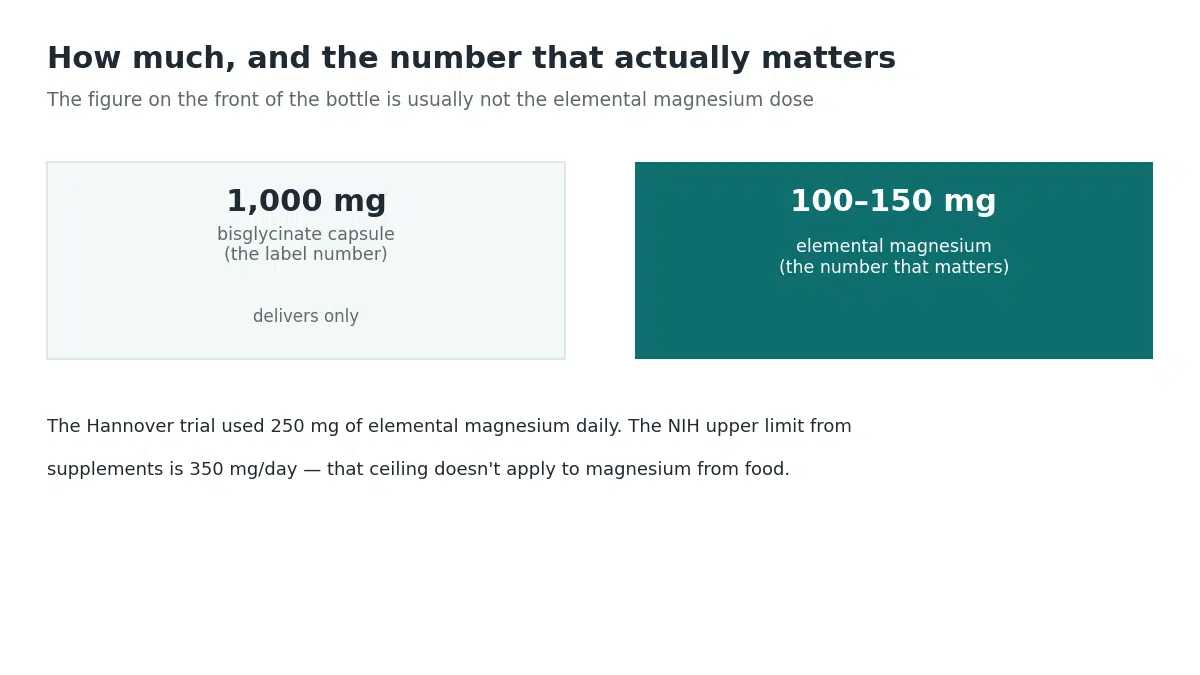
The Hannover trial used 250 mg of elemental magnesium daily. Trials in older adults have used up to 500 mg.[4] Starting around 200 mg is sensible.
Read the label carefully, because the number on the front is usually the weight of the whole compound, not the magnesium in it. A 1,000 mg bisglycinate capsule might deliver 100 to 150 mg of elemental magnesium. The elemental figure is the one that matters.
The NIH sets an upper limit of 350 mg per day from supplements for adults.[5] That ceiling applies to supplements and medications only, not to magnesium in food, which healthy kidneys clear without difficulty.
Take it in the evening, an hour or two before bed. Give it four weeks before judging; the trials measured change over weeks, not nights. And note what magnesium is not: it isn’t a sedative, and it won’t knock you out. If you feel nothing dramatic on night one, that’s the expected result.
Who Should Not Take a Magnesium Supplement for Sleep
Check with a doctor first if you have kidney disease or reduced kidney function. This is the important one. Your kidneys clear excess magnesium; when they can’t, it accumulates, and high blood magnesium causes low blood pressure, confusion, irregular heartbeat and breathing difficulty.[5]
The same caution applies with heart block or other serious rhythm problems, myasthenia gravis (where magnesium can worsen muscle weakness), and pregnancy or breastfeeding, not because magnesium is known to be harmful, but because supplemental doses haven’t been established for it.
Loose stools are the common side effect and the usual signal to lower the dose or switch to bisglycinate.
Three medication interactions are worth knowing. Magnesium binds tetracycline and fluoroquinolone antibiotics and bisphosphonates for osteoporosis, making both less effective, so separate them by at least two hours. Proton pump inhibitors taken long-term lower magnesium levels, so if you’re on omeprazole or similar, mention supplementation to your prescriber. Diuretics cut both ways depending on type, and need monitoring rather than guesswork.
When Poor Sleep Needs a Doctor, Not a Supplement
Magnesium is a reasonable thing to try. It is not a reasonable thing to keep trying while something treatable goes undiagnosed.
See a doctor rather than reaching for another supplement if:
- You snore heavily and wake unrefreshed, or a partner has seen you stop breathing. Untreated sleep apnea is common, and no supplement touches it
- Low mood, loss of interest or hopelessness came with the insomnia
- You have an irresistible urge to move your legs at night that eases when you move them. Restless legs is often driven by low iron, which needs testing
- Daytime sleepiness is affecting your driving or your safety
- The insomnia started suddenly alongside other new symptoms
- You’ve slept badly for months. Cognitive behavioral therapy for insomnia outperforms every supplement on this page and is the recommended first-line treatment
Common Questions About Magnesium Supplements for Sleep
Which magnesium supplement for sleep has the best evidence?
That trial is still small and short, and the improvement left most participants with some residual sleep difficulty.
Is magnesium L-threonate worth the extra cost?
It may have a stronger case for cognition. For sleep alone, bisglycinate gives you better-evidenced results for less money.
How long before it works?
Give it four weeks at a consistent dose and time before deciding.
Can I take magnesium every night indefinitely?
If your kidney function is reduced, this doesn’t apply, and that’s a conversation with your doctor.
Should I get my magnesium level tested first?
A more useful question is how much magnesium your diet supplies, since that’s what predicted who benefited in the trial.
What if it gives me diarrhea?
Taking it with food and splitting the dose also helps. Persistent diarrhea despite those changes is a reason to stop.
The Bottom Line
If you’re going to try a magnesium supplement for sleep, take bisglycinate, start around 200 mg of elemental magnesium in the evening, stay under 350 mg from supplements, and give it four weeks.
Expect a modest effect rather than a transformation. That’s what the trials found, including the positive one. And if your diet is already rich in greens, nuts, seeds and beans, expect less still, because the people who benefited most were the ones starting from the least.
If four weeks pass and nothing changes, the answer isn’t a more expensive form of magnesium. It’s finding out what’s actually keeping you awake.
SOURCESOur Editorial Standards
HealthMagHub is built on primary sources: peer-reviewed research, clinical practice guidelines, and health agencies such as the NIH, CDC, and FDA. Read our editorial standards to see how we research, cite, and update our articles.
- Mah J, Pitre T. Oral magnesium supplementation for insomnia in older adults: a systematic review and meta-analysis. BMC Complement Med Ther. 2021;21:125. ncbi.nlm.nih.gov
- Schuster J, Cycelskij I, Lopresti A, Hahn A. Magnesium bisglycinate supplementation in healthy adults reporting poor sleep: a randomized, placebo-controlled trial. Nat Sci Sleep. 2025;17:2027-2040. pubmed.ncbi.nlm.nih.gov
- Hausenblas HA, et al. Magnesium-L-threonate improves sleep quality and daytime functioning in adults with self-reported sleep problems. Sleep Med X. 2024;8:100121, plus the 2025 corrigendum disclosing sponsor funding and patent ownership, Sleep Med X. 2025;9:100141. pubmed.ncbi.nlm.nih.gov
- Abbasi B, et al. The effect of magnesium supplementation on primary insomnia in elderly: a double-blind placebo-controlled clinical trial. J Res Med Sci. 2012;17(12):1161-1169. ncbi.nlm.nih.gov
- National Institutes of Health, Office of Dietary Supplements. Magnesium: Fact Sheet for Health Professionals. ods.od.nih.gov
Disclaimer: This article is general information, not medical advice. Magnesium supplements interact with several common medications and are not safe for everyone, particularly anyone with reduced kidney function. Speak to a doctor or pharmacist before starting, especially if you take prescription medication, are pregnant or breastfeeding, or have an existing health condition. Persistent insomnia deserves proper assessment rather than another supplement.