
Adequate folic acid before and during early pregnancy prevents up to 70% of neural tube defects.[1] Few interventions in medicine are that effective, that cheap, or that dependent on timing.
What follows is the pregnancy-specific part: when to start, how much, who needs far more, and what to do if you’re already pregnant and haven’t been taking it. For the general picture, including what folate is, how it differs from folic acid, and where to find it in food, see our guide to what folic acid does.
- Adequate folic acid before and during early pregnancy prevents up to 70% of neural tube defects, but only if it’s already in your system before conception.
- The neural tube closes around day 21-28, usually before a missed period, so start at least a month before trying to conceive.
- Standard dose is 400 mcg before pregnancy, 600 mcg during, and 500 mcg while breastfeeding. Most prenatals supply 400-800 mcg.
- A previous pregnancy affected by a neural tube defect, epilepsy, diabetes, or certain medications can raise the recommended dose to 1-5 mg, a prescribing decision only.
Why the Timing Matters More Than the Dose
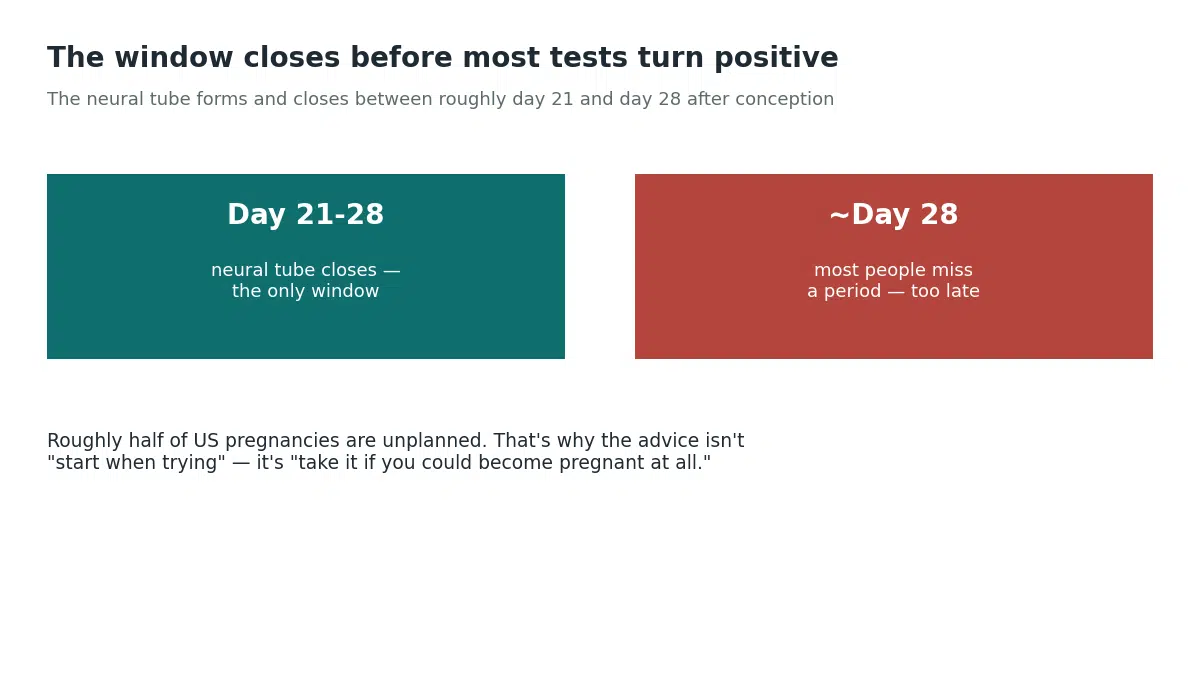
The neural tube, which becomes the brain and spinal cord, forms and closes between roughly day 21 and day 28 after conception.[3]
Most people don’t miss a period until around day 28. By the time a test reads positive, that window has usually shut. Nothing taken afterwards reopens it.
Add the other number that drives the advice: roughly half of pregnancies in the United States are unplanned.[3] That’s why the recommendation isn’t “start when you’re trying” but “take it if you could become pregnant at all.”
| Stage | What’s happening | Why it matters |
| Before conception | Building folate stores | Levels need to already be adequate at conception |
| Days 21-28 | Neural tube forms and closes | The only window for preventing these defects |
| Weeks 5-12 | Rapid cell division, organs forming | Continued DNA synthesis |
| Second and third trimesters | Growth, blood volume rising | Prevents megaloblastic anemia |
Start at least one month before trying to conceive. Three months is better. If you’re not planning pregnancy but could become pregnant, the honest answer is that you should already be taking it.
What It Actually Prevents
Neural tube defects affect roughly 3,000 pregnancies in the US each year.[3] The two main forms are spina bifida, where the spine doesn’t close completely, and anencephaly, where parts of the brain and skull don’t form and which is not survivable.
Since the US began fortifying enriched grain products with folic acid in 1998, neural tube defects have fallen by roughly 36%.[4] That is a public health result achieved largely without anyone changing their behavior.
Fortification adds an estimated 100 to 200 mcg a day for people who regularly eat bread, pasta and cereal.[1] Useful, but well short of what pregnancy requires, which is why a supplement is still recommended on top of it.
How Much Folic Acid During Pregnancy You Need
| Situation | Daily amount | Notes |
| Could become pregnant | 400 mcg | Start at least a month before trying |
| Pregnant | 600 mcg | Throughout the pregnancy |
| Breastfeeding | 500 mcg | Continue while nursing |
| Previous pregnancy affected by a neural tube defect | 4,000 mcg | Prescription and supervision only, starting 1-3 months before conception |
Most prenatal vitamins supply 400 to 800 mcg, which covers the standard case. Check the label rather than assuming, because amounts vary.
The general upper limit is 1,000 mcg a day from supplements and fortified foods.[5] Prescribed high-dose regimens are a deliberate exception, not a contradiction.
Who Needs Considerably More
Some situations call for 1 to 5 milligrams daily rather than micrograms. That’s a different order of magnitude, and always a prescribing decision.[2]
Raise it with your provider before conception if:
- You’ve had a previous pregnancy affected by a neural tube defect
- You, your partner, or a parent or sibling has a neural tube defect
- You have diabetes that predates the pregnancy
- You have epilepsy and take anti-seizure medication
- You take methotrexate, sulfasalazine, or another folate-depleting drug
- You’ve had gastric bypass or another procedure affecting absorption
On MTHFR: routine testing isn’t recommended.[5] The gene variation is common, standard folic acid works for the overwhelming majority who carry it, and methylfolate is mostly a more expensive answer to a question most people don’t have. If you’ve had recurrent pregnancy loss, that’s a conversation with your provider rather than a supplement aisle decision.
If You’ve Just Found Out You’re Pregnant
Start today, and don’t spend energy on guilt. The ideal window may have passed, but development continues for months and folate is needed throughout: for red blood cell formation, for the placenta, and for the sheer rate of cell division ahead.
Book a prenatal appointment and mention any medications you take. Most people in this position are fine, and half of all pregnancies begin exactly this way.
If morning sickness makes swallowing a prenatal impossible, say so rather than quietly skipping it. Taking it at night, with food, or switching formulation often solves it, and providers deal with this constantly.
The B12 Point Worth Knowing
High folic acid intake corrects the anemia caused by B12 deficiency without touching the nerve damage that deficiency also causes, which is the reason the 1,000 mcg ceiling exists.[6]
In pregnancy this matters most if you’re vegetarian or vegan, since B12 comes almost entirely from animal foods. Check that your prenatal contains B12, and mention a plant-based diet at your first appointment. Our guide to what B12 does covers why a deficiency here is worth catching early.
Medications That Interfere
Several drugs deplete folate or interact with supplementation. None of these mean stopping your medication. They mean your prescriber needs to know.
- Anti-seizure medication such as phenytoin, carbamazepine and valproate. These lower folate, and folic acid can in turn affect seizure control. Your neurologist and obstetrician should both be in the loop, ideally before conception
- Methotrexate works by blocking folate metabolism and is contraindicated in pregnancy; this needs planning well in advance
- Sulfasalazine, for inflammatory bowel disease, blocks folate absorption
- Trimethoprim, in some antibiotics, interferes with folate metabolism
- Metformin reduces B12 absorption, which matters alongside the interaction above
Choosing a Supplement
A standalone folic acid tablet and a prenatal vitamin both work. If you’re pregnant or trying, the prenatal makes sense because you need the iron, iodine and vitamin D too.[7] Our guide to choosing a prenatal vitamin covers what else belongs in one. If pregnancy isn’t on the horizon but is possible, a plain folic acid tablet is a reasonable and much cheaper safety net.
We don’t recommend specific products. What to check on any label: at least 400 mcg of folic acid, and ideally a USP Verified or NSF Certified mark, since supplements aren’t reviewed before sale.
Generic works identically to branded: same compound, same effect. And several marketing terms mean nothing here. Folic acid is synthetic by definition, so “whole food based,” “organic” and “non-GMO” don’t describe the folic acid itself. “Pharmaceutical grade” isn’t a regulated term at all.
Gummies are fine if pills are the barrier, but check the dose actually reaches 400 mcg, since some fall short, and note the added sugar. The best supplement is the one you’ll take daily.
When to Contact Your Provider
Folic acid is well tolerated and side effects are uncommon. Contact your provider if you have:
- Signs of an allergic reaction such as rash, swelling or difficulty breathing (seek emergency care for the last of these)
- Numbness or tingling in hands or feet, which points toward B12 rather than folate
- Nausea severe enough that you can’t keep a prenatal down
- Unusual fatigue, breathlessness or a racing heart
- Any new medication prescribed by another doctor during pregnancy
Cost is also a legitimate reason to call. Providers frequently have samples, and assistance programs exist, so going without is the worse option.
Common Questions About Folic Acid During Pregnancy
When should I start taking folic acid during pregnancy planning?
If pregnancy is possible rather than planned, the recommendation is to take it anyway, since about half of pregnancies are unplanned.
I’m already pregnant and haven’t been taking it. Is it too late?
Book a prenatal appointment and mention any regular medications.
Can I get enough from fortified food alone?
Food and a supplement together is the recommended combination, not one or the other.
Should I take methylfolate instead?
Routine MTHFR testing isn’t recommended. If you’ve had recurrent pregnancy loss or another specific concern, discuss it with your provider.
Does folic acid help you conceive faster?
That’s why the advice is to start before trying rather than after.
What if I accidentally take two doses?
The concern is sustained intake above 1,000 mcg daily, not an occasional double.
The Bottom Line
If you could become pregnant, take 400 mcg daily starting now. If you’re pregnant, 600 mcg, usually through a prenatal. If you’re breastfeeding, 500 mcg.
If you’ve had a pregnancy affected by a neural tube defect, or you have diabetes or epilepsy, that conversation belongs with your provider before conception rather than after, because the dose may be ten times higher.
And if you’re reading this while already pregnant and haven’t started, the useful response is to start today, not to look backwards.
SOURCESOur Editorial Standards
HealthMagHub is built on primary sources: peer-reviewed research, clinical practice guidelines, and health agencies such as the NIH, CDC, and FDA. Read our editorial standards to see how we research, cite, and update our articles.
- Centers for Disease Control and Prevention. Folic Acid: Sources and Recommended Intake. cdc.gov
- American Academy of Pediatrics, Committee on Genetics. Folic Acid for the Prevention of Neural Tube Defects. Pediatrics. publications.aap.org
- US Preventive Services Task Force. Folic Acid Supplementation to Prevent Neural Tube Defects. uspreventiveservicestaskforce.org
- Centers for Disease Control and Prevention. CDC Grand Rounds: Additional Opportunities to Prevent Neural Tube Defects with Folic Acid Fortification. MMWR. cdc.gov/mmwr
- National Institutes of Health, Office of Dietary Supplements. Folate: Fact Sheet for Health Professionals. ods.od.nih.gov
- Miller JW, et al. Excess Folic Acid and Vitamin B12 Deficiency: Clinical Implications? Food and Nutrition Bulletin, 2024. pubmed.ncbi.nlm.nih.gov
- American College of Obstetricians and Gynecologists. Nutrition During Pregnancy. acog.org
Disclaimer: This article is general information, not medical advice, and doesn't replace prenatal care. Speak to your provider before conception if you have had a pregnancy affected by a neural tube defect, have diabetes or epilepsy, or take regular medication. Several of these call for a much higher dose that requires a prescription. High-dose folic acid should never be self-prescribed.