

Acid reflux at night is not the same problem as acid reflux during the day. It happens less often, it lasts far longer, and it does more damage.
The reason for that is not that your stomach makes more acid overnight. It is that lying down removes three separate defenses at the same time, and none of them come back until you sit up.
One of the fixes is free, takes no effort, and most people have never heard it. It is not raising the bed, though that helps too.
- Reflux episodes at night are less frequent than daytime ones but last significantly longer, which is why they cause more damage.
- Lying flat removes gravity, swallowing slows, and saliva production falls close to zero. All three normally clear acid from the esophagus.
- Sleeping on the left side measurably shortens acid exposure and clears acid roughly twice as fast as sleeping supine or on the right.
- Difficulty swallowing, unintended weight loss, vomiting blood or black stools need medical assessment rather than another antacid.
Why acid reflux at night is different
During the day, acid reflux tends to be frequent but brief. At night the pattern reverses: fewer episodes, each one lasting much longer.
That difference matters more than the raw count. Damage to the esophagus depends on how long the lining sits in contact with acid, not how many times acid arrives. A single long overnight episode can do more than several short daytime ones.
Longer overnight acid exposure has been linked to esophagitis and to symptoms outside the gut entirely, including asthma.[3] It is also why some people who feel nothing at night still turn out to have inflammation when they are examined.
The three defenses you lose lying down
Upright and awake, your body clears acid reflux three ways at once. Sleeping removes all three.
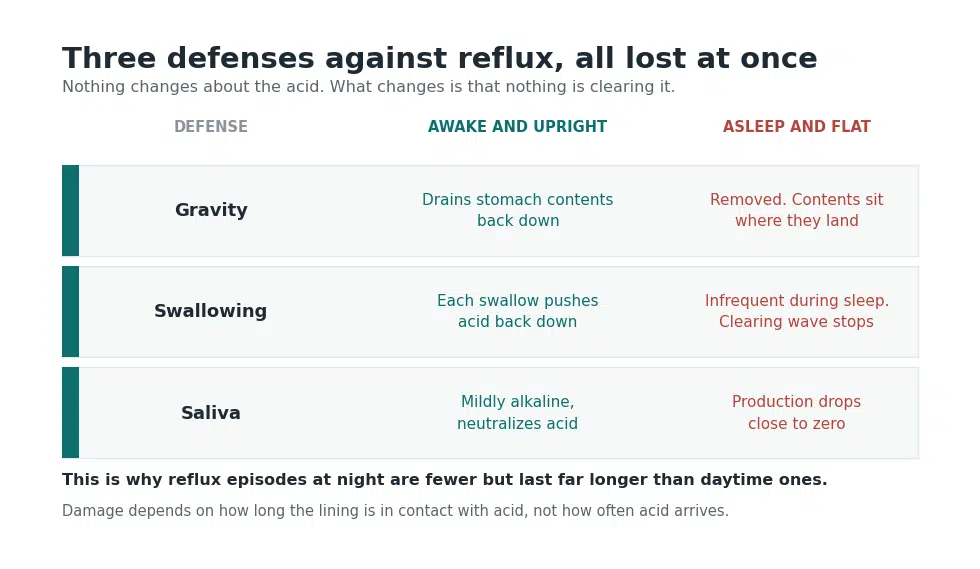
Gravity. Standing or sitting, anything that comes up tends to drain back down. Horizontal, it does not. Stomach contents sit where they land.
Swallowing. Every swallow drives a wave of muscle contraction down the esophagus, pushing acid back into the stomach. Swallowing becomes infrequent during sleep, so that clearing wave largely stops.
Saliva. Saliva is mildly alkaline and neutralizes acid as it is swallowed. Production drops close to nothing overnight, taking the buffering with it.
Nothing here is a fault in your stomach. It is ordinary sleep physiology, which is why the fixes are mostly about position and timing rather than medication.
Which side you sleep on changes the numbers
This is the part most people with acid reflux have never been told, and it costs nothing to act on.
A 2022 study monitored 57 patients overnight, measuring esophageal acid with a pH catheter while an accelerometer on the chest recorded which position they were actually in. Acid exposure time was lowest sleeping on the left, at a median of 0.0% of sleep time, compared with 1.2% on the right and 0.6% flat on the back.[1]
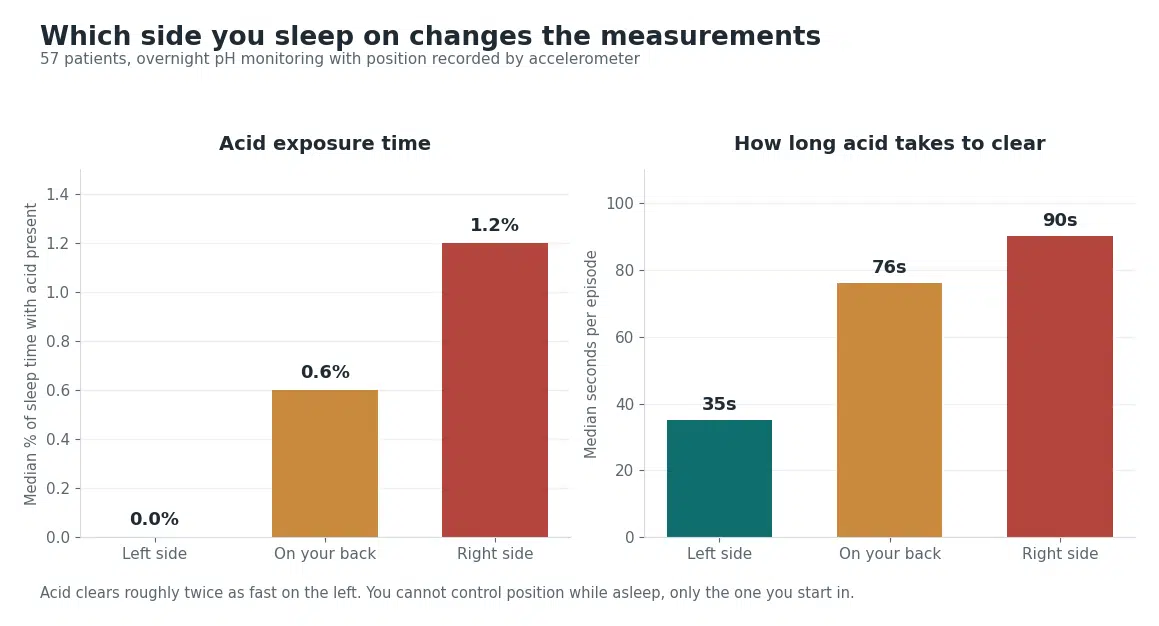
Clearance time showed the same pattern more starkly. Acid took a median of 35 seconds to clear on the left, against 76 seconds lying on the back and 90 seconds on the right.[1] Roughly twice as long, every episode, all night.
A 2023 systematic review pooling the available studies reached the same conclusion, and found that interventions which increased time spent on the left improved nocturnal symptoms.[2]
The anatomy explains it. The stomach sits slightly left of the esophagus, so lying on your left puts the junction between them above the level of the stomach contents. On your right, it sits below.
The practical problem is that nobody controls their sleeping position for eight hours. Starting on your left is still worth doing, and a pillow behind your back makes rolling over less likely.
Raising the head of the bed, and by how much
The other positional fix restores some of the gravity you lose lying flat.
A trial in patients with confirmed nocturnal reflux raised the head of the bed on a 20cm block and measured acid with a pH probe before and after. Both acid exposure and clearance time fell, with some improvement in heartburn and sleep disturbance.[3]
Worth being straight about the evidence quality here. Results across bed elevation trials have been inconsistent, and current guidance treats it as a reasonable recommendation resting on relatively weak evidence.[3] It is cheap and harmless, which is why it is still advised, although it is not as well supported as the sleeping position finding.
Two practical points. Raise the whole bed at the head end using blocks or risers rather than stacking pillows, because pillows bend you at the waist and can make reflux worse. And a wedge that lifts the shoulders and torso works; a thicker pillow under the head alone does not.
The cough nobody connects to their stomach
Acid reflux at night does not always feel like heartburn. Sometimes there is no burning at all.
A persistent dry cough that is worse at night or on waking, a hoarse voice in the mornings, a sore throat with no infection, or the sensation of a lump in the throat can all come from acid reaching higher than the esophagus. Longer overnight exposure is also associated with asthma symptoms.
Reflux is also one of the things that can disturb sleep without waking you fully, which our guide to night sweats in men touches on from a different angle. People with this pattern often spend months investigating the cough rather than the cause. It is worth mentioning acid reflux to a doctor if a cough has no obvious respiratory explanation.
What to stop doing before bed
- Eating within three hours of lying down. The single highest-value change after sleeping position. A full stomach refluxes more readily, while lying down removes the drainage.
- Alcohol in the evening. It relaxes the valve at the top of the stomach and fragments sleep, a poor combination.
- Large or fatty meals late. Fat slows stomach emptying, leaving the stomach still full at bedtime.
- Smoking. Reduces both saliva production and the pressure holding that valve closed.
- Tight waistbands overnight. Pressure on a full stomach pushes contents upward.
On home remedies: baking soda in water neutralizes acid and does work briefly, but it is high in sodium and interacts with a number of medications, which we cover in our guide to what sodium bicarbonate does in the body. It is not a nightly solution.
If you are pregnant, the calculation is different again. Our guide to whether Tums is safe for heartburn during pregnancy covers which antacids are appropriate and which to avoid.
When acid reflux needs a doctor
Occasional acid reflux is common. These are the features that change the question.
- Difficulty swallowing, or food feeling as though it sticks
- Pain on swallowing
- Unintended weight loss
- Vomiting blood, or stools that are black and tarry
- Persistent vomiting
- Symptoms that started for the first time after 55
- Heartburn needing over-the-counter treatment more than twice a week
- Symptoms that continue despite several weeks of treatment
- Anemia found on a blood test alongside reflux symptoms
One more, and it is the reason not to self-diagnose at 3am. Chest pain from acid reflux and chest pain from the heart can feel similar, and antacids sometimes relieve both. Chest pain with breathlessness, sweating, nausea, or pain spreading to the arm or jaw needs emergency assessment, not an antacid.
Frequently asked questions
What causes acid reflux at night specifically?
Not extra acid, but lost defenses. Lying flat removes gravity, swallowing slows during sleep, and saliva production drops close to zero. All three normally clear acid from the esophagus, and anything that refluxes therefore stays put considerably longer.
Why do I get acid reflux at night but not during the day?
Daytime episodes are cleared within seconds by swallowing and gravity, often before you notice them. The same amount at night sits long enough to be felt. Eating late is the other common reason, since the stomach is still full when you lie down.
Does sleeping on the left side really help?
The measurements say yes. Acid clears in roughly half the time on the left compared with the back or the right, and acid exposure time is lowest on the left. The limitation is practical rather than scientific: you cannot control your position while asleep, only the one you start in.
Can acid reflux cause a cough at night?
Yes, and it can do so without heartburn. A dry cough worse at night or on waking, morning hoarseness, or a persistent sore throat can all come from acid reaching the throat and airway. It is worth raising if a cough has no clear respiratory cause.
How high should I raise the bed?
Trials have used blocks of around 20cm, roughly six to eight inches, under the head-end legs. Raise the bed frame rather than adding pillows: pillows bend you at the waist, which increases abdominal pressure and can make things worse.
The one thing to take away
Nighttime acid reflux is a clearance problem rather than an acid problem. The acid itself is not unusual. What has changed is that nothing is removing it.
So the two changes worth making first are both free. Stop eating three hours before bed, and start the night on your left side. If symptoms persist beyond a few weeks, or any of the red flags above appear, that is the point to see a doctor rather than reach for another antacid.
Sources
SOURCESOur Editorial Standards
HealthMagHub is built on primary sources: peer-reviewed research, clinical practice guidelines, and health agencies such as the NIH, CDC, and FDA. Read our editorial standards to see how we research, cite, and update our articles.
- Schuitenmaker JM, et al. Associations Between Sleep Position and Nocturnal Gastroesophageal Reflux: A Study Using Concurrent Monitoring of Sleep Position and Esophageal pH and Impedance. American Journal of Gastroenterology 2022. PubMed 34928874
- Left lateral decubitus sleeping position is associated with improved gastroesophageal reflux disease symptoms: a systematic review and meta-analysis. 2023. PubMed 37969463
- Khan BA, et al. Effect of bed head elevation during sleep in symptomatic patients of nocturnal gastroesophageal reflux. Journal of Gastroenterology and Hepatology. PubMed 22353364