

Gout symptoms have a signature almost no other joint problem shares. The pain arrives in the middle of the night, usually in one joint, usually the base of the big toe. Within twelve to twenty-four hours it goes from a vague ache to the point where the weight of a bedsheet is unbearable.
That pattern is doing a lot of diagnostic work, and it is worth recognizing, because gout is the most common inflammatory arthritis in the country. Roughly 12 million American adults have it, about 5% of the adult population.[3]
Most articles on this will now tell you to give up red meat and shellfish. That advice is not wrong exactly, but it is wildly overstated, and it is the reason a lot of people spend years managing this badly.
- A gout flare peaks 12 to 24 hours after it starts, affects one joint in 85–90% of first attacks, and settles over 7 to 14 days even untreated.
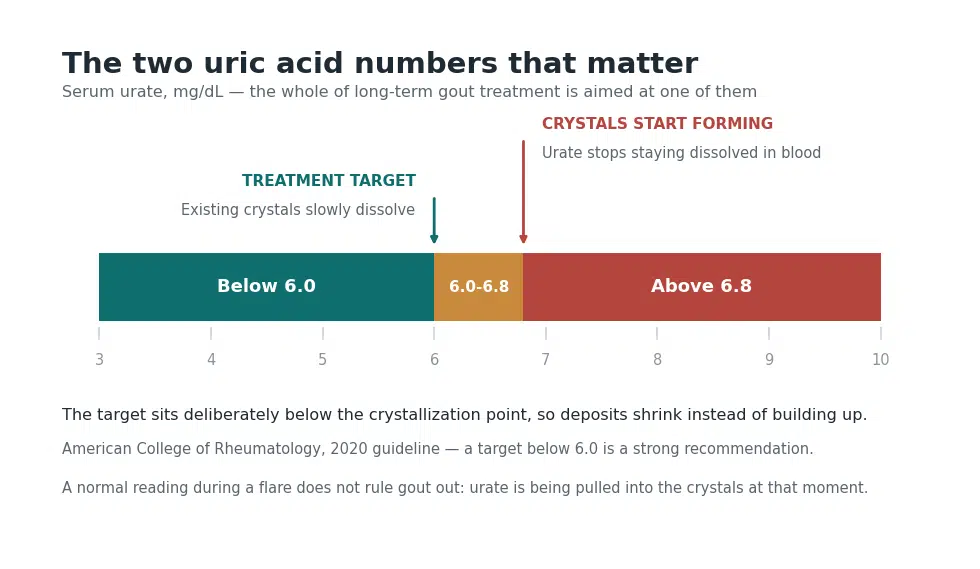
- Uric acid crystallizes above about 6.8 mg/dL, which is why the treatment target sits below 6.0.
- A hot, swollen joint with fever can be joint infection rather than gout. That is a same-day emergency, and only fluid from the joint tells them apart.
- The American College of Rheumatology’s 2020 guideline is built around medication and a urate target. Diet is a supporting act, not the treatment.
What gout symptoms actually feel like
The clinical name for the classic presentation is podagra, meaning gout in the first joint of the big toe. It is the site of most first attacks, though ankles, knees, wrists, elbows and fingers all get involved too.
The joint becomes swollen, red, hot and exquisitely tender. Skin over it can look shiny and stretched. Between 85% and 90% of first gout attacks involve a single joint, which is itself a clue, because most other kinds of arthritis are not so focused.[2]
Then it fades. Untreated, gout peaks within a day and resolves over roughly one to two weeks.[2] As it settles, the skin over the joint often peels, which surprises people who have not seen it before.
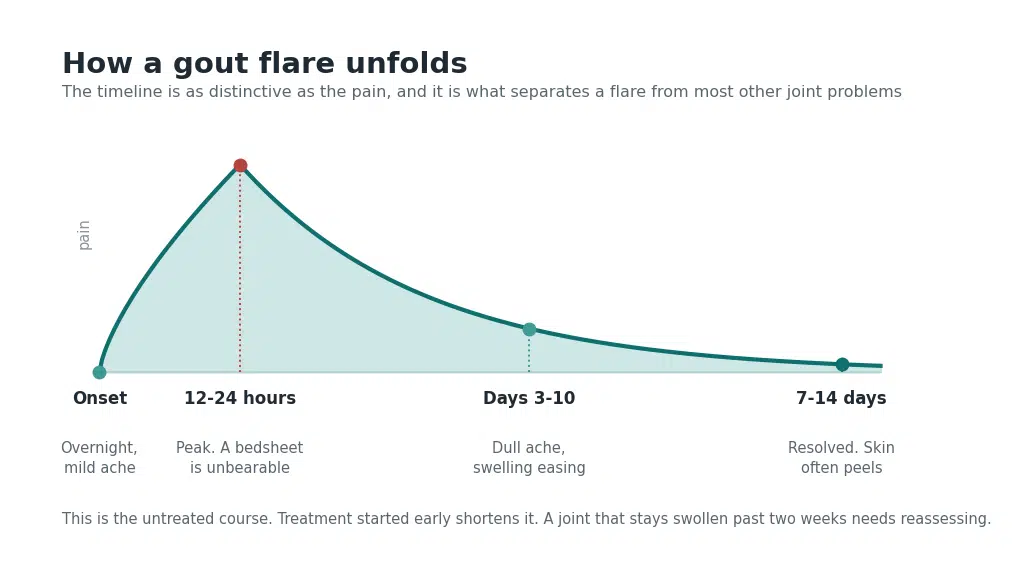
Here is the trap in that timeline. Because attacks end on their own, it is easy to conclude the problem is over. It is not. Between attacks the crystals are still sitting in the joint, and untreated gout tends to come back more often, involve more joints, and last longer each time.
Why the big toe, and why at night
Both come down to the same physics.
Uric acid stays dissolved in blood up to about 6.8 mg/dL. Above that it starts forming needle-shaped crystals. Solubility drops as temperature drops, so the coolest, most distant joints crystallize first.[3] Nothing is further from your core or cooler than the base of your big toe.
The night timing likely follows from the same thing: body temperature falls during sleep, and a joint sitting still under a sheet is cooler than one you are walking on.
Once crystals form, your immune system attacks them as if they were an infection. The pain is not the crystals scraping anything. It is the inflammatory response to them, which is also why anti-inflammatory drugs work so quickly.
The one thing that looks identical and is an emergency
Gout in a single hot, swollen, agonizing joint has essentially one serious mimic: bacterial infection inside that joint. Septic arthritis presents almost the same way, and it destroys cartilage within days if it goes untreated.[3]
You cannot reliably tell them apart at home, and neither can a doctor by looking. The distinction is made by drawing fluid out of the joint and examining it: crystals mean gout, bacteria mean infection. A blood uric acid level does not settle it either, because levels are often normal or even low during an attack.[2]
Get seen the same day if a hot swollen joint comes with fever or chills, if you feel systemically unwell, if it is your first attack and nobody has confirmed the diagnosis, or if it followed a wound, injection or surgery near that joint.
Inflammatory arthritis that settles in several joints symmetrically is a different picture again, and one worth distinguishing. Our guide to early rheumatoid arthritis in the hands covers that pattern.
Why gout is not really a diet disease
This is where most coverage goes wrong, and where the practical consequences are worst.
Your body makes most of its uric acid itself, as a normal byproduct of breaking down cells. Food contributes a minority share. What matters far more is how efficiently your kidneys clear it out, and that is largely set by genetics, which is why gout runs in families and why plenty of careful eaters still get attacks.[4]
The ACR’s 2020 guideline is revealing on this point. Of its 42 recommendations, only five concern lifestyle, and none of them is a strong recommendation. They are all conditional, reflecting weak underlying evidence.[1] The strong recommendations are about medication and a blood target.
That does not make diet pointless. Alcohol, especially beer, and drinks sweetened with high-fructose corn syrup are worth limiting, and losing excess weight helps. But treating diet as the whole answer to gout is how people end up with crystal deposits and damaged joints while feeling they have done everything right.
Supplements are a similar story. The joint aisle is full of products with far less evidence than their packaging implies, as we found comparing collagen against glucosamine for joint pain.
What actually lowers uric acid
The strategy for controlling gout has a name: treat to target. You take a urate-lowering drug, measure the blood level, and adjust the dose until the number is where it needs to be.
The ACR strongly recommends a serum urate target below 6.0 mg/dL.[1] That is not arbitrary: it sits below the 6.8 threshold where crystals form, so existing deposits slowly dissolve rather than accumulating.
Allopurinol is the strongly recommended first choice, including for people with moderate to severe kidney disease. It is started at a low dose and titrated upward against repeat blood tests.[1]
Treatment is recommended for people having two or more gout flares a year, anyone with visible crystal deposits under the skin, and anyone with joint damage on imaging. For a raised uric acid level with no attacks at all, the guideline conditionally recommends against treating.[1]
One safety point rarely mentioned in general coverage: people of Southeast Asian descent and Black patients have a higher risk of a severe hypersensitivity reaction to allopurinol, and a blood test for the HLA-B*5801 gene before starting is recommended for those groups.[1]
Why people quit right before it starts working
This is the single most useful thing to understand, and it explains an enormous amount of failed treatment.
Starting a urate-lowering drug can trigger a gout flare. As crystal deposits begin dissolving, they shed fragments that set off exactly the inflammation you were trying to prevent. So the tablet meant to fix the problem appears to cause an attack, and people stop taking it, concluding it made things worse.
The guideline anticipates this. It strongly recommends taking an anti-inflammatory alongside the urate-lowering drug for at least three to six months at the start, specifically to cover that window.[1]
Two related points. If you are already on a urate-lowering drug and a flare hits, do not stop it, because stopping and restarting causes more attacks. And starting treatment during a flare is acceptable rather than something to postpone, provided anti-inflammatory cover is in place.[1]
Undertreatment is the norm rather than the exception here. Only about one in five people who should be on long-term urate-lowering therapy are, and among those who start allopurinol, only a small minority ever have the dose increased, which is precisely the step that gets the number to target.
Things that quietly push uric acid up
Diuretics. Thiazide and loop diuretics, widely prescribed for blood pressure and fluid retention, raise urate levels.[4] If flares began after a new prescription, that is worth raising, and worth knowing that losartan, an alternative blood pressure drug, actually increases urate excretion. Our guide to reading your blood pressure numbers covers the wider picture there.
Low-dose aspirin. Raises urate slightly. Not a reason to stop it if it was prescribed for your heart.
Reduced kidney function. The kidneys do most of the clearing, so when they slow down, urate rises.
Dehydration and crash dieting. Both concentrate urate. Rapid weight loss in particular can precipitate an attack, which is an awkward irony given that gradual weight loss helps.
When to see a doctor
- A hot, swollen joint with fever or chills, or feeling generally unwell: same day, since this may be joint infection
- Your first attack, even if it settles, since the diagnosis needs confirming rather than assuming
- Gout flaring two or more times a year, which is the threshold for long-term treatment
- Lumps forming under the skin near joints, on the ear, or over the elbow
- A joint that stays swollen or stiff after the pain has gone
- Flares that began soon after starting a new medication
- Being on a urate-lowering drug for a year without knowing your latest uric acid number
That last one matters more than it sounds. Treatment without measurement is not treat-to-target, and it is why so many people take a tablet daily for years and still have attacks.
Frequently asked questions
How long do gout symptoms last?
An untreated gout attack peaks within 12 to 24 hours and settles over about 7 to 14 days. Treatment started early shortens it considerably. Pain lasting beyond two weeks, or a joint that never fully settles, needs reassessment.
Can you have gout with a normal uric acid level?
Yes, and this catches people out. Levels frequently read normal or low during an attack, because urate is being pulled into the crystals. A normal result mid-flare does not rule it out, which is one reason diagnosis rests on joint fluid rather than a blood test.
Do cherries help?
The evidence is weak and mostly observational. Cherries are harmless and cheap, so there is no reason to avoid them, but nothing suggests they substitute for treatment in someone having repeated attacks.
Is it only a problem for older men?
Gout is more common in men and becomes more common with age, but women’s risk rises noticeably after menopause as estrogen’s effect on urate excretion falls away. Kidney disease, diuretics and obesity shift the risk at any age.
Can gout affect the knee rather than the toe?
Yes. Knees, ankles, wrists and elbows are all common sites, and later attacks spread beyond the foot. A swollen painful knee has a long list of other explanations too, which we work through in our guide to knee pain when bending.
The one thing to take away
Recognize the pattern (one joint, overnight, peaking within a day) and treat a first gout attack as a reason to get a diagnosis rather than something to wait out.
After that, managing gout comes down to a number. Get your uric acid measured, get it under 6, and keep it there. Diet helps at the margins; the target is what changes the outcome.
SOURCESOur Editorial Standards
HealthMagHub is built on primary sources: peer-reviewed research, clinical practice guidelines, and health agencies such as the NIH, CDC, and FDA. Read our editorial standards to see how we research, cite, and update our articles.
- FitzGerald JD, Dalbeth N, Mikuls T, et al. 2020 American College of Rheumatology guideline for the management of gout. Arthritis Care & Research 2020;72(6):744–760. Full guideline
- Johns Hopkins Arthritis Center. Clinical presentation of gout. hopkinsarthritis.org
- Gout. StatPearls, National Library of Medicine. NCBI Bookshelf
- Merck Manual Professional Edition. Gout. merckmanuals.com