

Before anything else: new or severe pain in the upper abdomen, particularly under the right ribs, in the second half of pregnancy is not ordinary heartburn. Alongside headache, visual changes, swelling or feeling generally unwell, it can signal preeclampsia. That needs assessing the same day, not treating with an antacid.
Calcium carbonate antacids are the usual first choice for heartburn in pregnancy, and for occasional use they’re generally considered safe.[2]
That’s the short answer. The longer one matters, because three things change it: how much you’re taking, what else you’re taking it with, and which antacid you actually picked up.
- Calcium carbonate is a reasonable first choice for occasional heartburn, used at the dose on the label.
- Separate an antacid from iron or folic acid by at least two hours, since it reduces how much iron you absorb.
- Avoid sodium bicarbonate antacids and bismuth subsalicylate (the pink stomach liquid) in pregnancy.
- New upper-abdominal or right-rib pain after 20 weeks, especially with headache or visual changes, needs same-day assessment for preeclampsia rather than another antacid.
Why heartburn happens in pregnancy
It affects up to 80% of pregnancies, which makes it one of the most common complaints there is.[1]
Two things drive it. Progesterone relaxes smooth muscle throughout your body, including the valve at the bottom of the esophagus that normally keeps stomach contents where they belong. And as the uterus grows, it pushes upward on the stomach.
That combination means heartburn tends to arrive in the first trimester, ease slightly, then return with a vengeance in the third. It usually resolves within days of delivery, which is worth knowing when you’re lying awake at 34 weeks.
What calcium carbonate actually does
It neutralizes acid already in your stomach. Chemistry, not pharmacology.
That’s the appeal: it works within minutes, it isn’t absorbed into your bloodstream in any meaningful quantity at normal doses, and calcium is something you need more of in pregnancy anyway. It’s also why relief is short-lived. Neutralization finishes quickly, and the stomach carries on making acid.
Worth knowing: calcium supplementation in pregnancy isn’t just tolerated but actively recommended by the World Health Organization in populations with low dietary calcium, from 20 weeks onward, because it roughly halves preeclampsia risk.[3] So calcium itself isn’t the concern here. The dose and the pattern of use are.
How much is too much
Follow the label. Every product states a maximum in 24 hours, and that number exists for a reason.
One review flagged excessive use of calcium-containing antacids, meaning above roughly 1,000 mg of elemental calcium a day from antacids, as the point where problems appear.[1]
The problem has a name: milk-alkali syndrome, now often called calcium-alkali syndrome. Sustained high calcium intake produces a triad of raised blood calcium, metabolic alkalosis and kidney injury. Case reports in pregnancy exist, including one requiring dialysis, and there’s a documented case of maternal calcium carbonate use causing low calcium in a newborn.[2]
Pregnancy raises the stakes slightly, because hormonal changes increase how much calcium you absorb from the gut. The same intake goes further.
None of that argues against a couple of tablets after dinner. It argues against treating them as candy, which is exactly what happens when heartburn is relentless and the tub is on the bedside table.
The antacids to avoid in pregnancy
This is the part that catches people out, because the wrong choices sit on the same shelf.
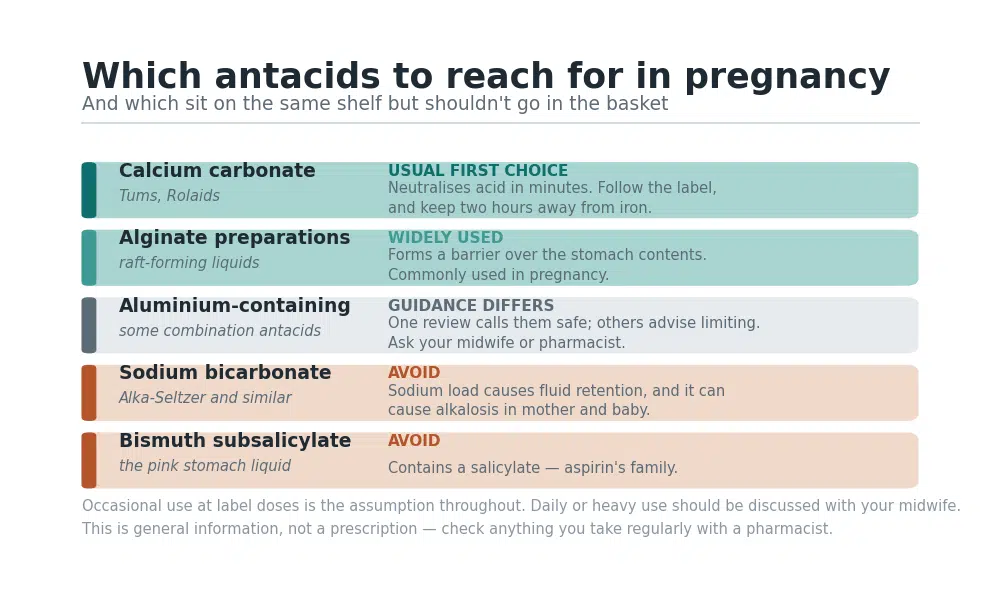
- Sodium bicarbonate antacids. Avoid these. The sodium load causes fluid retention and swelling, which pregnancy supplies plenty of already, and it can produce metabolic alkalosis in both mother and baby. This is also why baking soda from the cupboard isn’t a home remedy in pregnancy, even though the same compound is fine in a recipe.
- Bismuth subsalicylate, the pink stomach liquid. It contains a salicylate, which is aspirin’s family, and isn’t appropriate in pregnancy.
- Anything containing aspirin, unless your doctor has specifically prescribed low-dose aspirin, which is a different thing entirely.
Guidance on aluminum-containing antacids genuinely differs. One review describes aluminum salts as considered safe in pregnancy; other sources advise limiting them because of constipation and effects on calcium at higher doses.[1] Where reputable sources disagree, the sensible move is to ask your midwife or pharmacist rather than pick a side from an article.
The timing problem nobody mentions
Antacids reduce stomach acidity, and stomach acid is what you need to absorb iron.
Take your calcium carbonate at the same time as your iron tablet or prenatal vitamin and you reduce how much iron you absorb, at a point in life when iron deficiency is already common.
Separate them by at least two hours. The WHO makes the same point about calcium supplements and iron, recommending they be taken several hours apart.[3]
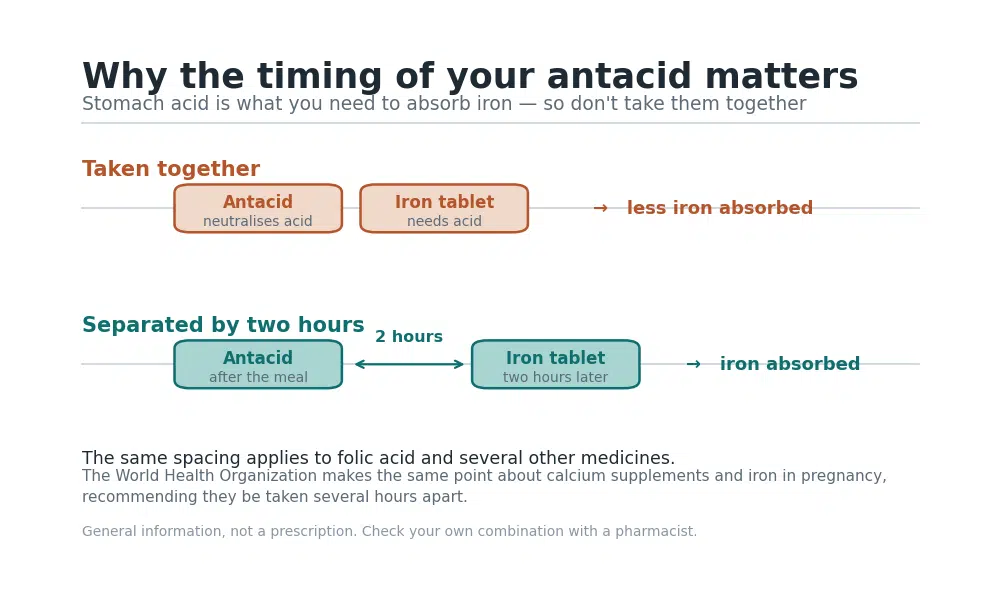
The same caution applies to folic acid and to some other medications. The pattern is the one that makes mineral supplements interfere with certain antibiotics. If you take anything regularly, ask a pharmacist to check the spacing. It costs nothing.
Calcium can also worsen constipation, which already affects up to 40% of pregnancies thanks to hormones and iron supplements. More fiber and fluid helps.
What to try before and alongside the tablets
The unglamorous measures work better than they sound, mainly because they address why the acid is arriving rather than neutralizing it afterwards.
- Eat smaller meals more often. A full stomach pushes harder against a relaxed valve.
- Stop eating around three hours before lying down.
- Raise the head of your bed rather than stacking pillows, which bends you at the waist and can make things worse.
- Sleep on your left side, which places the stomach below its junction with the esophagus.
- Identify your own triggers. Fatty and fried food, chocolate, caffeine, citrus, tomato and spice are the usual suspects, but the list varies enormously between people.
- Chew gum after meals. It stimulates saliva, which is alkaline and helps clear acid from the esophagus.
When antacids aren’t enough
If lifestyle changes and antacids aren’t controlling it, there are further steps, and they’re conversations with your midwife or doctor rather than decisions to make in a pharmacy aisle.[1]
Alginate preparations form a raft over the stomach contents and are widely used in pregnancy.
H2 blockers reduce acid production rather than neutralizing it. Famotidine is the one now in use. Worth flagging if you’re reading older advice: ranitidine was withdrawn from markets in 2020 over a contamination concern, so any article still recommending it is out of date.
Proton pump inhibitors are used when symptoms are severe, under medical guidance.
The general principle in pregnancy is the lowest effective step, for the shortest useful time, discussed with the person managing your care.
Does pregnancy heartburn mean anything about the baby?
Two beliefs circulate here, and they deserve separating.
The hair one. The idea that heartburn predicts a hairy newborn sounds like folklore, and mostly is, though a small study did find an association between heartburn severity and newborn hair, proposing that the same hormones relaxing the esophageal valve also influence hair growth. One small study. A curiosity, not a finding to rely on.
The worry one. Heartburn itself doesn’t harm the baby. It’s miserable, it wrecks sleep, and severe reflux can make eating difficult enough to affect weight gain, which is worth raising. But the reflux isn’t damaging your pregnancy.
What does matter is what unmanaged heartburn leads to: people stop eating properly, sleep badly for months, and self-medicate with whatever is to hand. Those are the reasons to treat it rather than endure it.
When heartburn is not heartburn
The most important section on this page.
Pain in the upper abdomen or under the right ribs in the second half of pregnancy can be preeclampsia or HELLP syndrome rather than reflux. It’s frequently mistaken for indigestion, sometimes by the person experiencing it, and occasionally by clinicians.
Get assessed urgently, the same day, for upper abdominal or right-sided rib pain after 20 weeks, especially with headache, visual disturbance, sudden swelling of the face or hands, or feeling unwell in a way you can’t place.
Also seek advice for heartburn with vomiting that stops you keeping fluids down, difficulty or pain swallowing, vomiting blood or material like coffee grounds, black stools, or unexplained weight loss.
And speak to your doctor about any chest pain rather than assuming it’s reflux, particularly with breathlessness, sweating, or pain spreading to your arm or jaw.
The one thing to take away
For occasional heartburn in pregnancy, calcium carbonate is a reasonable first choice, used at the dose on the label and kept two hours away from your iron.
The things worth remembering are the ones that aren’t on the packet: avoid sodium bicarbonate antacids, don’t let daily use drift upward unsupervised, and treat new upper-abdominal pain in the second half of pregnancy as a reason to be seen rather than a reason to chew another tablet.
Sources
This article is general information and isn’t a substitute for advice from your midwife, obstetrician or pharmacist, who can advise on your own pregnancy and the other medicines you take.
SOURCESOur Editorial Standards
HealthMagHub is built on primary sources: peer-reviewed research, clinical practice guidelines, and health agencies such as the NIH, CDC, and FDA. Read our editorial standards to see how we research, cite, and update our articles.
- Review of recent evidence on the management of heartburn in pregnant and breastfeeding women. BMC Gastroenterology. bmcgastroenterol.biomedcentral.com
- Calcium Carbonate. MotherToBaby Fact Sheets. ncbi.nlm.nih.gov
- WHO calcium supplementation guidance in pregnancy and the iron-separation recommendation. PMC. pmc.ncbi.nlm.nih.gov