
- Prostate size doesn't predict symptom severity — a large gland can cause few problems while a modestly enlarged one causes many.
- BPH affects 5-6% of men aged 40-64, rising to 29-33% of men 65 and older, and it is not cancer and doesn't raise cancer risk.
- Common decongestants and older antihistamines can tighten the bladder neck and trigger acute urinary retention in a narrowed urethra.
- Inability to pass urine at all, visible blood in urine, or fever with urinary symptoms need same-day medical care.
Enlarged prostate symptoms usually announce themselves at night. You’re awake at 2 a.m. for the second or third time, and it has started to feel less like a quirk of getting older and more like a pattern.
Here’s the reassuring part, first: this is common, it isn’t cancer, and the size of the gland matters far less than you’d expect. Here’s the part worth acting on: a few of these symptoms need a doctor within days rather than whenever you get around to it.
Before Anything Else: The Signs That Need Care Today
Go to an emergency department if you cannot pass urine at all despite a full, painful bladder. That’s acute urinary retention, and it needs the bladder drained rather than a wait-and-see approach.
Get seen the same day for:
- Visible blood in your urine
- Fever or chills alongside burning, urgent or painful urination
- Severe pain in the lower belly, back or groin with difficulty urinating
Book an appointment soon rather than eventually if symptoms came on suddenly rather than creeping in over years, if they’re getting noticeably worse month to month, or if they arrive with unexplained weight loss or bone pain.
What an Enlarged Prostate Actually Is
The prostate sits below the bladder and wraps around the urethra, the tube urine travels through. That geography explains everything else. When the gland grows, it squeezes the pipe running through it.
The National Institute of Diabetes and Digestive and Kidney Diseases describes two growth phases: one early in puberty, when the prostate doubles, and a second beginning around age 25 that continues for life.[1] Benign prostatic hyperplasia (BPH), the medical name for an enlarged prostate, usually shows up late in that second phase.
It’s more common than most men realize. NIDDK puts it at 5% to 6% of men aged 40 to 64, rising to 29% to 33% of those 65 and older. “BPH is the most common prostate problem in men older than age 50,” the institute states.[1]
Source: National Institute of Diabetes and Digestive and Kidney Diseases
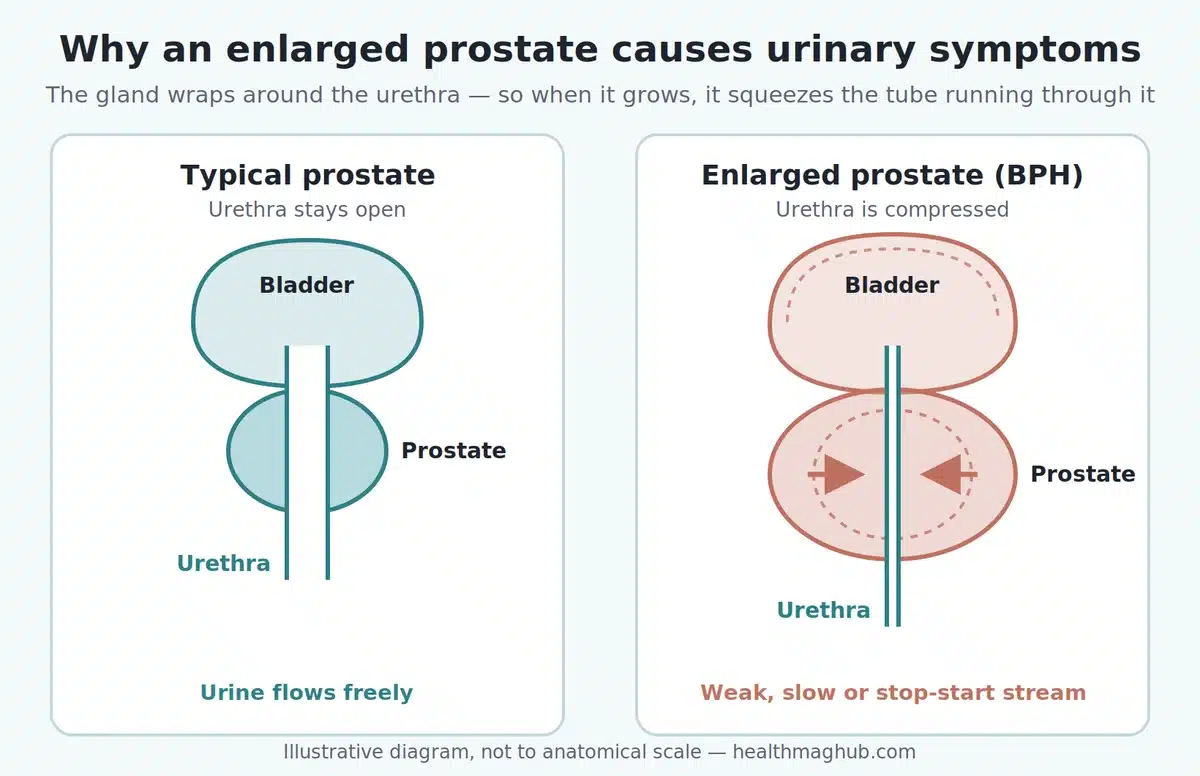
The American Urological Association is precise about the vocabulary, and the precision is worth borrowing. Its 2026 guideline defines BPH as “the proliferation of glandular and stromal components within the transition zone,” which is a tissue diagnosis.[2] It then treats the obstruction that growth can cause, and the urinary symptoms themselves, as separate things that may come from the bladder or urethra instead.[2]
Which means the symptoms don’t automatically point at your prostate. That’s a genuinely useful thing to hold onto.
The Enlarged Prostate Symptoms Men Actually Notice
Doctors split them into two groups, and knowing which group yours fall into helps a lot.
Trouble emptying. A stream that’s weak or slow. Standing there waiting for it to start. A stop-start flow. Dribbling at the end. The sense that the bladder still isn’t empty when you walk away.
Trouble storing. Needing to go often. Sudden urgency that’s hard to put off. And the one that drives most men to a doctor: waking repeatedly through the night.
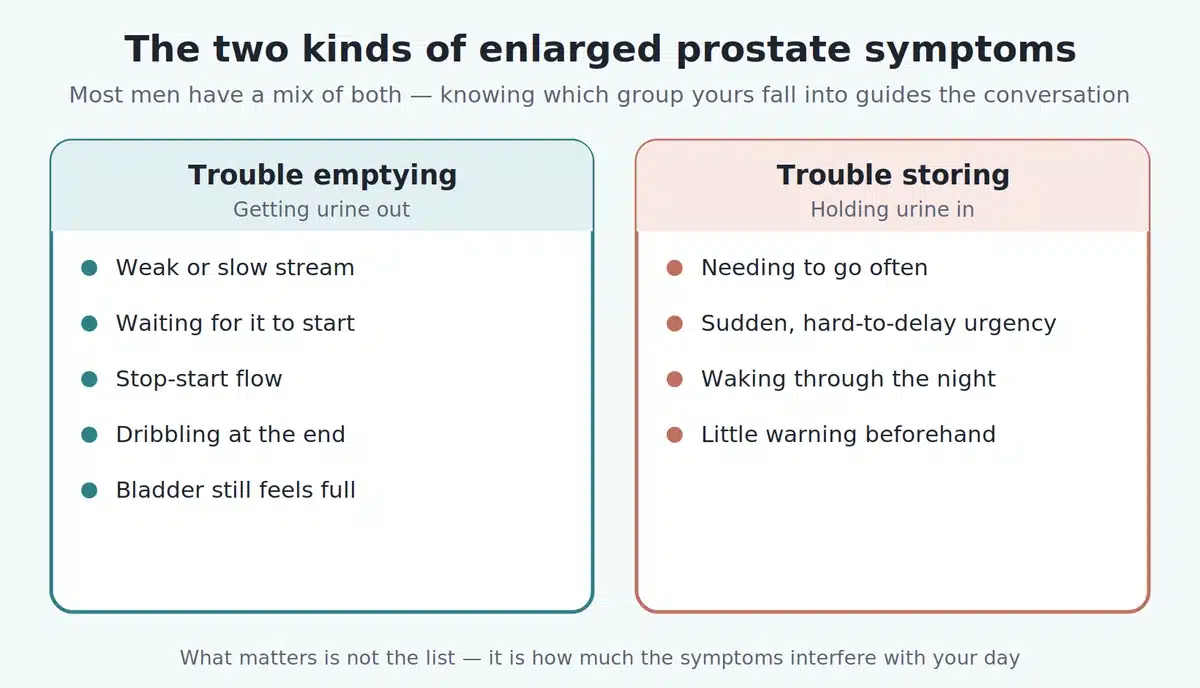
Most men have some mix of both. What matters isn’t the list. It’s how much the symptoms interfere. Plenty of men have a measurably enlarged prostate and barely think about it.
Why Size Doesn’t Predict Enlarged Prostate Symptoms
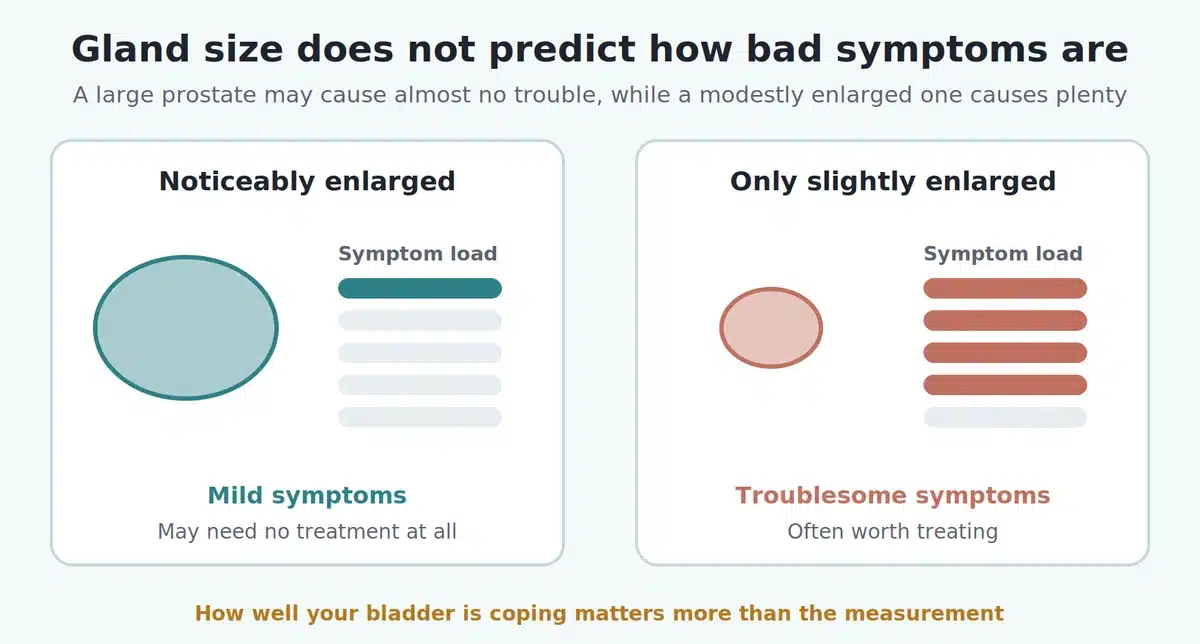
This surprises nearly everyone. A large prostate can cause almost no trouble, while a modestly enlarged one causes plenty. NIDDK says it plainly: symptoms may not be directly related to the size of the gland.[1]
So the number a doctor quotes you after an exam isn’t the headline. How the bladder is coping is.
Cause is similarly unsettled. Stephen J. Summers, MD, a urologist writing for University of Utah Health, doesn’t dress it up: “The exact cause of BPH (enlarged prostate) is not known.”[3] Most men will experience some enlargement with age, and there’s no lifestyle failure behind it.
Medicines That Make an Enlarged Prostate Worse
This is the most actionable section on this page, and it’s the one most guides skip.
Summers lists over-the-counter antihistamines, decongestants and NSAIDs among the aggravators, along with alcohol, coffee and tea.[3] NIDDK gives the same warning about cold and cough remedies.[1]
The reason matters. Decongestants tighten the muscle at the bladder neck; antihistamines make the bladder squeeze less effectively. In a man whose urethra is already narrowed, that combination can tip him from inconvenienced into unable to go at all.
So if you’re reaching for a cold remedy, it’s worth knowing what’s in it. Our guide to natural remedies for nose congestion covers the options that don’t involve a decongestant. And if you take one and then can’t urinate, that’s an emergency room trip, not a wait-until-morning problem.
What Else Could Be Causing This
Identical symptoms come from a urinary infection, bladder stones, a narrowed urethra, diabetes, and some neurological conditions. They also overlap with prostate cancer, which is the fear sitting underneath most searches like this one.
Worth saying clearly: an enlarged prostate is not cancer and doesn’t raise your risk of it. The two just happen to produce similar plumbing problems.
Blood in the urine deserves its own note. Johns Hopkins Medicine points out that while it can accompany BPH, “most men with BPH do not have hematuria.”[4] Meaning blood shouldn’t be filed under “probably just my prostate.” It needs looking at.
How Doctors Measure Enlarged Prostate Symptoms
The first tool is usually a questionnaire, not a scan. The AUA Symptom Index scores seven urinary symptoms and turns a vague complaint into a number, which makes it possible to tell later whether anything has actually improved.[4]
Alongside that, expect a urine test to rule out infection or blood, a discussion of your medications, and usually a digital rectal exam to feel the gland’s size and texture. A PSA blood test may come up. Some clinics measure how much urine is left behind after you go.
If you take one thing into that appointment, make it a three-day diary of what you drink, when, and how often you’re up at night. It’s more useful than trying to remember.
What Actually Helps
For mild symptoms that don’t bother you much, doing nothing is a legitimate medical choice, since monitoring is a recognized option rather than a brush-off.
Practical changes come next: shifting fluids earlier in the day, cutting evening alcohol and caffeine, and double voiding, which means waiting a moment after you finish and trying again.
When symptoms are more troublesome, prescription options do the heavy lifting. Alpha blockers relax the bladder neck and often work within days; 5-alpha reductase inhibitors shrink the gland slowly over months. Procedures exist for men those don’t help.
Diet plays a supporting role rather than a starring one. Our guide to foods to avoid for better prostate health covers what’s worth limiting. If you’re weighing supplements, the evidence is thinner than the marketing: our comparison of saw palmetto versus beta sitosterol goes through the trial data, and our wider look at natural supplements for enlarged prostate symptoms covers the rest of the category.
One caution before any of it: get assessed first. A supplement that takes the edge off can quietly delay a diagnosis by months.
Common Questions About Enlarged Prostate Symptoms
Are enlarged prostate symptoms a sign of cancer?
Usually not. BPH is not cancer and doesn’t increase your cancer risk. The two produce similar urinary symptoms because both involve the same small space around the urethra.
That said, symptoms alone can’t tell them apart, which is why a single evaluation is worth having rather than assuming.
Does a bigger prostate mean worse symptoms?
No. NIDDK notes symptoms aren’t directly tied to gland size. A large prostate may cause few problems while a slightly enlarged one causes many.
How your bladder is managing matters more than the measurement.
Can cold medicine make it worse?
Yes, and this catches men out regularly. Decongestants and older antihistamines can tighten the bladder neck and weaken bladder contraction.
If you take one and then can’t pass urine at all, treat that as an emergency.
At what age do enlarged prostate symptoms usually start?
Rarely before 40. NIDDK estimates 5% to 6% of men aged 40 to 64 are affected, rising to roughly a third of men 65 and older.
Symptoms appearing well before 40 are worth investigating for a different cause.
Do I have to treat it?
Not if the symptoms are mild and don’t bother you. Monitoring is a recognized approach, not a brush-off.
What changes the calculation is symptoms that worsen, or complications like retention or repeated infections.
The Bottom Line
Enlarged prostate symptoms are common, treatable, and not a sign that something has gone badly wrong. The gland’s size is close to irrelevant; what matters is how much the symptoms interfere and whether they’re changing.
Check your medicine cabinet before you change anything else. Then get one proper assessment, so that whatever you do next is aimed at the right problem.
SOURCESOur Editorial Standards
HealthMagHub is built on primary sources: peer-reviewed research, clinical practice guidelines, and health agencies such as the NIH, CDC, and FDA. Read our editorial standards to see how we research, cite, and update our articles.
- National Institute of Diabetes and Digestive and Kidney Diseases. Enlarged Prostate (Benign Prostatic Hyperplasia). niddk.nih.gov
- American Urological Association. Management of Lower Urinary Tract Symptoms Attributed to Benign Prostatic Hyperplasia: AUA Guideline (2026). auanet.org
- Summers SJ. Enlarged Prostate / Benign Prostatic Hyperplasia (BPH). University of Utah Health. healthcare.utah.edu
- Johns Hopkins Medicine. Benign Prostatic Hyperplasia (BPH). hopkinsmedicine.org
Disclaimer: This article is general information, not medical advice. Urinary symptoms in men need proper evaluation, because benign enlargement, infection, bladder stones and prostate cancer can produce the same complaints. Seek emergency care if you cannot pass urine at all, see blood in your urine, or develop fever and chills alongside urinary symptoms. Discuss any supplement or over-the-counter medicine with your doctor or pharmacist, particularly cold and allergy remedies.