

Before anything else: if your finger joints have been swollen and stiff for more than six weeks, especially on both hands, ask your doctor about a rheumatology referral rather than waiting to see whether it settles. The reason is in this article, and it’s the most important thing in it.
Rheumatoid arthritis in hands isn’t wear and tear. It’s an immune system attacking the lining of your own joints, and unlike osteoarthritis, the damage it causes is permanent once done.
That’s the whole reason timing matters here more than in almost any other joint condition. Treatment started early can prevent damage. Treatment started late can only manage it.
- It typically spares the joints nearest your fingertips, unlike osteoarthritis, which usually affects them first.
- Morning stiffness lasting over 30 to 60 minutes points toward inflammatory arthritis; under 15 minutes suggests osteoarthritis.
- Referral to rheumatology is recommended within 6 weeks and treatment within 12, yet only about half of patients are seen in time.
- Joint damage from untreated rheumatoid arthritis is permanent, so early treatment changes the outcome in a way it doesn’t for most joint conditions.
Which hand joints rheumatoid arthritis hits, and which it spares
This is the most useful self-check available, and it’s remarkably specific.
Rheumatoid arthritis typically affects the knuckles where your fingers meet your hand, the middle joints of your fingers, and your wrists. It also commonly hits the equivalent joints in the feet.
It usually spares the joints closest to your fingertips.
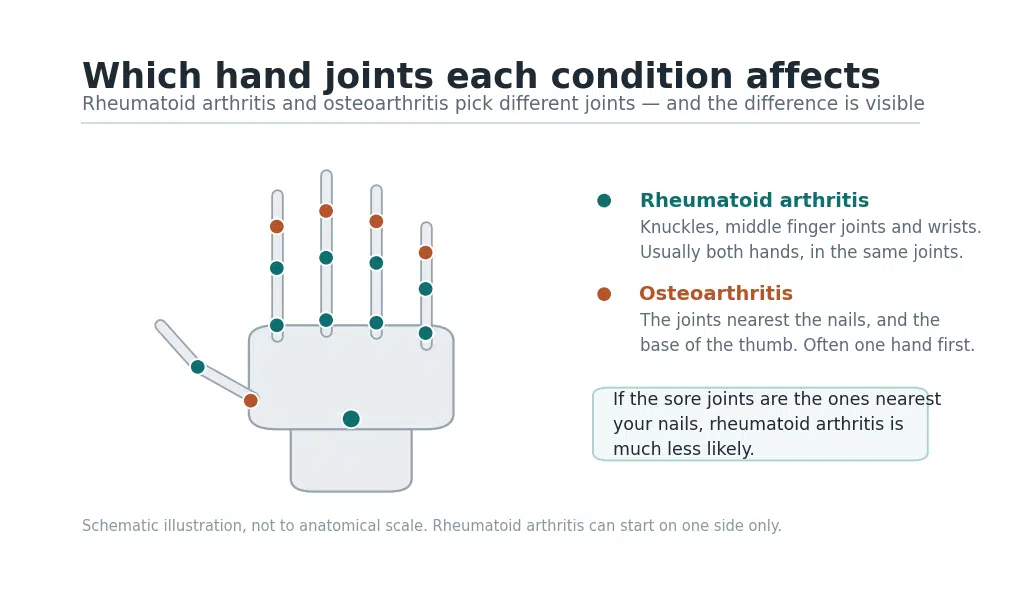
That’s the point worth remembering. The end joints of the fingers are classic territory for osteoarthritis, which produces the bony knobs many people recognize on older hands. If your painful joints are the ones nearest your nails, rheumatoid arthritis is much less likely. The distinction matters as much here as knowing which knee movement hurts does there.
The pattern also tends to be symmetrical. Both index fingers, both wrists. That said, early rheumatoid arthritis can start on one side only, so a one-sided start doesn’t rule it out.
The other clue: stiffness that lasts
Everyone’s hands feel stiff occasionally. The duration is what separates the two conditions.
- More than 30 to 60 minutes of morning stiffness before your hands loosen up points toward inflammatory arthritis.
- Under about 15 minutes is more typical of osteoarthritis.
- The “gelling” phenomenon: hands seizing up after any period of sitting still, not just overnight. A long car journey, a film, an afternoon at a desk.
Beyond the joints, rheumatoid arthritis is a whole-body disease. People often report fatigue that sleep doesn’t fix, a low-grade unwell feeling, occasional fever, or unexplained weight loss, and those frequently arrive before anything visible happens to the hands.
What the swelling actually looks like
Rheumatoid swelling is soft and puffy rather than bony. The knuckles look fuller, the skin over them can look stretched, and the joints feel warm and boggy rather than hard.
Osteoarthritis produces the opposite: firm, bony enlargement that doesn’t feel warm.
One test doctors use is worth knowing, because you can approximate it. Gently squeezing across the knuckles of one hand shouldn’t hurt. If that produces real tenderness across several joints at once, it suggests inflammation in the joint lining rather than a mechanical problem.
The window of opportunity, and why half of people miss it
Here’s the part that justifies the urgency, and most articles on rheumatoid arthritis in hands never mention it.
There’s a period early in the disease, roughly the first three months after joint inflammation begins, when treatment appears to work differently. Introducing disease-modifying drugs during that window can prevent joint erosion, and in some cases appears to switch the disease process off rather than merely slow it.[3]
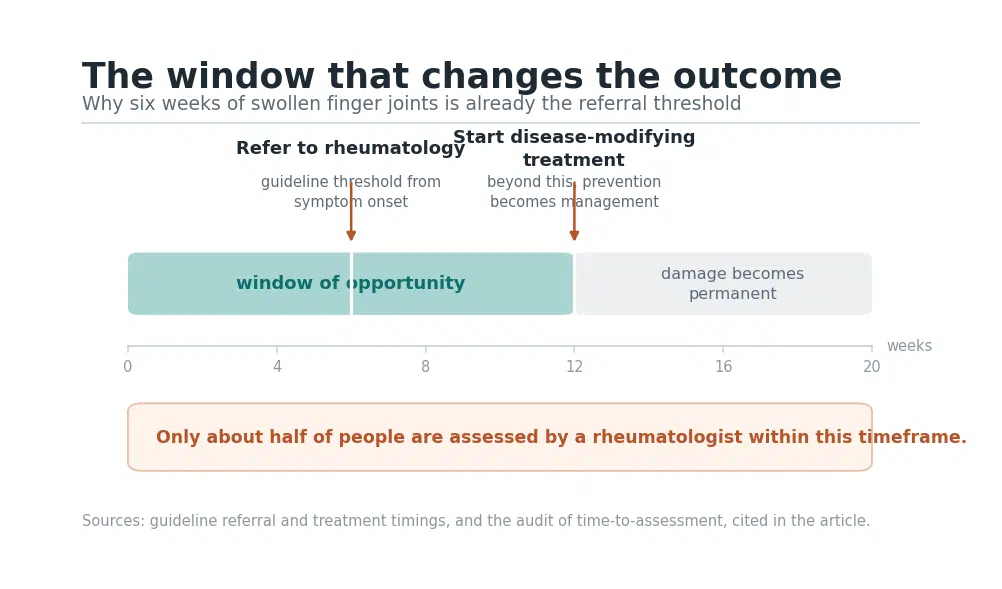
Guidelines reflect this. Referral to rheumatology is recommended within six weeks of symptoms starting, and disease-modifying treatment within 12 weeks.[1]
Now the uncomfortable statistic. One analysis noted that only about half of patients were actually assessed by a rheumatologist within that timeframe.[2]
So the delay is common, it’s consequential, and a meaningful share of it comes from people waiting to see whether the stiffness settles on its own. That’s a reasonable instinct for most aches. It’s the wrong instinct for this one.
What testing involves
Diagnosis is clinical first. A doctor examining your hands, counting swollen and tender joints, and asking how long the stiffness lasts gets most of the way there. Blood tests support that picture rather than deciding it.
- Rheumatoid factor is the older test and the less specific one. It turns up in plenty of people who don’t have the disease.
- Anti-CCP is more specific for joint disease and more strongly associated with developing rheumatoid arthritis. It’s the more useful of the two.
- ESR and CRP show whether inflammation is present, but not what’s causing it.
- Imaging, usually x-ray or ultrasound, looks for erosion and for joint-lining inflammation an examination might miss.
One thing worth knowing before results arrive: a meaningful minority of people with rheumatoid arthritis have negative antibody tests. That’s called seronegative disease, and it’s real disease. A normal blood test in someone with persistently swollen finger joints doesn’t close the question, and it shouldn’t end the referral.
The classification criteria doctors use have around 73% sensitivity, meaning roughly a quarter of genuine early cases would be missed if the criteria alone decided who gets treated.[2] Clinical judgment still carries weight.
What treatment actually does
Disease-modifying antirheumatic drugs are the core of it. They suppress the immune activity driving the damage rather than simply relieving pain, which is why they change outcomes when painkillers don’t.
Anti-inflammatories and short steroid courses manage symptoms while the slower-acting drugs take effect. They’re bridging treatment, not the treatment.
Biologic drugs target specific parts of the immune response, and are used when first-line drugs aren’t enough.
The approach is called treat-to-target: aiming for remission or low disease activity, measuring regularly, changing course when the target isn’t met.[3] That’s a very different model from managing osteoarthritis, where the goal is comfort and function rather than switching a process off.
Hand therapy, joint protection and keeping the hands moving all matter alongside medication. Movement helps; rest as a strategy doesn’t, the same principle that governs tendon problems elsewhere.
On supplements, worth being blunt: nothing sold over the counter modifies rheumatoid arthritis. Our comparison of collagen vs glucosamine for joint pain concerns cartilage in osteoarthritis, a different disease in different tissue. Omega-3 has modest evidence for symptom relief only, and replaces nothing.
What happens to untreated hands
This is unpleasant to read and worth reading anyway, because it makes the argument for acting early concrete.
Persistent inflammation in the joint lining erodes bone and stretches the ligaments holding joints in line. Over years, that produces the hand deformities people associate with rheumatoid arthritis: fingers drifting sideways away from the thumb, joints buckling into fixed bends, tendons rupturing.
Those changes are structural. No drug reverses them once established, and surgery can improve function without restoring a normal hand.
The encouraging half: they’re far less common than they used to be. Modern treatment started promptly means many people never develop visible deformity at all, and severe cases have become markedly less frequent since disease-modifying drugs became standard early rather than late.[3]
Which is exactly why the timeline matters. The difference between those two outcomes usually isn’t the severity of someone’s disease. It’s how quickly it was recognized and treated.
Rheumatoid arthritis also carries risks beyond the joints, including increased cardiovascular risk driven by chronic inflammation. Controlling the disease is part of managing that too.
When to get help quickly
Book an appointment and ask specifically about rheumatology referral if you have joint swelling and stiffness lasting more than six weeks, particularly in the small joints of both hands, morning stiffness lasting over half an hour, or hand joints tender when squeezed across the knuckles.
Don’t wait for a positive blood test before pushing for that referral, and don’t wait to see whether it improves. Six weeks of symptoms is already the referral threshold.
Seek urgent assessment for a single joint that is hot, red and very painful, especially with fever, since that can be a joint infection rather than a flare.
Get seen promptly for new numbness or weakness in the hands, chest pain or breathlessness, or a red painful eye, since rheumatoid arthritis affects tissue beyond joints.
The one thing to take away
If the small joints of both hands have been swollen and stiff for more than six weeks, and the stiffness lasts over half an hour in the mornings, that combination deserves an appointment this week rather than next month.
Rheumatoid arthritis is one of the few conditions where being early genuinely changes the outcome. The damage is permanent, the drugs that prevent it work best in the first three months, and roughly half of people aren’t seen in time.
Being one of the people who is comes down largely to not waiting.
SOURCESOur Editorial Standards
HealthMagHub is built on primary sources: peer-reviewed research, clinical practice guidelines, and health agencies such as the NIH, CDC, and FDA. Read our editorial standards to see how we research, cite, and update our articles.
- Patients with suspected rheumatoid arthritis should be referred early to rheumatology. PMC
- Siddle HJ, Bradley SH, Anderson AM, et al. Opportunities and challenges in early diagnosis of rheumatoid arthritis in general practice. British Journal of General Practice
- Early Diagnosis and Treatment of Rheumatoid Arthritis. Hospital for Special Surgery